Metrics on new AI FTP Detection + TrainerRoad AI

Hey ya’ll!

We’re slowly rolling out TrainerRoad AI to people today. There’s been some confusion and misinformation going around, so I wanted to start a new thread to try to clear some of that up.

What is the new AI FTP Detection?
The updated AI FTP Detection you’re getting puts you around a level 3 threshold level. This will be consistent between detections, and we think this is a good insert point into your overall zone progressions to get faster.

The old AI FTP Detection was predicting the result of a ramp test, then we would make adjustments to your workout levels to try to make things incremental. That means you could end up with an FTP with a threshold level of around 1-8. Although you could still get good workouts, this wasn’t a consistent way to assess FTP from one detection to the next, or to compare it with others.

You’ll see your FTP recalibrated through AI FTP detection today. This doesn’t mean that you’re stronger/weaker than before. This is kind of like buying a new bathroom scale that is more precise. Just because the number changed by +/- 5 lbs doesn’t mean your weight changed.

Range of Changes
Early in the forum TrainerRoad AI beta thread (it was private), there was an idea that the new AI FTP Detection overestimated people’s FTP’s and everyone was getting an increase. We saw a few people post big +10% FTP increases, and people ran with that as fact.

Because we’re recalibrating to about a level 3 threshold workout being able to be completed in the expected zone, if you had an athlete level higher than that, your FTP would increase, and lower than that, your FTP would decrease.
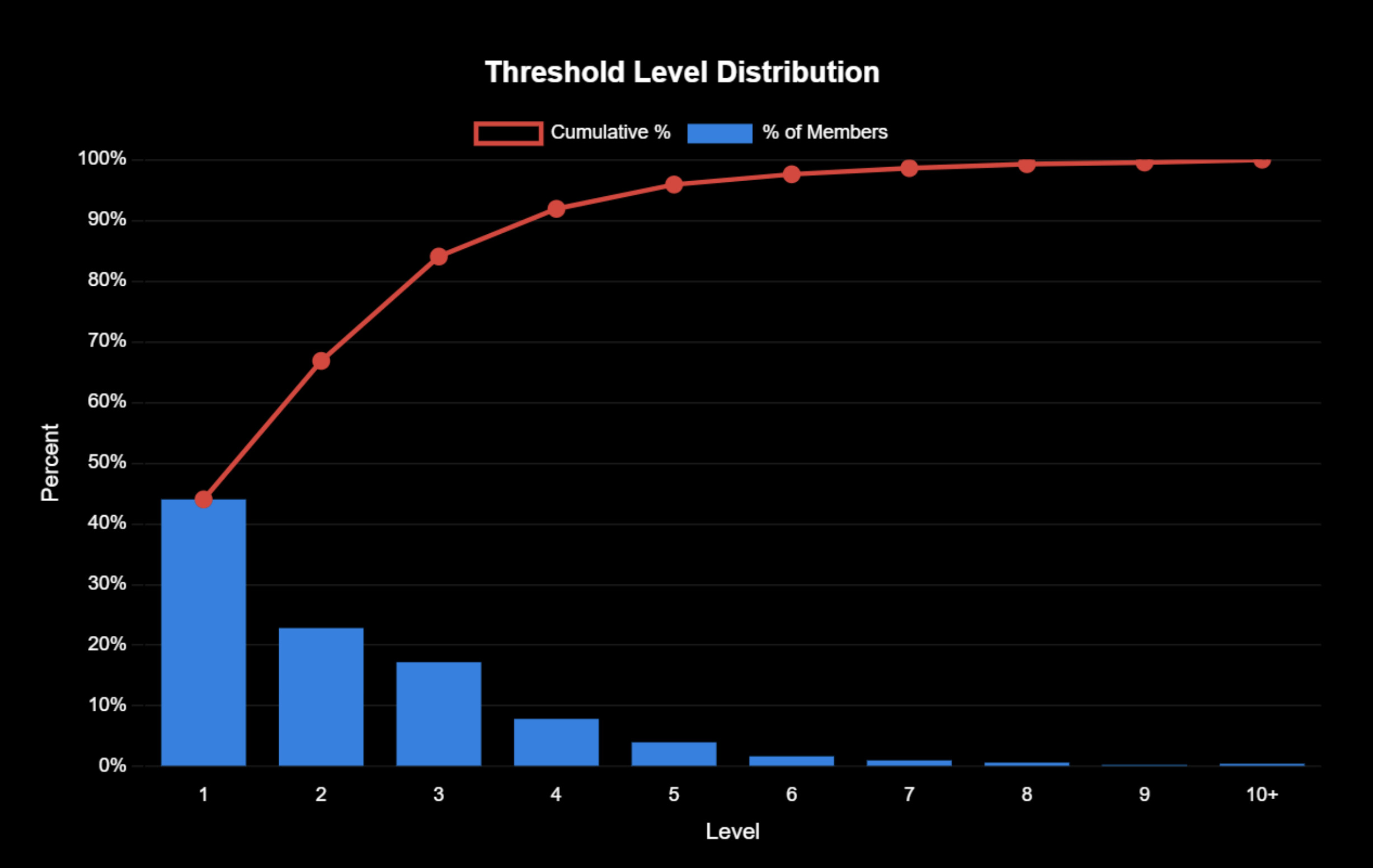
Threshold Level
< 3 FTP Decrease
3-4 About the same
4-6 FTP Increase
7+ Large Increase

Workout Performance after new AI FTP Detection

We measure your first workout after an AI FTP Detection, and we see improvements in fail rate and expected outcome with our new AI FTP Detection + TrainerRoad AI vs the old system.

Our failure rate for the “hard” zones is sitting right at 2.0%, which is right within our targeted failure rate (we calibrate for some in the predictions).

That’s a 33% improvment compared to the old AI FTP Detection! :exploding_head: :tada:

The bottom bar shows athletes who used the new AI FTP Detection, then ignored TrainerRoad AI and chose their own workout. Their failure rate is about 2x as high as compared to letting TrainerRoad AI choose it.

And for the expected outcome, we see an increase in performance as well. And interestingly, we see a larger percent improvement in athletes who have a LARGE FTP improvement of +10%.

We’ve seen this in reports, too. During the beta we’ve consistently had feedback of “No way I can/should do these workouts. They are too hard/easy for me”. Then, when the athlete actually tries the workout, it feels perfect!

This is because the AI is just trying to incrementally increase the watts you’re doing. So even though you might have a big FTP bump, the watts you’re doing for your intervals are still similar.

Some athlete feedback examples:
*”Well, I did my first non-endurance workout with the new beta. The new AI had increased my FTP by 18w (6.1%). I was a bit worried going into it but the AI predicted my RPE very well.”

”I was one of them with a 12% bump and after some work travel finally had my first hard workout post bump and it was definitely the perfect setup for me. AI guessed hard and was right on the money with it. Excited to see where this is going as I do more workouts.”

”I was also skeptical about the big difference between my old AI FTP, the new one, and my tested FTP, but I’m two weeks in and so far the workouts have been great, to the point where the FTP I’m questioning now is the one I tested myself.”

”Yes and just to provide a datapoint on this, the new model reduced my “FTP” by 8% and finally got me back to doing the kind of threshold workouts that make sense.*

“So far I’m having a great experience with this beta and it’s reinforced something I already knew deep down, which is just how poorly served I’ve been by the previous model. I don’t blame TR, I knew the solution would have been to reduce my FTP manually, I just always chose not to ( easy to do when the previous AI FTP detection just kept saying I was at a certain level, I just kind of went with it, but was never able to get my PL levels up, particularly in Threshold). Being served up short interval over-overs trashed my fitness, my motivation, and just had me avoiding those workouts altogether. Similar for the higher endurance rides and SS rides I’d been doing. (VO2 and Anaerobic were generally fine for me).”

“It’s early days, but what I’m experience in the new model is very promising.”

“The new AI FTP detection increased my FTP from 285 to 306 W. I was pretty skeptical and worried I would fail the new workouts but so far so good. Today I completed a SS 6.8 workout (4 x 13 min at 288W) and rated it 7/10. Prior to that my last SS workout was a SS 5.4 (2 x 20 min at 262W) and I rated that 4/10. It does seem the AI model knew what I could do better than me.”

”The AI does seem great at nailing what you’re able to handle, so knowing this also helps to be relaxed about seeing upcoming stuff in the Calendar. In OG TR on the fixed plans years ago I’d be terrified when some of the known v hard w/o’s were coming up, but those days seem gladly over - AT was major progress, and the new AI is next level”

”Just got served up Katahdin -2 (VO2 float sets) by the AI and it felt perfect”

That’s just some of the feedback. We recommend trying a workout or two at your new FTP and see how it feels. If it is too easy/hard for you, the AI will adjust and lock you in.

FAQ

I still don’t think this is right….
If you don’t think it is right, I recommend looking at the actual watts being prescribed to you, then finding a recent workout of the same interval length/structure, checking those watts, and comparing.

4x10 @ 250 watts is the same if that’s at 96% FTP or 101% FTP. Watts are really what we’re after. If you still think it’s bad, please get your career, pictures/links of the workouts you’re talking about, and what you rated them, and post them in the forum and ask us. We’ll look at all of them and answer any questions.

I’ve used my old FTP to pace!
Your fitness is a combination of FTP and your athlete level. But if you found you could hold your FTP for X minutes at a level 5 threshold, that will be the same in the new system. You could also self-adjust your FTP down/up until the AI gives you a level 5 if you have a one-time pacing question. That’s a way to get it answered in whatever system you used to use.

What about my TSS?
If you were at really high progression levels, your TSS was probably pretty high. There would be a down adjustment compared to what you’ll get now.

Frankly, I think we’re moving to a post-TSS world with this AI, but if you’d still like to use it, I would just be aware of the recalibration and know it will be more consistent going forward. But remember, even at the same FTP you’re going to get more TSS if you’re at a higher workout level (in general).

48 Likes

I guess I’ll post this here, since this looks like it will turn into the main thread on the update. First of all, good luck on dealing with all the support requests over the next few weeks.

I’ve largely done my own training the past few years, mostly using TR as a workout library. Life has gotten too busy recently since we moved, so I’m riding way less, and also don’t want to have to think about planning training. As a result, moved back to just truly using the TR ecosystem this month, so this update is timely.

I had no significant change in my “FTP,” with the update, which I think was appropriate. The AIFTP from before the update was already appropriate based on my gestalt. I realized a few years ago that formal FTP testing does not add much for me anymore beyond the estimate I draw based off RPE from workouts.

I went back in and modified my existing training plan to incorporate the update - specifically, to make the endurance rides dynamic length. What it’s generated looks much more appropriate than the old plan. I would like the ability to have a flexible max duration for these dynamic endurance rides that I could alter month by month, or even weekly, as I’d really prefer to not do >3h long endurance rides until I can do them outside.

The proscribed workouts also look more reasonable than before. For example, it has my first VO2max workout as a “level 6.7",” whereas before it was starting me off below 2 probably because I hadn’t done VO2 work in over a year. I’ve always found VO2 work comparatively easy and the workout it prescribed is about what I would pick as a good starting one for myself based on historical experience.

I like the ability to be less aggressive with my threshold progression compared to other intensities, as I’ve always found aggressive threshold progression tends to cause nonfunctional fatigue for me, whereas I can be much more aggressive with like VO2 or sub-threshold progression.

The AI predicted survey response (if ultimately accurate) seems useful for giving a heads up about how much mental prep I’ll need to do beforehand.

I was also entertained by the predicted future FTP, as the value is congruent with my own expectations for what it would likely be at that point based on prior training.

Basically, I’ve been doing structured training for like a decade now, and on first glance this seems like TR is now generating a plan that I would have made for myself - one that jives with my personal idiosyncrasies and preferences based on my experience of what works and doesn’t work for me over the years. And I think thats pretty impressive TBH.

21 Likes

IMHO - if the metric you are presenting is not the “industry-standard” definition of FTP, then to avoid confusion, you should call it something else, like “TrainerRoad Power” (TRP). I’m not going to give up on the standard FTP metric so now I have to track both FTP and TRP, and I feel compelled to take occasional 20 minute FTP tests.

16 Likes

Yay! Great to hear!! I think all of the TR employees that ride have experienced part if not all of what you’ve said here.

6 Likes

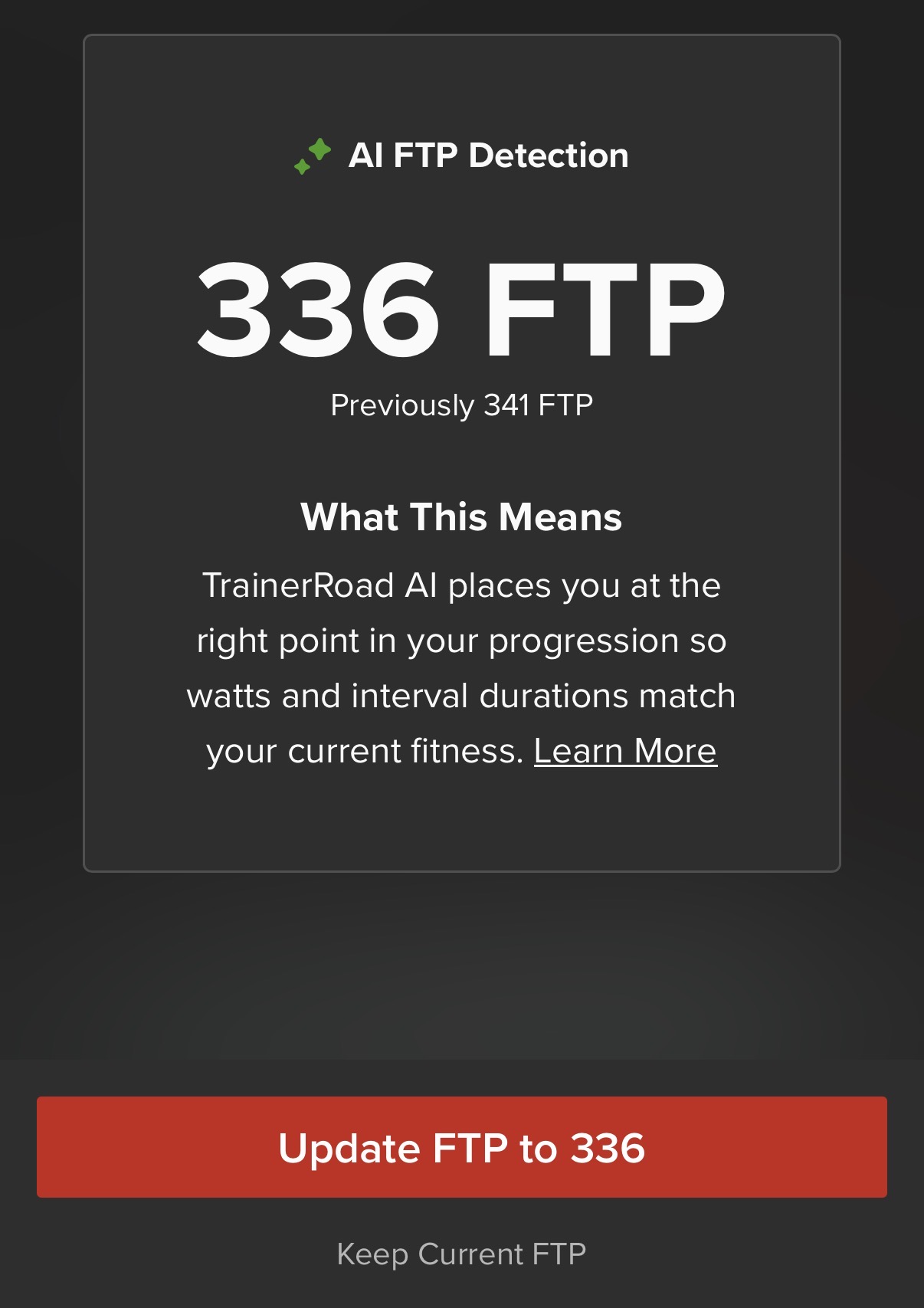
Thanks with this update. My FTP did drop 2% which is ok from 341 to 336. What I am worried about is my ftp prediction in 28 days with 23 scheduled workouts goes down even more by another 2% 336 to 329. What is going on here? I’m worried lol

2 Likes

There is no industry standard, sadly. The 20 minute test that you mention was developed by Hunter Allen and not endorsed by Andrew Coggan. He’s said as much on forums. When questioned about it in racing and training in a power meter Dr. Coggan says “that’s hunter’s test, not mine”.

But, if that’s how you want to do, more power to you! It’s not a bad thing to see where you can perform physically AND mentally in an ALL OUT effort once in a while (although I don’t think it’s needed).

I’d like to keep this thread free of the debate of how to measure your FTP. There’s been thousands of posts on this and other forums about how to do that. Feel free to debate it in the other thread that’s up about that topic.

14 Likes

Dropping few a quotes from Dr. Andy Coggan & Hunter Allen here to add to that:

“There really is no such thing as a threshold, all physiological responses reside on a continuum.”

“Many ways to [estimate thresholds]: muscle oxygenation is one, lactate is another. But the easiest way is just to look at power output… because the best predictor of performance is performance itself.”

“The exact duration [at FTP/CP] doesn’t matter. The slope of the [local] intensity-duration relationship is about 1:10, so a 10% variation in duration translates to 1% variation in intensity… And yet our performance varies by 2-5% day to day.”

“We were always telling people round to the nearest 5 W. And if you want to be conservative round down, not up.” [proceeds to joke about the over-confidence of FTP estimates to the nearest 10th of a watt]

“Personally when I was competing, I never ever did a formal test… as I realised what worked and what didn’t in training… I just did benchmark workouts of 2x 20min… I know what my FTP is based on what I can do in training.”

Can’t find another one I was looking for, but it was something along the line of slope of the lactate curve far more resembling an exponential than any piece wise linear function.

Source:

16 Likes

Please check this thread. TrainerRoad AI FTP Prediction FAQs - #2

I changed your training approach from demanding to balanced, and you’re getting an FTP increase.

9 Likes

Omg, thank you!! And what our AI is doing is just looking at your watts, and trying to increase what you can do for different durations.

It’s kinda like how in weight training you don’t really need to know your max bench press to get appropriate rep/weight combos. You can just track the weight you do for the amount of reps and progressively overload.

This relates to when Dr. Coggan says “the best predictor of performance is performance itself”.

19 Likes

@nate_pearson Thank you for the explanation about normalizing FTP to a level 3 threshold level. That really puts things into perspective.

Ah! I’m so excited. I got a huge increase when I logged onto TR today (+12.8% from 282→318), and was feeling a little scared going into the next workout. I don’t really remember where all my progression levels were, but I had recently completed a 9.3-level VO2 max workout and a 6.5-level threshold workout and they were super achievable. I’ve set a bunch of new all-time power bests in the past few weeks (at 5-minutes, 10-minutes, 20-minutes, 30-minutes, 45-minutes, 1-hour, 90-minutes), so the big increase seems spot on. After all, if I can do 2x22 minutes at 282 watts with a four minute recovery, it seems I should be able to perform, for example, 4x8.5 minutes at 308 watts with 8.5-minute recoveries.

A couple questions for you (or anyone on the TR team). I’m a triathlete and I want the AI training simulation to take into account my other workouts (I use different software for my swims and runs). My questions:

  1. Should I add runs/swims with estimated TSS to my upcoming calendar?
  2. Should I estimate the TSS for runs/swims I’ve done previously? (this is pretty easy for me to do accurately, as I can just borrow the TSS estimates from my TrainingPeaks.)

Thanks y’all. Can’t wait to get after my threshold ride tomorrow.

2 Likes

Thanks for the helpful and brief explanation. I wasn’t sure I wanted to accept the new FTP at first but this makes sense. Looking forward to seeing where these updates take my training this year

3 Likes

So I gather from reading all of the above posts that the new AI FTP Detection will be different than the old AI FTP Detection, which I can follow based upon your reset of the baseline. My question is this: I did an actual ramp test in TR on December 26. The number it gave me was a number I was pretty much expecting ballpark wise as it has been that way for a while. With today’s AI update, it dropped my FTP over 30w. So I’m pretty confused as you can imagine. Especially when I’ve been doing 3x20 workouts at the “new AI FTP” for a few months now. Help me get rid of the puzzled look on my face at the moment, thanks.

1 Like

Just want to post that my FTP estimate dropped to -1% when I was doing aggressive as well. Balance gave me a +0.7%. Then I changed only my Sweet Spot to aggressive and got myself a +1.3%. Seems like a lot of fiddling around the custom plan builder to get a good estimate going. AI has been really random in selecting the workouts. I was able to get it to 1.5%, by adding longer endurance session but a change in plan reset it back down to 1.3%

Also I find doing it all with per-planned outdoor rides in the calendar helps somewhat. For the custom plan, I revert the outdoor to indoor TR workout.

Feels more micromanaging for the new AI, but maybe things will smooth out in later updates.

Would also be interested in best practice for this.

But keep in mind there have been bugs with recurring workouts in the beta thread and I guess these have not been fixed completely yet (for example estimated TSS for swims is not saved).

Also there are definitely bugs with fatigue detection and runs look here https://www.trainerroad.com/forum/t/trainerroad-ai-beta-testing/107104/3679 or here https://www.trainerroad.com/forum/t/trainerroad-ai-beta-testing/107104/2117 .

The day after your ramp test in dec, the new system would put you at a 220 FTP. So the change is a 4 watt drop to 216 from then. You’ve had some trouble with workouts since then at the FTP of 240, here’s a couple last week.

You lowered the target wattage and took extra rest.

You did 20 min intervals at 209 outside. If you move indoors, the AI was going to give you threshold intervals around 10 min with less rest between. It only rated that as moderate, as it sees you’re having problems with workouts and is trying to get you back on track.

I’d also wear your heart rate for outdoor rides, which will help the system calibrate.

If you do a balanced plan, you end up with a 5% increase at the end of the block. I would go with the new FTP and do a few workouts to confirm and get back on track.

Also, please be sure to post screen shots of your calendar so everyone can see what you’re talking about. I think that helps everyone learn.

12 Likes

Normalisation of the threshold level when detecting FTP makes sense…. I just wish it was level 4-5 :man_shrugging:t2:

But I can attest that the system continues to prescribe the perfect workouts with respect to RPE regardless :+1:

6 Likes

But TrainerRoad does not live in a vacuum. I need a measurement of FTP that is consistent over time that I can:

  • Share with my coach or peers when discussing form and training
  • Track in a spreadsheet covering > 15 years of my FTP
  • Enter into Garmin and Zwift to set power zones on my device
  • Enter into Best Bike Split or similar to set power targets for races
  • Use as baseline for training in TrainerRoad, or whatever other training platforms I might use now or in the future
  • Doesn’t change value when the TrainerRoad philosophy or AI model changes …

Previously AI FTP detection was calibrated to the ramp test, and for me it correlated to within < 1% of my tested FTP, both for ramp test and 20 minute test. It was literally more accurate than using a different trainer. :grinning_face:

Now the offset is more like a year’s worth of gains, and I can’t realign the rest of world to TrainerRoad AI’s new definition of TR FTP, so I have to track two metrics. At least I’ll find out whether they are correlated with each other. :slight_smile:

8 Likes

It’s not random; it’s deterministic, meaning that with the same inputs, it will show the same outputs.

You changing and adjusting your plan is what’s causing the changes. Your changes have resulted in a 0.5% difference in the prediction. That seems pretty small, and that’s with you changing your volume.

Looking back at your training, you’ve been pretty “flat” for the last year. Doing the same stuff and not improving. The AI is picking up on that and thinks that if you keep doing the same stuff, you won’t improve. I don’t see a single break in a year; you might want to consider that.

10 Likes

Congrats on the new AI model, love what you guys are doing. Im 61 and still ride as much as possible, but a lot of general rides, without specific training so my drop in FTP by 13.8% is expected.

About to go away for a month where I’ll be scuba diving and hiking. I like the new feature with AI prediction of further 8% drop in first two weeks.

Gives me motivation to work hard with other sports so can bounce back in March!

Keep up the good work! You have a great Company Nate!

7 Likes