How to Train for Big Sugar Gravel: What 2026 Rider Data Says
The Life Time Big Sugar Gravel 2026 took place on Saturday, October 17, out of Bentonville, Arkansas, and closed out the 2026 Life Time Grand Prix. Tobias Kongstad won the elite men’s race from a nine-rider sprint, and Stella Hobbs won the elite women’s race with a long solo. Behind them, 734 amateurs finished the 100-mile race, and 22% of them have a TrainerRoad account.
That gave us a lot of race files to read next to the official results. First the winners and the links you need. Then what those files show: how fast those riders finished the 50 and the 100, the power they held, how many made it to the finish, and what separated the fastest riders from the rest.
Who Won Big Sugar Gravel 2026?
Tobias Kongstad won the 2026 elite men’s race in 4:36:02, coming out of a nine-rider sprint on the paved run back into Bentonville. Stella Hobbs won the elite women’s race in 5:10:34 after attacking out of the lead group and riding the final stretch alone. Big Sugar was the sixth and final round of the 2026 Life Time Grand Prix, and the series titles went to Keegan Swenson and Sofia Gomez Villafañe.
You can watch the full elite broadcast on the official Life Time Grand Prix livestream replay, and the full results for every distance are on ChronoTrack and Athlinks. Course details, cutoffs, and next year’s registration are on the official Life Time Big Sugar Gravel page.
- 100 mile102 miles (164 km), about 6,400 ft (1,950 m) of climbing. Crosses into Missouri, with the first aid station at Pineville, MO, at mile 40 (64 km).
- 50 mile58 miles (93 km), about 3,500 ft (1,070 m) of climbing. Also dips into Missouri.
- 25 mile31 miles (50 km), about 1,500 ft (460 m) of climbing. Stays in Arkansas.
- Start and finishThe Momentary in Bentonville, Arkansas. Saturday, October 17, 2026.
The elite races have their own start and their own results, so every number from here on leaves them out. Everything below is about the amateur races, which is where almost everyone reading this would have been riding. If you are new to gravel, start with our guide to training and preparation for gravel racing.
How Many Big Sugar Riders Have a TrainerRoad Account?
22% of the 734 amateur finishers in the Big Sugar 100 have a TrainerRoad account. That is more than 1 in 5 riders. On the 50 it was about 15% of 956 finishers, roughly 1 in 7, and across all three distances it was 17% of the 1,961 amateur finishers.
We counted a rider if their race file synced to a TrainerRoad account. A rider who trained with TrainerRoad and never synced the file is not counted, so the real numbers are at least that high.
How Did TrainerRoad Riders Do on the Big Sugar 50?
On the 50, riders with a TrainerRoad account finished about 9 minutes faster than riders of the same age and gender in the rest of the field. Over 58 miles (93 km) that works out to 3 to 4% less time. The typical amateur finisher in the 50 came in at about 4 hours 20 minutes, so 9 minutes is a real gap.
We compared riders of the same age and gender because both change finish times on their own, and the two groups do not have the same mix of either. Riders following a plan tend to put in more consistent hours, and hours a week mattered more than anything else we measured. More on that below.
How Did TrainerRoad Riders Do on the Big Sugar 100?
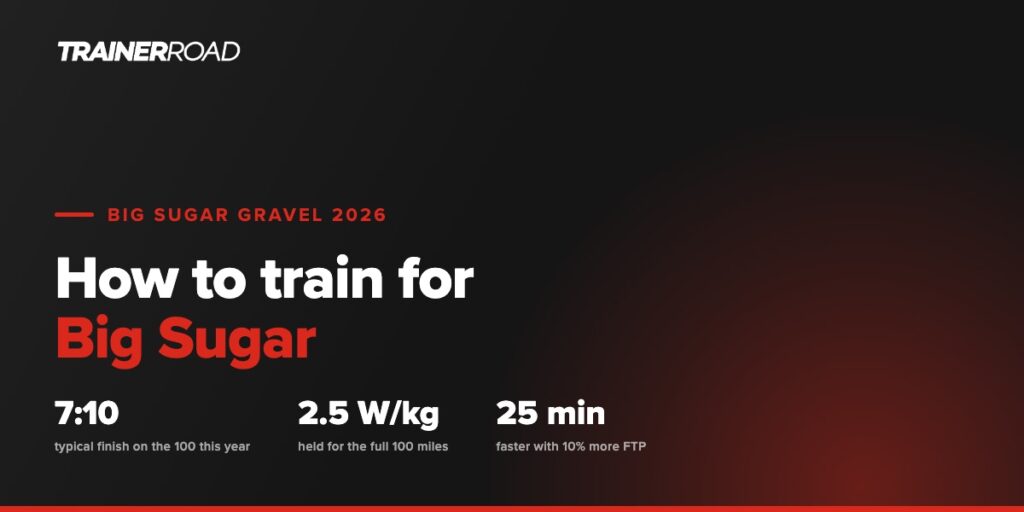
On the 100, riders who were training with TrainerRoad finished about 8 minutes ahead of riders who have a TrainerRoad account but were not training with it, when both groups were matched on age, gender, and hours a week. Over 102 miles (164 km) that is about 2% less time. The typical amateur finisher in the 100 came in at about 7 hours 10 minutes.
This is a different comparison from the 50. Here both groups have a TrainerRoad account, and the only difference between them is whether they were training with it going into the race. Matching on age, gender, and hours a week means the 8 minutes is not explained by one group being younger or riding more.
Eight minutes is interesting because both groups rode the same hours. The gap has to come from what they did with those hours. A training plan decides which workouts you do, when you do them, and how they build toward race day, so that is where we would look first.
How Much Power Does It Take to Ride Big Sugar?
The typical rider with a TrainerRoad account held 2.5 W/kg for the whole 100 miles (160 km), and 2.4 W/kg on the 50. For a 175 lb (79 kg) rider, 2.5 W/kg is 198 watts for about seven hours. The table shows what it means at other weights.
Power held
What 2.5 W/kg looks like at six body weights
The power the typical rider with a TrainerRoad account held for the full Big Sugar 100, converted to watts at six body weights.
| Body weight | Kilograms | Watts at 2.5 W/kg |
|---|---|---|
| 100 lb | 45 kg | 113 W |
| 125 lb | 57 kg | 142 W |
| 150 lb | 68 kg | 170 W |
| 175 lb | 79 kg | 198 W |
| 200 lb | 91 kg | 227 W |
| 225 lb | 102 kg | 255 W |
Median of riders whose race file synced to a TrainerRoad account, finishers only, amateur race. Power held means their effort averaged over the whole race.
They held that power at about 80% of FTP. So to ride 2.5 W/kg for seven hours the way the typical finisher did, you would want an FTP near 3.2 W/kg. That is about 8% above the typical TrainerRoad athlete’s FTP. So the typical Big Sugar 100 finisher is a little fitter than the typical TrainerRoad rider, but only a little. If you want to see where your own FTP sits, our FTP and W/kg comparison charts cover it.
80% of FTP for seven hours is a steady, controlled effort. It leaves you room for the climbs and the rough sections, and it is easy enough that fueling and pacing decide the back half of the day. If your FTP is below 3.2 W/kg, you can still finish Big Sugar comfortably. You would hold a lower W/kg and take a bit longer.
How Fast Would You Finish Big Sugar?
Pick your weight and your FTP below and three riders race to the finish: you at your current FTP, the typical rider with a TrainerRoad account this year, and you with your FTP up 10%, which is about what riders who followed a TrainerRoad plan gained over a season. Switch to the 50 if that is your race.
Where would you finish?
Your FTP and weight, next to this year’s riders
Pick the race, your weight and your FTP, and watch the three riders race to the finish. The clock shows the leader’s time, and the other two show how far behind they are.
Tap along a slider to set it, then use the arrow keys to fine-tune in 5 lb and 5 W steps.
Your W/kg is outside the range we saw this year, so this is the edge of the model.
Finish times are the typical chip time for riders at that FTP W/kg among finishers with a TrainerRoad account at Big Sugar 2026, amateur races, not a prediction for any one rider. FTP explains about 40% of the spread in finish times here. The rest is pacing, stops, fueling, and the day you have. The 10% gain comes from riders who signed up for TrainerRoad, started a plan, and followed it; your own gain will depend on where you start and how consistently you train.
Two things to read into it. First, FTP matters a lot: on the 100, going from 3.0 to 3.3 W/kg is worth about 25 minutes for the typical rider. Second, FTP is only about 40% of the story. Riders at the same W/kg finished an hour apart this year because of stops, pacing, and fueling, which is why the sections below spend so long on them.
How Many Riders DNF’d Big Sugar 2026?
Riders with a TrainerRoad account DNF’d the Big Sugar 100 at 4%. The rest of the field DNF’d at 10%. That is less than half the rate. For a sense of scale, the 2026 Unbound 200 lost 18% of its amateur starters, though that was twice the distance on a mud year, so it is not a direct comparison.
DNF rate
Who made it to the finish of the Big Sugar 100
Riders with a TrainerRoad account DNF’d at less than half the rate of the rest of the field. Unbound 200 is shown for scale only.
DNF means a rider crossed the start mat and did not record a finish. Big Sugar amateur 100-mile race. Unbound 200 from the official 2026 results, 230 DNFs of 1,249 starters.
Fitness is only part of why a rider DNFs a race like this. The usual reasons are a mechanical, a stomach that gives up, a cutoff missed after a slow first half, or a decision at an aid station when the legs are gone and the finish is still 60 miles (100 km) away. Training helps with most of those. A rider with more hours in the legs reaches the Pineville aid station fresher, eats on schedule because the effort is under control, and has more room before a bad patch turns into a ride back in the shuttle.
What Saved the Most Time at Big Sugar?
Riding more hours a week. Among riders with a TrainerRoad account, every extra hour a week in the 120 days before the race lined up with about 13 minutes saved on the 100, and 9 to 10 minutes saved on the 50, comparing riders of the same age and gender. Nothing else we looked at came close.
Training hours
Riders who trained more hours finished faster on both courses
Riders who rode 9 or more hours a week finished the 100 about 1 hour 48 minutes ahead of riders on 3 to 5 hours a week.
Big Sugar 100
Big Sugar 50
Median finish time, riders whose race file synced to a TrainerRoad account, finishers only, amateur races. Hours are all riding synced in the 120 days before the race. Bars are drawn from zero on each chart.
Here is what that looks like in finish times. On the 100, riders on 3 to 5 hours a week typically finished in 8:00, riders on 6 to 8 hours in 7:03, and riders on 9 or more hours in 6:12. On the 50 the same three bands came in at 4:12, 3:45, and 3:25.
There is a limit to this. More hours helped at every level we saw, and the riders we saw were amateurs fitting training around a job. That does not mean 20 hours a week would save you another two hours, and it does not mean you should pile on hours you cannot recover from. The riders on 9 or more hours a week were not doing anything unusual. They rode consistently through late summer and early fall and built the aerobic base you need for a seven-hour day.
If you are planning Big Sugar for 2027, ask yourself whether you can add one hour a week that you will actually keep, every week, from July onward. In this year’s field, that one hour lined up with about 13 minutes saved on the 100.
How Many Hours a Week Did Big Sugar Riders Train?
The typical rider with a TrainerRoad account who finished the Big Sugar 100 rode about 7 hours a week in the 120 days before the race, and half of them were somewhere between 5 and 10. On the 50, the typical finisher rode about 4 hours a week, with half between 3 and 6.5. Age barely changed the hours. Riders in their 50s and 60s rode as much as riders in their 30s, and on the 100 they rode a little more.
Training hours
Riders of every age put in similar hours for the same distance
Hours a week in the 120 days before the race, riders with a TrainerRoad account who finished. The range is the middle half of each group.
| Age group | Big Sugar 100, hours a week | Typical finish | Big Sugar 50, hours a week | Typical finish |
|---|---|---|---|---|
| Under 40 | 6.8 (5 to 10.5) | 6:24 | 3.9 (2 to 6) | 3:58 |
| 40 to 49 | 7.1 (4.5 to 8.5) | 7:21 | 4.2 (2.5 to 5.5) | 4:10 |
| 50 and up | 7.3 (5.5 to 9) | 7:36 | 4.7 (3 to 7.5) | 4:12 |
| All ages | 7.1 (5 to 9.5) | 7:10 | 4.3 (2.5 to 6.5) | 4:10 |
Median hours a week and median chip time, finishers only, amateur races. Hours are all riding synced to the account, indoors and out. On the 100, one in four riders rode under 5 hours a week and four in ten rode 8 or more.
Those are the hours this year’s finishers rode. They are not a target for you. If you are riding 4 hours a week right now, jumping to 7 next month is the quickest way to get sick, hurt, or burned out, and it is not how the riders on 7 hours got there either. Most of them built up to it over a few seasons. The right number of hours for you depends on what your body can absorb and what your week can hold, and both of those change over time.
That is the job Plan Builder was built for. It starts from the hours you have now, builds the plan toward your race date, and raises the load step by step as you show you can handle it. When your schedule changes, the plan adapts. A rider on 4 hours a week with a plan that fits those 4 hours will get to Big Sugar in better shape than a rider who tried to copy 7 and missed half the workouts.
How Should You Pace the Big Sugar 100?
Ride the first 25 miles (40 km) at the power you want to average for the whole day, keep your aid station stops short, and save something for miles 50 to 76 (km 80 to 122), which hold the most climbing on the course. Among riders with a TrainerRoad account, the fastest third stopped for about 2 minutes in total. The slowest third stopped for close to 30, and a lot of that was flats and mechanicals.
Time off the bike
The fastest riders barely stopped
Total time stopped during the race, riders with a TrainerRoad account, split into thirds by finish time.
Big Sugar 100
Big Sugar 50
Median minutes between the start and finish lines with the bike not moving, from the GPS in each rider’s race file. Finishers only, amateur races. Bars drawn on the same scale across both charts.
Time stopped is the biggest pacing difference in the data, and it comes in two kinds. The first is the long stop you did not plan. In the slowest third on the 100, six riders in ten had at least one stop longer than 10 minutes, and the typical longest stop was 12 minutes. The Ozark gravel at Big Sugar is sharp, and a stop that long is usually a flat, a cut tire, or a dropped chain, with cramps and a long aid station visit behind those. Only 16% of the fastest third had any stop over 10 minutes.
You cannot control whether you flat, but you can control how long it costs you. Run tubeless with fresh sealant, carry plugs where you can reach them, and practice the repair at home until it takes five minutes, because the same flat cost some riders here fifteen. The second kind of stop is the one you can plan away. Take out each rider’s single longest stop and the slowest third still spent about 16 minutes stopped across shorter stops, mostly at aid stations, while the fastest third spent under a minute. Treat the Pineville aid station at mile 40 (64 km) as a bottle swap. Know what you are grabbing before you roll in, and roll out in two minutes.
On the bike, every group started hot. Fast and slow alike, riders put out about 8% more power in the first quarter of the course than they averaged for the day, and about 7% less in the last quarter. The fastest riders did not pace more evenly. They were fitter, and they held it together better. The fastest third rode the first quarter at about 94% of FTP and the last quarter at 81%. The slowest third went from 78% down to 67%, and their coasting went from 14% of the time early to 20% of the time late. The fastest riders kept their heart rate flat all day. The slowest third’s heart rate drifted down through the second half, which is what a rider looks like when they have backed off, often because the fuel ran out.
The course explains some of that. The first quarter is the easiest, with a fast paved rollout and only about a sixth of the day’s climbing. The third quarter, miles 50 to 76 (km 80 to 122), holds about a third of the climbing and the steepest ramps on the course, around miles 60 to 64 and again near mile 77. If you feel great at mile 20, that is the course talking, and mile 60 is where it catches up with you. A pacing plan for a long event is built around exactly this: hold your number through the easy early miles so you have it for the hard middle.
The 50 follows the same pattern over a shorter day. The heaviest climbing comes in the second quarter, miles 14 to 29 (km 23 to 47), with the steepest ramps near mile 25 and mile 34. Riders in the fastest third stopped for about a minute. The slowest third stopped for 18, and for most of them that was one long stop rather than a string of short ones.
What Should You Eat and Drink at Big Sugar?
Eat from the first hour, aim for 60 to 90 grams of carbs an hour, and build your drinking up as the day warms. Big Sugar 2026 started at 41 F (5 C) under clear skies and finished in the low 60s F (about 17 C) in full sun with the humidity down near 40%. Your first two hours asked for far less fluid and sodium than your last three.
Here is what the day looked like. At the 7 AM start the air was 41 F (5 C) with 93% humidity, calm, and the riders’ head units read about 45 F (7 C). By 10 AM it was 54 F (12 C) and drying out. By 1 PM it was 59 F (15 C) in direct sun, and the head units on the course read closer to 64 F (18 C). The day peaked at 62 F (17 C) around 4 PM, with the humidity under 40%. There was no rain and almost no wind.
Those are good conditions, and they still catch people out. In the cold, damp first two hours you barely sweat, so one bottle an hour feels like plenty and sodium does not cross your mind. Then the sun comes up over the climbs in the middle of the course, the air dries out, and your sweat rate roughly doubles while your attention is on the gravel. The riders whose heart rate faded in the back half of the 100 are the ones this catches. Plan to drink and take sodium on a schedule that rises through the day, and get ahead of it before the mile 40 (64 km) aid station rather than after.
The carbs are simpler. The typical Big Sugar 100 finisher with a power meter burned about 4,200 kJ over seven hours, close to 600 kJ an hour, and the typical 50 finisher burned about 2,300 kJ. You cannot eat that back during the race and you do not need to. 60 to 90 grams of carbs an hour is 240 to 360 calories an hour, enough to keep your glycogen from running dry on a seven-hour day. Start in the first hour, when it is cold and you do not feel like eating, because that is when it is easiest to get it in. Our guide to cycling nutrition covers how to split that between bottles and food.
We cannot see what these riders ate or drank, only how they rode, so none of this is a report on their fueling. What we can give you is a starting point for the weeks before the race. Our free cycling nutrition calculator works out how much you should be eating day to day around your training, based on your weight, your FTP, and your weekly schedule, so you arrive at race week properly fueled. Race-day fueling works a lot better when you have not spent the last month under-eating.
How Should You Train for Big Sugar?
Start by July, pick a number of hours you can keep every week, and build toward a seven-hour day. That is the short version of what this year’s finishers did. Here it is in order.
- Start by July. The hours that lined up with faster finishes were the 120 days before the race, so mid July is the latest you want to be riding with a purpose. Earlier is better, because the riders on 7 hours a week got there over seasons, not in one summer.
- Pick hours you can keep. The typical finisher with a TrainerRoad account rode about 7 hours a week for the 100 and about 4 for the 50, and age barely changed that. Those are what they rode, not your target. Start from the hours you have now, and add one you can hold every week before you add another.
- Build the base first. Most of the day is ridden at about 80% of FTP, so aerobic base is the fitness that carries you. Raise your FTP toward 3.2 W/kg if you can, because every 0.1 W/kg was worth about 8 minutes on the 100 this year, but steady hours matter more than any one workout.
- Make one ride a week long, and eat on it. Practice 60 to 90 grams of carbs an hour from the first hour, in the cold, when you do not feel like eating. The riders whose heart rate faded in the back half of the 100 were not short on fitness alone.
- Train for the middle of the course. The hardest climbing on the 100 sits in miles 50 to 76, with the steepest ramps around miles 60 to 64 and 77. Put your hard efforts late in your long rides, after three or four hours, so your legs know what a climb at hour five feels like.
- Practice the flat. The slowest third lost more time stopped than the fastest third lost on the climbs. Tubeless with fresh sealant, plugs within reach, and a five-minute repair you have done at home.
- Put it on the calendar. Plan Builder takes your race date and your hours and builds the base, build and specialty phases around them, then adapts when your week changes. It is the simplest way to turn this list into workouts.
What Does a Big Sugar Training Plan Look Like?
Tell Plan Builder the race date and how many days a week you can ride, and it lays out base, build and specialty phases that end on race day. If you give it 12 months, you get a long base and a second pass through the phases. If you give it 16 weeks, the phases shorten, but the order and the peak stay where they belong. However much time you have, the plan is built to have you at your best on the Saturday of the race.
Here is what the weeks look like for a rider on five days a week. The hours run 8 to 11.5 a week in these examples, depending on how long the plan makes the weekend endurance ride and whether it is a loading week or a lighter one.
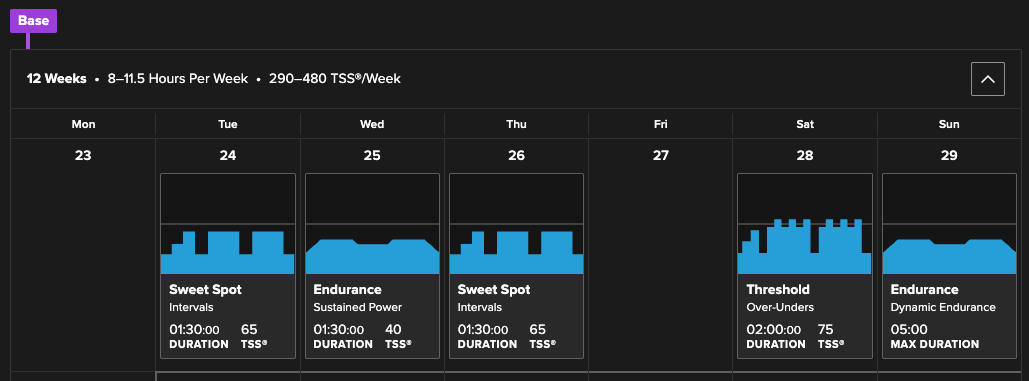
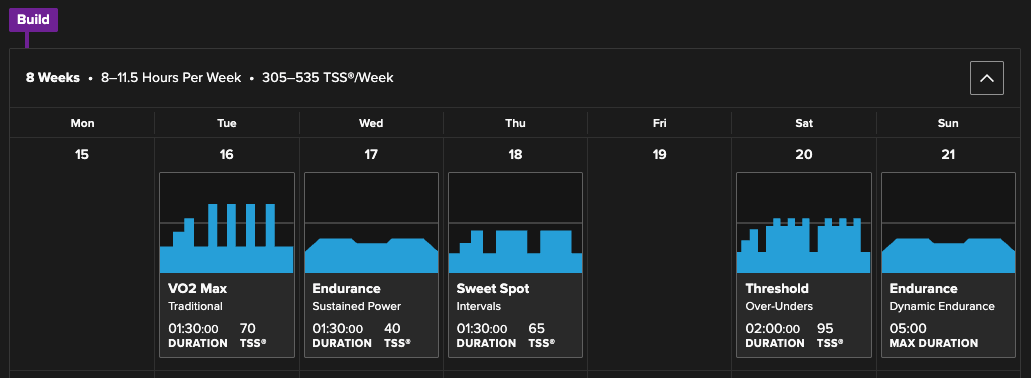
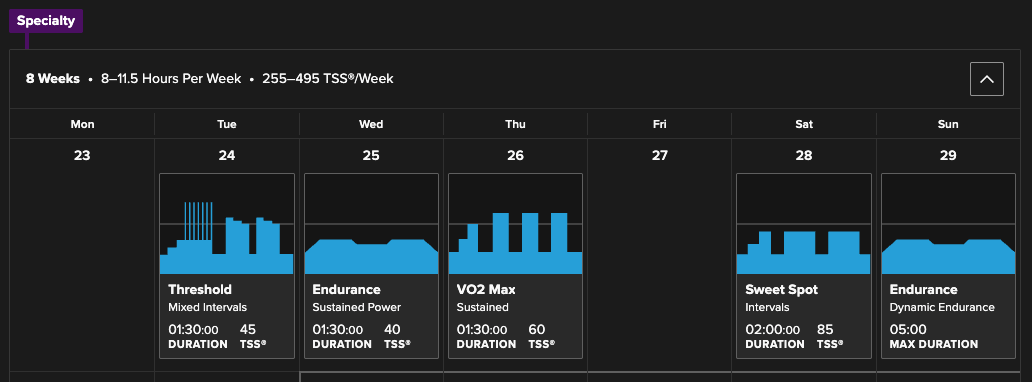
Two things in those weeks are doing more than they look. The Sunday ride is a dynamic endurance workout, which means TrainerRoad sets its length for you and stretches it over the plan, so your long-ride hours grow without eating into your ability to hit the power targets on Tuesday, Thursday and Saturday. And the plan knows how long your race will take, so those long rides are built toward the expected duration of your day at Big Sugar, not a generic weekend ride.
“I shaved 17min off my Big Sugar time on a harder course thanks to TrainerRoad.”
Chris S., TrainerRoad athleteThat is what those numbers look like for one rider. If you want more hours in your week and the right workout on every one of them, tell Plan Builder your race and your schedule and it builds the plan. We did the same kind of analysis for Leadville, if you want to see what it takes to earn a Leadville buckle.
Put Big Sugar on your calendar, tell Plan Builder how many hours a week you have, and get a plan built toward race day.
Start Your PlanFrequently Asked Questions
Who won Big Sugar Gravel 2026?
Tobias Kongstad won the 2026 elite men’s race at Life Time Big Sugar Gravel in 4:36:02 from a nine-rider sprint. Stella Hobbs won the elite women’s race in 5:10:34 with a long solo. The race was held on Saturday, October 17, 2026, in Bentonville, Arkansas, and was the final round of the 2026 Life Time Grand Prix.
How long is Big Sugar Gravel?
The Big Sugar 100 is 102 miles (164 km) with about 6,400 feet (1,950 m) of climbing. The 50 is 58 miles (93 km) with about 3,500 feet (1,070 m), and the 25 is 31 miles (50 km) with about 1,500 feet (460 m). All three start and finish at The Momentary in Bentonville, Arkansas, and the 100 and 50 cross into Missouri.
What is a good finish time for the Big Sugar 100?
In 2026 the typical amateur finisher in the Big Sugar 100 came in at about 7 hours 10 minutes, and the typical finisher in the 50 at about 4 hours 20 minutes. Among riders with a TrainerRoad account, those riding 9 or more hours a week before the race typically finished the 100 in about 6:12, and those on 3 to 5 hours a week in about 8:00.
How many watts do you need for Big Sugar?
The typical rider with a TrainerRoad account held 2.5 W/kg for the whole Big Sugar 100 in 2026, which is 198 watts for a 175 lb (79 kg) rider. They held it at about 80% of FTP, so an FTP near 3.2 W/kg lets you ride the course that way. A lower FTP still finishes the race, just at a lower W/kg or a lower share of FTP.
What was the DNF rate at Big Sugar 2026?
In the amateur Big Sugar 100, riders with a TrainerRoad account DNF’d at 4% and the rest of the field DNF’d at 10%. For scale, the 2026 Unbound 200 lost 18% of its amateur starters, though that race is twice the distance and 2026 was a mud year there.
How many hours a week should you train for a 100-mile gravel race?
The typical rider with a TrainerRoad account who finished the Big Sugar 100 in 2026 rode about 7 hours a week in the 120 days before the race, and half of them were between 5 and 10. Every extra hour a week lined up with about 13 minutes saved on the 100 and 9 to 10 minutes on the 50. Start from the hours you can keep every week right now and build up gradually from there, rather than copying someone else’s number.
Did TrainerRoad riders finish faster than the rest of the field at Big Sugar?
On the 50, riders with a TrainerRoad account finished about 9 minutes faster than riders of the same age and gender in the rest of the field. On the 100, the comparison is between account holders: riders training with TrainerRoad finished about 8 minutes ahead of riders with an account who were not, matched on age, gender, and hours a week. Both numbers come from the 2026 race.
How should you pace the Big Sugar 100?
Ride the first 25 miles (40 km) at the power you want to average for the day, keep aid station stops to a couple of minutes, and save your legs for miles 50 to 76 (km 80 to 122), where the most climbing and the steepest ramps are. In 2026, the fastest third of riders with a TrainerRoad account stopped for about 2 minutes in total and the slowest third for close to 30. Flats and mechanicals explain the longest stops, so run tubeless, carry plugs, and practice the repair. Short aid station stops cover the rest.
What were the weather conditions at Big Sugar 2026?
Clear and dry all day. It was 41 F (5 C) with 93% humidity at the 7 AM start, 54 F (12 C) by 10 AM, 59 F (15 C) by 1 PM, and peaked at 62 F (17 C) in the afternoon with humidity under 40%. Wind stayed under 8 mph. Riders’ head units read a few degrees warmer than the airport, about 45 F (7 C) at the start and 64 F (18 C) by early afternoon.
How much should you eat and drink during Big Sugar?
Aim for 60 to 90 grams of carbs an hour from the first hour. The typical Big Sugar 100 finisher burned about 4,200 kJ over seven hours, and the typical 50 finisher about 2,300 kJ. On a day like 2026, with a cold start and a warm, dry, sunny afternoon, plan your fluid and sodium to rise through the day rather than staying flat.
How many months before Big Sugar should you start training?
Start by July for the October race, which gives you the 120 days that lined up with faster finishes in the 2026 data, and start earlier if you can. Riders with a TrainerRoad account who finished the 100 typically rode about 7 hours a week in those 120 days, and riders who finished the 50 about 4. Pick hours you can keep every week and build from there, with a training plan that puts the base work first.
Finish times are official chip times for finishers only, in the amateur races, with the elite races left out. We counted a TrainerRoad rider as anyone whose race file synced to a TrainerRoad account, so the real counts are at least that high. The 50-mile comparison is adjusted for age and gender. The 100-mile comparison is between account holders matched on age, gender, and weekly hours, not against the whole field. Training hours are all the riding those accounts synced in the 120 days before the race.
Every TrainerRoad number here comes from riders at one race whose files synced to TrainerRoad, so it does not describe the full membership or every rider who raced. It describes what happened this year. Your own race will come down to your own preparation.