How Often Should You Strength Train for Cycling?
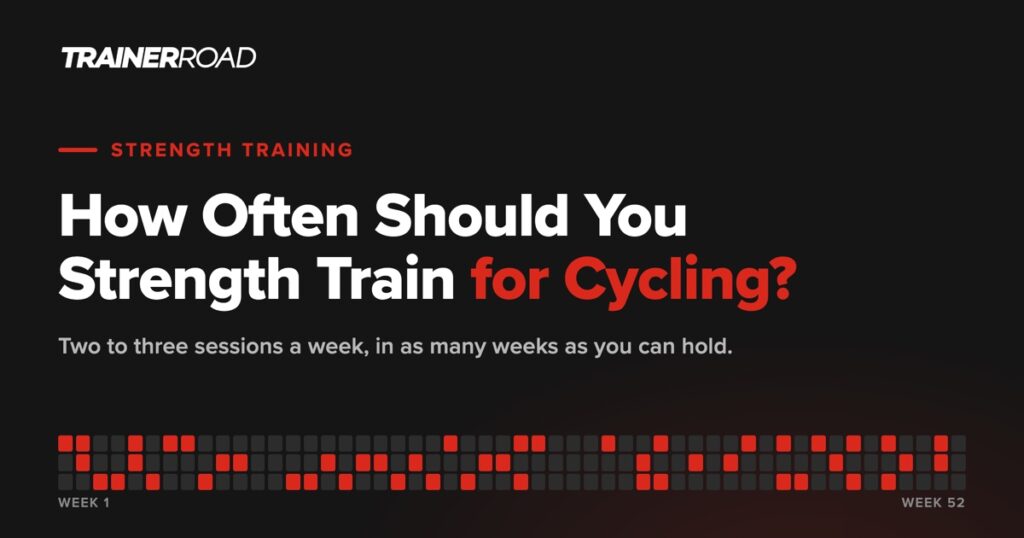
Two to three sessions a week is enough for most cyclists, and getting that number into as many weeks of the year as you can matters just as much. One extra session a week, held for a full year, is worth 1.2 to 1.6 W on your personal records, from a 3-minute effort out to a full hour.
How often to strength train is the question we get asked most. For most cyclists, two to three sessions a week is enough, but how many weeks of the year you get those sessions in matters just as much.
We compared riders in a filtered sample of TrainerRoad athletes who strength train against matched riders who don’t, with riding hours, starting fitness, and body weight held equal. Riders who held one weekly session for a full year came out 1.2 to 1.6 W ahead, and the gap was about the same at every effort length from 3 minutes out to a full hour. The gap kept growing as the weekly number rose, and that’s what puts most cyclists at two to three sessions a week. Nobody was assigned to lift, though, so these are patterns in who got faster, not a controlled experiment.
The calendar mattered too. Forty strength sessions a year can be one session a week for 40 weeks, or three sessions a week for 13 weeks and then nothing, and those are the same gym hours spent two ways. In a separate comparison, riders who spread their sessions across 50 weeks came in 3.2 W ahead on 20-minute power over riders who packed the same hours into 10 weeks.
The short version
- Start with any amount of strength work. Adding one session a week, held for a year, is worth 1.2 to 1.6 W at every effort length from 3 minutes out to a full hour.
- Aim for two to three sessions a week. Women and men gain at every weekly number, and the clearest step up lands in a different place for each. Women reach about 0.18 W/kg (watts per kilogram of body weight) over matched athletes who log none by two to three sessions a week. Men reach about 0.11 W/kg at 3 or more.
- Get a session into as many weeks of the year as you can. At the same gym hours, lifting in 50 weeks is worth 3.2 W at 20 minutes and 2.4 W at an hour over doing all of it in 10.
- Don’t let your year pack into one stretch. Riders whose gym work bunched that way gave up 2.2 W at 20 minutes against riders who spread the same work out.
- Treat the calendar gain as small and free. Spreading your sessions across the year is worth 0.0251 W/kg, about a quarter of a percent, and it doesn’t cost you a single extra hour in the gym.
If you’re like the typical rider in this sample, you lifted in 26 weeks of 52 and have room to move. You can pick a weekly number you’ll hold in a bad month, then get it into more weeks of the year.
What Strength Training Is Worth on the Bike
Strength training is worth a few percent on your power. Riders who added one session to their week and held it for a full year gained 1.2 to 1.6 W on their own records, meaning their best power for a given length of time. Athletes who lifted three times a week for a year came back about 5 W higher on their 60-minute record.
Comparing athletes who lift against matched athletes who don’t produces a bigger number. At three or more sessions a week that gap comes to about 9 W of FTP and 0.12 W/kg, or roughly 4% on a 230 W FTP. But athletes choose whether to lift, and part of that gap is the other things they do well, which makes it the optimistic version. The cautious one is 1.2 to 1.6 W per weekly session, and that’s the number to plan your season around.
One extra session a week, held for a year
The gain is about the same everywhere on the curve
Watts added to your own personal record at each effort length, same athlete, summer to summer.
Watts per extra weekly session
There’s a common misconception amongst cyclists that strength work only shows up in a sprint, but the gain here was about the same size at every effort length from 3 minutes out to a full hour. This analysis only looked at efforts between 3 and 60 minutes, so it stands to reason strength work would help your sprint as well. You can expect the gain in your long climbs and threshold efforts, not just in a 10-second kick.
How Many Days a Week Cyclists Should Lift
For most cyclists the answer is two to three days a week, and there’s no weekly number you have to clear before anything starts working. Athletes averaging under one session a week already recorded better FTP and W/kg than matched athletes who logged none, and the gap climbs steadily from there. Women and men improve as the weekly number goes up, and the clearest step up arrives at a different point for each.
Both climb, at different rates
How many sessions a week you actually need
Gap against athletes who log no strength work, matched on body weight, sex, and cycling volume.
W/kg gained against athletes who lift none
Men keep climbing. 0.178
then 0.189
Strength sessions a week
Women
Aim for 2 to 3 sessions a week. Most of the gain is in by then.
Why you can stop there: a woman’s gain per session runs about twice a man’s, and it levels off sooner. Past 3 sessions a week there is little extra return. Put that time back into riding.
Men
The clear step shows up at 3 or more sessions a week.
Why the bar is higher: 1 to 2 sessions a week moves the numbers less for men than it does for women. Something’s still there, it’s just small. To fit a third day into your week, keep all three of them short.
Three short sessions a week is harder to hold onto than it sounds. Most cyclists can get three done in a normal week. It’s the weeks when travel, illness, or a hard training block shows up that set your total for the year. If you’re new to strength training, Five Tips for Getting Started with Strength Training covers the smallest version worth repeating.
Whatever weekly number you land on, keep each session short enough that your next ride doesn’t pay for it. When you want to see progress, check your 20-minute and 60-minute power. For more on how strength work builds endurance, check out How Strength Training can Improve Endurance For Cyclists.
Spreading the Same Gym Work Across More Weeks
Spreading the same gym work across more weeks of the year gets you more out of it, because when those hours land matters. In a filtered sample of TrainerRoad athletes, riders who lifted in 50 weeks of the year were 3.2 W better at 20 minutes than riders who did the same lifting in 10 weeks, and at a full hour the gap was 2.4 W. In power-to-weight terms, watts divided by body weight, that’s about a quarter of a percent.
If you already lift, you’re being compared against another rider who lifts too, and who puts in the same number of gym hours across the year. The only difference is which weeks those hours landed in. Neither of you is measured against a rider who skips the gym.
Same gym hours, different calendar
Extra watts from lifting in 50 weeks of the year against 10
Each bar is the gap in watts.
Extra watts at 50 weeks vs 10
If a range crosses the zero mark, we can’t rule out that the effect is nothing at all. That’s the case for the two shortest efforts here.
The 20-minute and 60-minute numbers are the ones to go by, and those are the efforts that decide a climb or a time trial. The 1-minute and 5-minute numbers came in at 2.8 W and 2.3 W, neither certain enough to count on. You can judge your own strength training on your 20-minute power rather than on a one-minute effort.
You don’t need more gym time to get this. If you’ve already settled on how many sessions you can fit into a year, spread those same sessions across more weeks. If you pick a number of weeks you can hold, closer to 40 than to 10, the session count follows from there. Strength Training Maintenance for Cyclists covers how to carry a smaller version of your gym work through the rest of the year.
The Cost of Cramming Your Gym Year
Cramming your gym sessions into one busy stretch cost riders about 2.2 W at 20 minutes. Those riders did the same amount of lifting as everyone else here, just packed into a shorter part of the year. A single block is still better than skipping the gym, and holding a session most weeks gets you more out of the same hours.
Cyclists generally take one of two approaches to the gym. Some lift year-round and treat it as a regular part of the training week, the same way they treat a recovery ride. Others join a gym a few months out from a goal event and train hard right up until it arrives. That second one is a block: consecutive weeks of gym work with nothing on either side. Either approach can add up to around 40 sessions in a year, and the block is usually finished by July.
Two ways to spend the same year
Forty gym sessions, two calendars
Each column is one week of the year. Each small block in a column is one gym session, up to 3 a week. The two riders fill about the same number of blocks. Only the top one reaches across the year.
We looked at consistency three different ways: how many weeks of the year held at least one session, how much of the year sat inside a rider’s busiest stretch, and how uneven the weekly count was. All three point the same way, which you’d expect from three ways of describing the same calendar. Weeks with a session is the easiest to count off your own calendar.
You can keep that block in the offseason, when there’s less riding stress competing for your recovery. Offseason Strength Training for Cyclists covers the movements to build it around. Then carry one or two short sessions a week through the other 40 weeks, from March onward.
Is It the Schedule, or Is It the Person?
The schedule and the person keeping it are hard to separate. If you get to the gym in 40 weeks out of 52, you’re probably organized about sleep and food too. The gym is only part of why you’re faster.
What we could hold equal
- Total gym hours across the year
- Total riding hours across the year
- Fitness at the start of the year
- Body weight
What we couldn’t
- Sleep, food, stress and everything else that comes bundled with being organized
- Whether the rider was already the sort of person who shows up
Riders with a steady calendar have the better numbers either way, and that’s what to aim for. Derek Teel of Dialed Health treats the gym as part of your lifestyle rather than something you get motivated for. Schedule your sessions in advance to take motivation out of it.
Should You Trade Bike Time for Gym Time?
You don’t need to trade bike time for gym time. Two or three short sessions fit into most weeks without cutting a ride. The gym goes around the riding you already do. We never weighed a gym hour against a riding hour, and nothing here argues for riding less. Leave your training plan where it is, and log your strength sessions on the same calendar so you can see how many weeks of the year included one.
Why One Gym Day a Week Leaves You Sore All Week
One gym day a week leaves you sore all week because one session isn’t frequent enough for your legs to adapt to. Each session arrives after the last one has worn off, and the fix is a second, shorter day. Without one, you get stuck in a loop: you lift, your legs are wrecked for a week, and your riding suffers. A few months later you try again, get the same result, and give up on the gym for another year.
After a hard session your legs drop below where they started, then spend the next several days climbing back up. A session that lands while you’re still above your old level builds on the first. But wait a full week and you’re taking the same beating from the same place. That’s why it’s worth getting to two sessions a week before you add weight.
Make the second session light enough to add frequency without another heavy leg day. One movement later in the week aimed away from your quads is enough: glutes, hips, or a core session with a hinge movement like a deadlift. Your lower body still gets stronger, and the work still carries to the bike. Keep it short enough that it doesn’t affect your riding two days later.
Avoid strength training just one day per week. Even one movement later in the week as part of a core workout can be enough to mitigate that soreness a lot.
Derek Teel, Dialed Health, on the Ask a Cycling Coach podcastThe full episode this coaching comes from: Ask a Cycling Coach 598 with Derek Teel of Dialed Health.
You can start lighter than you think you need to, which keeps the soreness from getting out of hand early. When a session looks like too much, do one set of each movement and go home. Going easy in week one means you’re still lifting in weeks two and three. And if you’ve already gone too hard, something small a couple of days later helps more than another week off.
How That Squares With Lifting Once a Week for 40 Weeks
Lifting once a week for 40 weeks and lifting twice in a week answer different questions, and they don’t conflict. Across the year, riders in this sample who spread the same gym hours over more weeks were 3.2 W better at 20 minutes than riders who packed them into one stretch. That’s about which weeks you lift in, not how many sessions a week is best. Inside a single week, two small sessions beat one big one, because the soreness from the big one ends your streak. If you lower the weight per session, you can do both.
If Tuesday’s session is deciding how Thursday’s ride goes, it was too big. Not sure which movements to use? Strength Training Basics for Cyclists has the lifts, the form cues, and where to start. None of it has to be taken to failure.
Building a Gym Week You Can Repeat
A gym week you can repeat starts with one number: the gym days you can hold in a bad month. You’ll want a number that survives a work trip, a head cold, and the weeks you’d normally skip. Those weeks decide your year. Aim at a session in 40 weeks of the year. The typical rider in this comparison lifted in 26 weeks of 52, so if that sounds like your year, you have weeks to add.
Build the week you can repeat
How many days can you realistically get there?
One week, seven days. Red blocks are gym days, and the bracket underneath is the space between them.
The trap to avoid: one day a week tempts you to make that day enormous, and an enormous day leaves you sore until Friday. Keep it short and stop with something left in the tank. At the same total sessions, riders who lifted one day a week for 40 weeks beat riders who packed three a week into 13. Two or three days a week is better if you can.
Why this is our default: the second day fixes the soreness, and it’s small on purpose. One hinge, some hip work, and some core is plenty. It shouldn’t touch your quads hard enough to change how Saturday’s ride goes.
Only if it survives a bad month: three days works when all three are genuinely small. If they grow into three long days, you’ll start skipping them, and your yearly total drops.
What the Session Is Actually For
The session is there to keep you healthy, and the watts are a by-product. Derek’s example on the podcast was Kevin Vermaerke of UAE Team Emirates, a pro who lifts for that reason and isn’t max-lifting all year. Most cyclists don’t need to either. The work covers multiple planes of motion, core, mobility, getting your hips firing properly, and holding your position late in a ride. In this sample the by-product was a little over a watt per weekly session. In a separate comparison, riders who spread the same sessions across more weeks of the year were 3.2 W better at 20 minutes.
Keep each session small enough to repeat later in the week. When a session leaves you flat, it was too much, even if you finished it. Log your working sets on your TrainerRoad calendar as you go. A working set is a hard set with a rep or two in reserve.
When to Start
There’s no perfect month to start strength training when what counts is weeks of the year, and being halfway through one is no reason to wait for next base season. Start light in the week you’re in, and let your first 4 weeks feel easier than you think they should.
Where you are, where to aim
The 26 is measured: it’s the median week count in this comparison. The 40 is a coaching target we chose, not a result from the data, and the 14 is the difference between the two.
You can put your gym days in the calendar as repeating appointments for the rest of the year. Two short sessions a week keeps strength work alive through your race months, and Strength Training Maintenance for Cyclists covers those months.
What to Change This Week
Before you change your program, take a look at your calendar. Getting to the gym in more weeks of the year is worth doing even if each visit ends up smaller than what you’re doing now. It costs nothing extra, because it runs on the gym hours you already spend.
Most cyclists should aim for at least two to three strength sessions a week. Women in this sample reached most of their available gain there, and men kept improving at three or more. Riders who spread their sessions out were 3.2 W better at 20 minutes, while riders who crammed the same work into a short block were 2.2 W worse. Once you have a weekly number you can hold, work on getting a session into 40 weeks of the year instead of one busy stretch.
- Set your weekly number firstAim for two to three sessions a week. Women and men gain from lifting, and women get most of their available gain at two to three sessions while men keep improving at three or more. Beyond three, we’d rather see the extra time go back into riding.
- Count your weeks before your setsScroll back through a year and add up the weeks with at least one strength session in them. That number is your baseline. The typical rider in our comparison lifted in 26 weeks of 52. Count yours before you assume it’s higher.
- Shrink the session until you can repeat itIf Tuesday’s session decides how Thursday’s ride goes, it was too big. Do one set of each movement if you have to.
- Add a small second day before you add loadA second day settles the week-long soreness, which makes the rest of your weeks easier to hold. Glutes, hips, core, and one hinge (a bend at the hips) is enough to do it.
- Judge it on your 20-minute powerThe gain showed up at 20 minutes and at an hour, worth 3.2 W and 2.4 W. That’s smaller than a normal week-to-week swing. You can’t pick it out of your own numbers.
- Don’t save it all for the off-seasonPacking the year’s gym work into one stretch cost riders 2.2 W at 20 minutes. Keep something going in the weeks you’d normally drop it.
- Start nowStart in whatever week you’re in now. There’s no clean month to begin. Your first 4 weeks should feel easy on purpose.
These numbers are for arranging gym work you’ve already committed to, not for justifying more of it. Riding hours were held equal here, and nothing in these numbers says to ride less. The gain is about a quarter of a percent of your power-to-weight, which is free if you’re already lifting but won’t decide your season.
Strength work is one part of getting faster, and consistent structured riding is the bigger one. Not sure how to keep the riding side going all year? A TrainerRoad training plan schedules it week by week.
Get a training planFrequently Asked Questions
How Often Should You Strength Train for Cycling?
Most cyclists should strength train two to three times a week. Any amount beats none, and athletes averaging under one session a week still came out ahead of riders who did none. Once you have a weekly number you can hold, spread it across more weeks of the year: at the same gym hours, riders who lifted across 50 weeks were 3.2 W better on 20-minute power than riders who fit the same hours into 10.
Do Women Need to Strength Train More Than Men?
Women don’t need to strength train more often than men, and both sexes gained in this sample. A woman’s gain per session runs about twice a man’s and levels off sooner. Two to three sessions a week captures nearly all of it, worth around 0.18 W/kg and 11 W of FTP. Men keep improving past that, with a clear step up at three or more sessions a week.
Is It Better to Lift Once a Week All Year or Three Times a Week for a Few Months?
Once a week all year beats three times a week for a few months. One session a week for 40 weeks and three a week for 13 weeks come to nearly the same gym work, 40 sessions against 39, and the riders who spread it out finished ahead. If you pack a year of sessions into one stretch, you lose 2.2 W on 20-minute power. Keep your two or three days going through more weeks of the year.
Does Strength Training Raise Your FTP?
Riders who strength train record an FTP a few percent higher than riders who don’t, about 9 W and 0.12 W/kg at three sessions a week. That’s roughly 4% on a 230 W FTP. Nobody was assigned to lift, though, which makes this a strong association rather than proof. Your own gain will probably be smaller. Following the same riders from one summer to the next puts the gain a little over a watt per weekly session.
Should Cyclists Keep Lifting During Race Season?
Keep something going through race season, even if it shrinks to one short session a week. Riders who lift hard all winter and stop in March end up with the whole year packed into one stretch, which cost 2.2 W at 20 minutes. Spreading the same work out is worth about a quarter of a percent and costs no extra gym time. Not sure what a reduced in-season week looks like? Strength Training Maintenance For Cyclists lays one out.
Why Am I Sore for a Week After Every Gym Session?
A single gym session a week usually leaves you sore because your legs never get the chance to adapt to it. Each session lands after the last one has worn off. Add a small second session aimed at glutes, hips and core, keep the sessions short, and stop taking sets to failure, the point where you can’t finish another rep. The soreness settles down once your body stops meeting the work cold every time.
Does Consistent Lifting Cause the Extra Watts?
We can’t prove that consistent lifting causes the extra watts, because nobody was randomly assigned to be consistent. We held gym hours, riding hours, starting fitness and body weight equal, but we can’t hold personality equal, and the rider who lifts in 40 weeks is probably organized about sleep and food too. It’s a strong association, and you can still pattern your year after that group.
Should You Give Up Riding Time to Lift More?
Don’t trade riding time for gym time on the strength of these numbers. Riding hours were held equal in this comparison, and nothing here says a ride you skip turns into watts in the gym. Given the gym time you’ve already decided to spend, spreading it across more weeks of the year costs you nothing and is worth a few watts.
How to Read These Numbers
The calendar numbers come from one training year, May 2024 to April 2025. The frequency numbers come from a separate 24-month window spanning two summers. That lets each rider be compared against their own year-earlier power. Each is a filtered sample of TrainerRoad athletes who log their rides as well as their strength sessions. Here are five things to keep in mind before you quote any of it.
- There are two different comparisons in this post. The frequency numbers compare riders who lift against riders who don’t. The calendar numbers compare lifters against other lifters, sorted by how their year was arranged. Don’t read a figure from one as if it came from the other.
- Nobody was assigned to be consistent. We held gym hours, riding hours, starting fitness and weight equal between the riders being compared. We can’t hold personality equal, and the kind of person who shows up 40 weeks out of 52 tends to do other things well too.
- The effect is small. A quarter of a percent of power-to-weight is real, it’s free if you’re lifting anyway, and it won’t decide your season. We only quote the 20-minute and 60-minute results. The other effort lengths we looked at weren’t clear enough to report.
- Treat the frequency numbers as an upper bound. Comparing lifters with non-lifters gives the generous version, about 9 W of FTP at 3 sessions a week. Following the same rider from one summer to the next gives the cautious version, 1.2 to 1.6 W per weekly session. The truth sits somewhere between them, and the highest frequencies are the least precise of all.
- Riders who log aren’t all riders. We can only see the sessions somebody recorded, and athletes who track their gym work carefully may differ from those who don’t.
The coaching in this post comes from the Ask a Cycling Coach episode with Derek Teel of Dialed Health, which covers the soreness pattern, the small second session, and the advice to start light this week. You can watch the full episode or read more about Derek on the blog.