How Much Faster Could You Be Next Year?
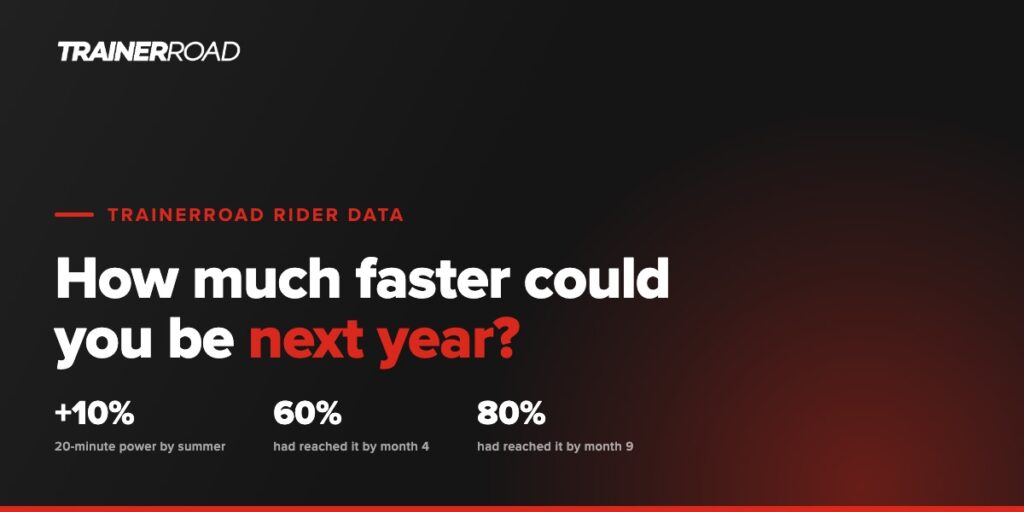
You could be about 10% faster next year. Riders who signed up for TrainerRoad, started a training plan, and followed it gained about 5% in 20-minute power after two months, 9% after four, and about 10% by the time summer came around.
Those riders had three things in common. They did the scheduled workouts at close to the prescribed training stress. They kept going past the point where the gains flatten out. And they started with months to spare, so the odds were on their side by race day. Here is each one, with the numbers behind it.
How Much Faster Do Riders Get on a Training Plan?
About 10% in 20-minute power over a season, with 60-minute power up by about the same. Riders who followed their plan gained about 5% after two months, 9% after four, and held about 10% from month 7 on.
Rider data
How much 20-minute power went up, month by month
Most of the gain is in by month 4. The rest of the season adds about a point.
Median change in a rider’s best 20-minute power from any ride, compared with their first two weeks on the plan. Riders who followed the plan. Columns are months on the plan.
The first month barely moves. Early plan workouts meet you where you are at with lower intensity and shorter duration work instead of pushing you all out, so few riders set a new 20-minute best in their first few weeks. From month 2 the gains come quickly, and by month 4 most of the improvement is in.
In watts, a rider starting from a 20-minute best of about 180 W added about 16 W by month 4 and about 20 W by month 7. For what a full first year looks like across every duration, see how much faster a TrainerRoad plan can make you.
Does Doing More Than Your Plan Asks Make You Faster?
No. At month 4, riders who did between 80 and 120% of their prescribed training stress gained about 9% in 20-minute power. Riders who did 120 to 150% gained about 7%, and riders who did more than 150% gained about 6%.
Adding to the plan is common, and it comes from a good place. You feel fresh on an endurance day and turn it into a hard one. You tack a group ride onto a week that already has three interval workouts in it. Each addition feels like progress. In the data, riders who did a lot more than their plan prescribed gained less, and the earlier analyses of adding training stress show why. Extra hard riding costs you key workouts later in the week and makes your training less consistent.
Rider data
How much 20-minute power went up by training stress done, month 4
Doing close to what the plan prescribed gained the most. Doing a lot more gained less.
Riders who completed 70% or more of their scheduled workouts, split by actual training stress as a share of what the plan prescribed. Bars scaled to 12%.
Doing the scheduled workouts matters at every step. Among riders in that 80 to 120% range, the ones who completed under 40% of their scheduled workouts gained about 2%. Riders who completed 40 to 70% gained about 6%. Riders at 70 to 90% gained about 8%, and riders who completed 90% or more gained about 10%.
Rider data
How much 20-minute power went up by scheduled workouts completed, month 4
Every step up in completion came with a bigger gain.
Riders whose actual training stress was 80 to 120% of prescribed, split by the share of scheduled workouts they completed. Bars scaled to 12%.
For comparison, riders who started a plan but did not follow it closely gained about 3% in 20-minute power and stayed there from month 3 on.
Read the two charts together and the advice is simple. Do the workouts on your calendar, at the intensity written on them. If you have energy to spare, add easy riding after a workout rather than turning an easy day into a hard one. Training stress is a useful number, and the plan already sets it to give you progress you can recover from.
What Happens If You Keep Going Past Month Four?
Your odds go up. The median gain adds only about a point after month 4. The share of riders who had reached a 10% gain kept climbing: 30% by month 2, 60% by month 4, about 7 in 10 by month 6, and about 8 in 10 by month 9.
Rider data
Share of riders who had reached a 10% gain in 20-minute power
The average flattens after month 4. The odds keep rising every month.
The same riders in every column: the ones who followed the plan through month 8. A rider counts from the first monthly check where their 20-minute power was up 10% or more. Columns are months on the plan.
Riders do not improve in a straight line. Some reached a 10% gain in month 3. Others needed six months, with a flat stretch in the middle. A quiet month is normal, and it is usually a block that did not ask for a maximal effort rather than a plan that stopped working. If you have been flat for longer than that, here is how to get through a plateau.
So the later months buy certainty more than watts. Four months on a plan gives you a good chance at a 10% gain. Nine months makes it likely.
When Should You Start Training for Next Season?
Now, if your races are in spring or summer. Count back from your first goal event. A March start gives you four months before summer, and 60% of riders had reached a 10% gain by then. January gives you six months, about 7 in 10. October gives you nine months, about 8 in 10.
Rider data
Odds of a 10% gain by summer, by start month
Each earlier start month raised the share of riders who got there.
Share of riders who had reached a 10% gain in 20-minute power by the month each start date allows before July. Bars scaled to 100%.
This lines up with what TrainerRoad coaches have recommended for years: start base training about 28 weeks before your priority event, so you have time for a full base, build, and specialty progression. For a July race that means starting by mid-December at the latest. An October start gives you a buffer for a cold, a work trip, or a week off the bike.
Starting early also means starting with base, even if you feel fit. Skipping base is tempting after a good summer, and the riders in this data who improved the most did the aerobic groundwork first.
If you are reading this in February, you have not missed the season. Four months still gave 60% of riders a 10% gain, and a shorter plan still beats no plan. You just give up some of the certainty an earlier start would have bought you.
What Should You Do This Week?
Put your goal event on your calendar and start a plan that counts back from it. Then follow it.
- Pick your event and work backward. Put your goal event on your TrainerRoad calendar and let TrainerRoad build the plan around it. If you have several races, prioritize them first so the plan peaks for the right one.
- Choose a volume you can hold for six months. The riders who gained the most were on low and mid-volume plans. A lower weekly training stress you can sustain beats a higher one you abandon in week five.
- Do the workouts as written. Match the intensity on the workout, and keep the easy days easy. That is the 80 to 120% range in the chart above.
- Expect month one to feel flat. You are building, not testing. Judge your progress at month 2 and again at month 4.
- Keep going after month four. That is where the odds that the gain is yours go from 60% to 80%. Habits that keep you consistent matter more than any single workout.
If you are new to structured training, here is how to get started.
Frequently Asked Questions
How much faster can you get in a year of cycling training?
Riders who started a TrainerRoad plan and followed it gained about 10% in 20-minute power within seven to nine months, and 60-minute power went up by about the same. About 8 in 10 of the riders who kept following the plan through month 9 had reached a 10% gain at some point along the way.
How long does it take to see results from a cycling training plan?
About two months for a clear change. Riders who followed their plan gained about 5% in 20-minute power by month 2 and about 9% by month 4. Month 1 is usually flat because early plan workouts do not ask for all-out efforts.
Should I do more than my training plan prescribes?
No. Riders who did between 80 and 120% of their prescribed training stress gained about 9% in 20-minute power at month 4. Riders who did more than 150% gained about 6%. Extra hard riding tends to cost you key workouts later in the week. If you want to add, add easy riding after a workout.
Is it too late to start training for spring races?
No, but the earlier you start the better your odds. Four months on a plan gave 60% of riders a 10% gain in 20-minute power, six months gave about 7 in 10, and nine months gave about 8 in 10. If your races are in spring or summer, starting in October gives you the most time.
Why did my power not improve in the first month of a training plan?
Because the first weeks of a plan aim to meet your fitness where it is at. Early workouts lay the groundwork for future gains with shorter intervals and lower intensity work, so most riders do not set a new 20-minute best until month 2. Riders who followed their plan gained about 1% in month 1 and 5% by month 2.
Is a 10% gain in 20-minute power the same as a 10% gain in FTP?
No. 20-minute power here is the best 20-minute average a rider recorded in any ride, indoors or out. FTP is your Functional Threshold Power, and it serves as a training benchmark for traditional coaching methods to define your zones. TrainerRoad uses AI FTP Detection, which is its own AI model it has trained on millions of rides from real athletes to calculate your FTP for you without requiring a painful, complicated fitness test. For some riders, FTP will be 95% of their 20 minute power, and for others it may be closer to their hour power, but TrainerRoad doesn’t give you workouts purely based on your FTP. TrainerRoad uses its own AI models to recognize your unique abilities in each training zone to give you the right workout every time.
Does this apply if I already use TrainerRoad?
Yes. Riders who already used TrainerRoad and started a new plan after at least eight weeks without one showed the same curve as new signups: about 9% in 20-minute power by month 4 and about 10% by month 6 or 7. The gains come from following the plan, not from being new.
You can be about 10% faster next year. The riders who got there did not find a secret workout. They followed the plan at the intensity it asked for, they kept going after the gains flattened, and they started early enough that the odds were on their side by race day.
TrainerRoad builds your plan around your event and gives you the right workout every day, then adjusts as your fitness changes. Try it risk-free for 30 days.
Check Out TrainerRoad