Do You Need an Off-Season? What the Data Says About Time Off the Bike
You might not need an off-season. Every pro takes one, but if you look at the data, it barely matters for most of us amateurs, and the reason is not what you’d expect. Among riders who followed a plan two years at the same training volume, off-season length didn’t matter much at all until you passed around eight weeks. Past that, athletes were about 30% less likely to reach last year’s 20-minute PR, and those that did get there got there about a month later.
This post walks through who we looked at, what we measured, why your off-season length probably doesn’t matter, and how long to take.
Want next season to be your most consistent yet? TrainerRoad builds your plan around your goal and gives you the right workout every day.
Start TrainingWho Did We Look At?
We started with training data from over 100,000 cyclists and then we started filtering. They needed reliable power data, and they needed to be following a training plan with consistency for two years at the same training volume, so that couldn’t skew the result. Then their off-season, no matter the length, had to be bookended by the end of a training plan and the start of another. That still left over 4,000 athletes.
For each one of them, each year, we measured two things: their 20-minute PR and how long it took them to get there. Then we compared each athlete’s second year with their first, grouped by how long their off-season was. An athlete counted as back at their PR if they got within a few percent of it.
This isn’t a controlled experiment, but with this many riders, a pattern started to show up. Read the numbers as a pattern, not a cause.
What Did the Off-Season Do to Next Season’s Power?
Not much, until you passed around eight weeks. Athletes with no off-season came back a little under 1% up on their 20-minute PR. Athletes who took one to two weeks, three to four weeks, or five to eight weeks all landed within a point of where they had been. Athletes who took eight weeks or more came back about 2% down.
The share who reached last year’s 20-minute PR tells the same story more clearly. Three in four athletes with no off-season reached it. That share eases down a little with each extra week off, then drops once the off-season passes eight weeks. Past that point, athletes were about 30% less likely to reach last year’s PR.
Rider data
Who got back to last year’s 20-minute PR
Up to eight weeks off, the share barely moves. Past eight weeks, it drops by about 20 points.
Share of riders whose second-season 20-minute PR got back to their first-season PR, by length of off-season. Athletes on a plan both years at the same training volume. A filtered sample, and an association, not a cause.
Those that did get there got there later, too. Athletes whose off-season was under five weeks typically set their 20-minute PR in April. Athletes who took more than eight weeks off typically set it in May, about a month later. If you take a long off-season, your early-season goals need to move with it.
Rider data
Next season’s 20-minute PR, by length of off-season
Everything up to eight weeks lands within a point of last year. Eight or more weeks is where the numbers turn.
| Off-season | Change in 20-minute PR | Got back to last year’s PR |
|---|---|---|
| No off-season | +0.7% | 73% |
| 1 to 2 weeks | 0.0% | 71% |
| 3 to 4 weeks | +0.4% | 68% |
| 5 to 8 weeks | 0.0% | 67% |
| 8 or more weeks | −2.1% | 52% |
Change in 20-minute PR for the typical rider from one season to the next, and the share who got back to their previous PR. Same riders as the chart above.
Why Does Your Off-Season Matter Less Than a Pro’s?
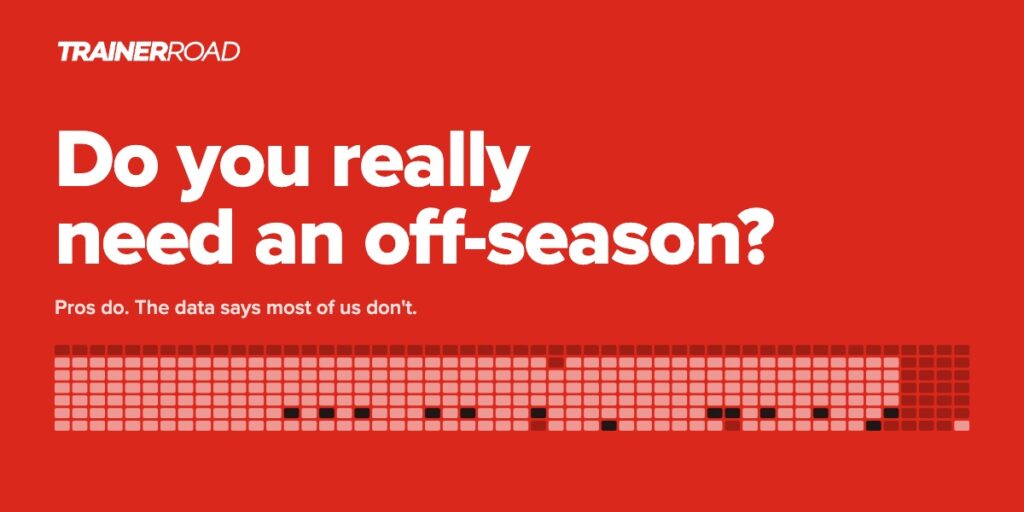
Because you’re probably not a pro. A top pro barely misses a day. They ride from November through October with one day off a week and race most weekends in season, and that relentless load is why they need a break to let their body fully reset. That reset is what an off-season is for.
Two years side by side
A pro’s year and a typical rider’s year
The pro rides almost every day and races most weekends, then takes a month off. The typical rider gets a dozen low weeks across the year and needs far less at the end.
One square is a day. Columns are weeks, rows run Monday to Sunday, mid-November to mid-November. The pro’s year is based on how a top gravel pro trains and races. The typical rider’s year has twelve low weeks, just over the median across a broad sample of TrainerRoad riders.
But you’re different. Illness, family, vacation, work. Even a very consistent amateur gets interrupted constantly all year, so your body rarely reaches the point where it actually needs time off. Across a broad sample of TrainerRoad riders, nearly nine in ten had at least four low weeks in the first nine months of last season, where their riding dropped to less than half of normal. About half had ten or more. One in a hundred had none.
In short, life gives you mini off-seasons all year long before you ever get to the end of the season. That is why skipping the off-season looked fine in the data, and why a few weeks off looked about the same. If you want to come back well from one of those unplanned gaps, we have a guide on getting back into training after unplanned time off.
Your head is a different matter. A long season wears on your motivation even when your body never reaches a pro’s level of fatigue. This is where an off-season still earns its place, and it is the part the data cannot measure directly.
When you come back, TrainerRoad starts your new plan from Base and AI FTP Detection sets your FTP from your first rides, so you are never guessing.
Try TrainerRoadHow Long Should Your Off-Season Be?
The biggest driver of improvement is consistency with progressive overload. So the best answer is to take whatever time you need to recharge and get your mind right, so you can be back training next year at the same level of consistency or greater, at a higher training volume. For most riders that’s probably one to three weeks, which sits inside the two to three weeks in our guide to planning your off-season. It might be zero. It might be more. If you trained hard all year with almost no low weeks, you are closer to the pro’s situation and probably need more.
So the question is not how many weeks your body needs. It is how much time you need before you can come back and train with better consistency and a bit more training volume than last year. Fitness builds year over year when you keep stacking seasons, and the off-season is where the motivation to do that comes back.
But the longer you take, the lower your odds are for next year, and eight weeks is the inflection point. Past it, expect to come back lower and peak about a month later, so plan your first goal later in the year. If you want to know what you lose in fitness terms along the way, our guide on recovering and maintaining fitness after a training cycle walks through how quickly it goes and how little riding it takes to hold it.
Why Does Riding More Next Year Matter More Than the Off-Season?
Because the swing from riding more or less next year is far bigger than anything the off-season did. Before we held training volume the same, we looked at every plan follower in the sample. Athletes who cut their training volume by 30% or more came back about 4% down on their 20-minute PR. Athletes who added 50% or more came back about 7.5% up. The one or two points the off-season moved sit well inside that swing.
Rider data
Riding more is what moves the 20-minute PR
Change in next season’s 20-minute PR, by how training volume changed from one year to the next.
Change in 20-minute PR for the typical rider, all plan followers in the sample before training volume was held the same. Athletes who added the most hours tended to start from a lower base, so some of that gain is new riders ramping up.
That doesn’t mean you can simply add 50% or more training volume year over year. The athletes who did that are anomalies, and most of them started from a low base. What our data shows is that it’s better to increase your training volume each year by more manageable amounts. A common approach is to add 1 to 2 hours to your weekly average the following year. You can do that by making two interval sessions 30 minutes longer and adding 30 minutes to your endurance rides, or by making an endurance ride slightly longer on the weekend.
That swing is why the off-season numbers above only compare athletes whose training volume stayed the same. It is also the frame for your own decision. What you do across the next ten months moves your 20-minute PR far more than what you do in November, so the off-season is worth getting right mainly because of what it sets up.
What Should You Do When You Come Back?
Don’t just do what pros do. Take the time you need, then come back more consistent. Start with a plan built around the training volume you can hold for ten months. The athletes who came back at the same training volume landed about where they left off, and the athletes who added volume got faster. Whatever the length of your off-season, start the new plan with Base. Base is where you fortify the aerobic conditioning you need to build to higher levels later in the season, and skipping it to jump into Build leaves that foundation thinner than it should be. Our guide on what to do after you finish a Specialty plan covers the restart, and how periodization works across a season explains why Base comes first.
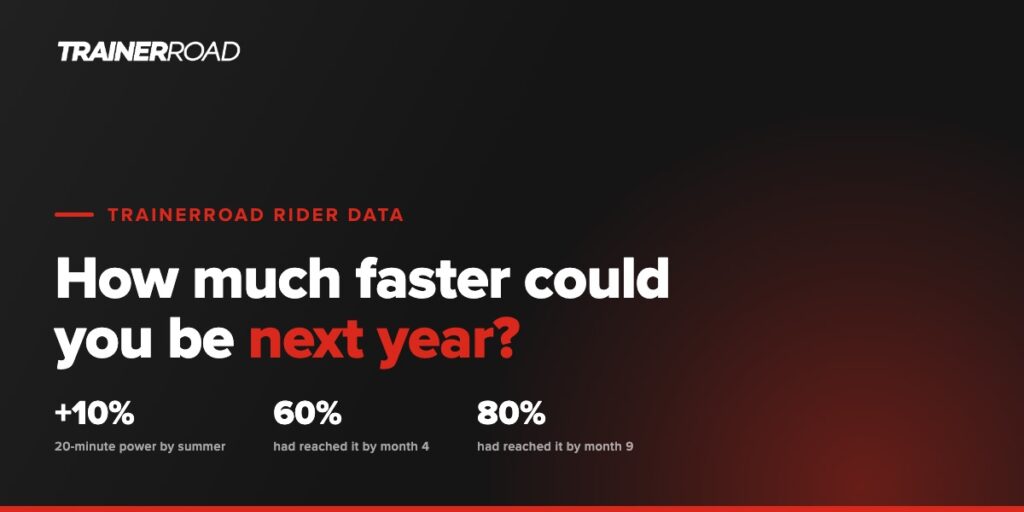
At TrainerRoad we spend huge amounts of time and money building our own AI models to make your training more consistent than ever before. When you start your new season, AI FTP Detection sets your FTP from your first rides so you are not guessing, and the plan keeps adjusting through the low weeks that will show up during the season. Athletes typically see a 10% improvement in their 20-minute power in year one.
Frequently Asked Questions
Do cyclists need an off-season?
Most amateur cyclists do not need a long one. Among athletes who followed a plan two years at the same training volume, those who took no off-season and those who took up to eight weeks off came back to about the same 20-minute PR. Pros need a real off-season because they train with almost no interruptions. Most amateurs already get rest from low weeks spread across the year.
How long should a cycling off-season be?
Probably one to three weeks for most riders. It might be zero, and it might be more. Take whatever time you need to recharge and get your mind right, then start. In our data, off-seasons up to eight weeks cost very little, and eight weeks is the inflection point where athletes were about 30% less likely to reach last year’s 20-minute PR.
What happens if you take no off-season?
In our data, athletes who kept training through the off-season came back a little under 1% up on their 20-minute PR, and about three in four reached last year’s PR. The catch is motivation. If you skip the off-season and then burn out in February, you have lost more than two weeks off would have cost. Skip it only if you still want to train.
How much fitness do you lose in the off-season?
Less than most riders fear in the first two weeks, and more after that. Our guide on recovering and maintaining fitness puts the loss at almost nothing in the first week, around 6% after ten to fourteen days, and around 12% after two to four weeks away. In our off-season data, that loss was made back by the next season for athletes who took under eight weeks off.
Should you ride at all during the off-season?
Ride if you want to, and keep it unstructured. The point of the off-season is to come back wanting to train, so easy rides, other sports, or nothing at all are all fine. What matters is that you are not forcing yourself through intervals you do not want to do. Save the structure for when the plan starts again.
When should you start training again after the off-season?
When you want to, and before eight weeks have passed. Our guide on what comes after your training plan walks through the signs you are ready. However long your off-season was, start the new plan with Base so the aerobic work comes first. That foundation is what lets you build to higher levels later in the season.
Why do pros take an off-season if amateurs do not need one?
Because a pro’s year has almost no gaps. They ride through the whole season with one day off a week, race most weekends, and build up a fatigue most amateurs never reach. At the end of that, the body needs a full reset. An amateur’s year already holds a dozen low weeks from work, travel, illness, and family, so the reset happens along the way.
So don’t just do what pros do. Take the time you need, then come back more consistent than ever. That is what next season is built on.
TrainerRoad builds its own AI models to make your training more consistent than ever before. Athletes typically see a 10% improvement in their 20-minute power in year one. That could be you.
Check Out TrainerRoad