Updated for the 2027 qualifying season, October 2026
To qualify for Kona in 2027 you need a slot from a full-distance IRONMAN race in the 2027 qualifying season, and as an age grouper there are two ways to earn one. Win your age group, or post a time close enough to the Kona Standard for your age and gender to earn a slot from the Performance Pool. The 2027 season opened at IRONMAN Tallinn on August 22, 2026 and runs through the summer races of 2027. Kona 2027 is on Saturday, October 9, 2027.
This Saturday, October 10, 2,548 athletes from 85 countries will race Kona 2026. About 110 of them are pros, and most of the rest earned their slot the way this guide describes, some of them more than a year ago. A smaller group came in through the Legacy Program, the IRONMAN Foundation, the draw for athletes with a disability, the Hawaii resident draw, or the paid Xclusive Challenge, and all of those are covered below. If you want to be on the start line in 2027, the races that get you there have already started.
If you already have a full-distance finish time, start here. Pick your gender and age group, then find your time in the table to see what it counts as when the Performance Pool ranks you. Look up last year’s age-group winner from your goal race in the same table, and the gap between the two age-graded times is how far you are from an automatic slot. The rest of the guide explains where those numbers come from.
Kona Standard
How close are you to a Kona slot?
Pick your gender and age group, then find your full-distance finish time in the table to read your age-graded time under the Kona Standard.
Use your age on December 31 of the year the race is held.
The women’s factors come from the November 2025 revision, which measures women against women aged 30 to 34. The table is re-evaluated each year, so check the official qualifying page for 2027.
Kona Standard factor
0.9698
Men 18 to 24
What it means
Your age-graded time is your finish time multiplied by 0.9698. Find your finish time below to read it off.
Age-graded times, men 18 to 24
| Your finish time | Your age-graded time |
|---|---|
| 8:00:00 | 7:45:30 |
| 8:10:00 | 7:55:12 |
| 8:20:00 | 8:04:54 |
| 8:30:00 | 8:14:36 |
| 8:40:00 | 8:24:18 |
| 8:50:00 | 8:34:00 |
| 9:00:00 | 8:43:42 |
| 9:10:00 | 8:53:23 |
| 9:20:00 | 9:03:05 |
| 9:30:00 | 9:12:47 |
| 9:40:00 | 9:22:29 |
| 9:50:00 | 9:32:11 |
| 10:00:00 | 9:41:53 |
| 10:10:00 | 9:51:35 |
| 10:20:00 | 10:01:17 |
| 10:30:00 | 10:10:58 |
| 10:40:00 | 10:20:40 |
| 10:50:00 | 10:30:22 |
| 11:00:00 | 10:40:04 |
| 11:10:00 | 10:49:46 |
| 11:20:00 | 10:59:28 |
| 11:30:00 | 11:09:10 |
| 11:40:00 | 11:18:52 |
| 11:50:00 | 11:28:33 |
| 12:00:00 | 11:38:15 |
| 12:10:00 | 11:47:57 |
| 12:20:00 | 11:57:39 |
| 12:30:00 | 12:07:21 |
| 12:40:00 | 12:17:03 |
| 12:50:00 | 12:26:45 |
| 13:00:00 | 12:36:27 |
| 13:10:00 | 12:46:09 |
| 13:20:00 | 12:55:50 |
| 13:30:00 | 13:05:32 |
| 13:40:00 | 13:15:14 |
| 13:50:00 | 13:24:56 |
| 14:00:00 | 13:34:38 |
Kona Standard factor
0.9921
Men 25 to 29
What it means
Your age-graded time is your finish time multiplied by 0.9921. Find your finish time below to read it off.
Age-graded times, men 25 to 29
| Your finish time | Your age-graded time |
|---|---|
| 8:00:00 | 7:56:12 |
| 8:10:00 | 8:06:08 |
| 8:20:00 | 8:16:03 |
| 8:30:00 | 8:25:58 |
| 8:40:00 | 8:35:54 |
| 8:50:00 | 8:45:49 |
| 9:00:00 | 8:55:44 |
| 9:10:00 | 9:05:39 |
| 9:20:00 | 9:15:35 |
| 9:30:00 | 9:25:30 |
| 9:40:00 | 9:35:25 |
| 9:50:00 | 9:45:20 |
| 10:00:00 | 9:55:16 |
| 10:10:00 | 10:05:11 |
| 10:20:00 | 10:15:06 |
| 10:30:00 | 10:25:01 |
| 10:40:00 | 10:34:57 |
| 10:50:00 | 10:44:52 |
| 11:00:00 | 10:54:47 |
| 11:10:00 | 11:04:42 |
| 11:20:00 | 11:14:38 |
| 11:30:00 | 11:24:33 |
| 11:40:00 | 11:34:28 |
| 11:50:00 | 11:44:23 |
| 12:00:00 | 11:54:19 |
| 12:10:00 | 12:04:14 |
| 12:20:00 | 12:14:09 |
| 12:30:00 | 12:24:05 |
| 12:40:00 | 12:34:00 |
| 12:50:00 | 12:43:55 |
| 13:00:00 | 12:53:50 |
| 13:10:00 | 13:03:46 |
| 13:20:00 | 13:13:41 |
| 13:30:00 | 13:23:36 |
| 13:40:00 | 13:33:31 |
| 13:50:00 | 13:43:27 |
| 14:00:00 | 13:53:22 |
Kona Standard factor
1.0000
Men 30 to 34
What it means
This is the reference group. The factor is 1.0000, so your age-graded time equals your finish time.
Age-graded times, men 30 to 34
| Your finish time | Your age-graded time |
|---|---|
| 8:00:00 | 8:00:00 |
| 8:10:00 | 8:10:00 |
| 8:20:00 | 8:20:00 |
| 8:30:00 | 8:30:00 |
| 8:40:00 | 8:40:00 |
| 8:50:00 | 8:50:00 |
| 9:00:00 | 9:00:00 |
| 9:10:00 | 9:10:00 |
| 9:20:00 | 9:20:00 |
| 9:30:00 | 9:30:00 |
| 9:40:00 | 9:40:00 |
| 9:50:00 | 9:50:00 |
| 10:00:00 | 10:00:00 |
| 10:10:00 | 10:10:00 |
| 10:20:00 | 10:20:00 |
| 10:30:00 | 10:30:00 |
| 10:40:00 | 10:40:00 |
| 10:50:00 | 10:50:00 |
| 11:00:00 | 11:00:00 |
| 11:10:00 | 11:10:00 |
| 11:20:00 | 11:20:00 |
| 11:30:00 | 11:30:00 |
| 11:40:00 | 11:40:00 |
| 11:50:00 | 11:50:00 |
| 12:00:00 | 12:00:00 |
| 12:10:00 | 12:10:00 |
| 12:20:00 | 12:20:00 |
| 12:30:00 | 12:30:00 |
| 12:40:00 | 12:40:00 |
| 12:50:00 | 12:50:00 |
| 13:00:00 | 13:00:00 |
| 13:10:00 | 13:10:00 |
| 13:20:00 | 13:20:00 |
| 13:30:00 | 13:30:00 |
| 13:40:00 | 13:40:00 |
| 13:50:00 | 13:50:00 |
| 14:00:00 | 14:00:00 |
Kona Standard factor
0.9895
Men 35 to 39
What it means
Your age-graded time is your finish time multiplied by 0.9895. Find your finish time below to read it off.
Age-graded times, men 35 to 39
| Your finish time | Your age-graded time |
|---|---|
| 8:00:00 | 7:54:58 |
| 8:10:00 | 8:04:51 |
| 8:20:00 | 8:14:45 |
| 8:30:00 | 8:24:39 |
| 8:40:00 | 8:34:32 |
| 8:50:00 | 8:44:26 |
| 9:00:00 | 8:54:20 |
| 9:10:00 | 9:04:14 |
| 9:20:00 | 9:14:07 |
| 9:30:00 | 9:24:01 |
| 9:40:00 | 9:33:55 |
| 9:50:00 | 9:43:48 |
| 10:00:00 | 9:53:42 |
| 10:10:00 | 10:03:36 |
| 10:20:00 | 10:13:29 |
| 10:30:00 | 10:23:23 |
| 10:40:00 | 10:33:17 |
| 10:50:00 | 10:43:11 |
| 11:00:00 | 10:53:04 |
| 11:10:00 | 11:02:58 |
| 11:20:00 | 11:12:52 |
| 11:30:00 | 11:22:45 |
| 11:40:00 | 11:32:39 |
| 11:50:00 | 11:42:33 |
| 12:00:00 | 11:52:26 |
| 12:10:00 | 12:02:20 |
| 12:20:00 | 12:12:14 |
| 12:30:00 | 12:22:08 |
| 12:40:00 | 12:32:01 |
| 12:50:00 | 12:41:55 |
| 13:00:00 | 12:51:49 |
| 13:10:00 | 13:01:42 |
| 13:20:00 | 13:11:36 |
| 13:30:00 | 13:21:30 |
| 13:40:00 | 13:31:23 |
| 13:50:00 | 13:41:17 |
| 14:00:00 | 13:51:11 |
Kona Standard factor
0.9683
Men 40 to 44
What it means
Your age-graded time is your finish time multiplied by 0.9683. Find your finish time below to read it off.
Age-graded times, men 40 to 44
| Your finish time | Your age-graded time |
|---|---|
| 8:00:00 | 7:44:47 |
| 8:10:00 | 7:54:28 |
| 8:20:00 | 8:04:09 |
| 8:30:00 | 8:13:50 |
| 8:40:00 | 8:23:31 |
| 8:50:00 | 8:33:12 |
| 9:00:00 | 8:42:53 |
| 9:10:00 | 8:52:34 |
| 9:20:00 | 9:02:15 |
| 9:30:00 | 9:11:56 |
| 9:40:00 | 9:21:37 |
| 9:50:00 | 9:31:18 |
| 10:00:00 | 9:40:59 |
| 10:10:00 | 9:50:40 |
| 10:20:00 | 10:00:21 |
| 10:30:00 | 10:10:02 |
| 10:40:00 | 10:19:43 |
| 10:50:00 | 10:29:24 |
| 11:00:00 | 10:39:05 |
| 11:10:00 | 10:48:46 |
| 11:20:00 | 10:58:27 |
| 11:30:00 | 11:08:08 |
| 11:40:00 | 11:17:49 |
| 11:50:00 | 11:27:30 |
| 12:00:00 | 11:37:11 |
| 12:10:00 | 11:46:52 |
| 12:20:00 | 11:56:33 |
| 12:30:00 | 12:06:14 |
| 12:40:00 | 12:15:54 |
| 12:50:00 | 12:25:35 |
| 13:00:00 | 12:35:16 |
| 13:10:00 | 12:44:57 |
| 13:20:00 | 12:54:38 |
| 13:30:00 | 13:04:19 |
| 13:40:00 | 13:14:00 |
| 13:50:00 | 13:23:41 |
| 14:00:00 | 13:33:22 |
Kona Standard factor
0.9401
Men 45 to 49
What it means
Your age-graded time is your finish time multiplied by 0.9401. Find your finish time below to read it off.
Age-graded times, men 45 to 49
| Your finish time | Your age-graded time |
|---|---|
| 8:00:00 | 7:31:15 |
| 8:10:00 | 7:40:39 |
| 8:20:00 | 7:50:03 |
| 8:30:00 | 7:59:27 |
| 8:40:00 | 8:08:51 |
| 8:50:00 | 8:18:15 |
| 9:00:00 | 8:27:39 |
| 9:10:00 | 8:37:03 |
| 9:20:00 | 8:46:27 |
| 9:30:00 | 8:55:51 |
| 9:40:00 | 9:05:15 |
| 9:50:00 | 9:14:40 |
| 10:00:00 | 9:24:04 |
| 10:10:00 | 9:33:28 |
| 10:20:00 | 9:42:52 |
| 10:30:00 | 9:52:16 |
| 10:40:00 | 10:01:40 |
| 10:50:00 | 10:11:04 |
| 11:00:00 | 10:20:28 |
| 11:10:00 | 10:29:52 |
| 11:20:00 | 10:39:16 |
| 11:30:00 | 10:48:40 |
| 11:40:00 | 10:58:04 |
| 11:50:00 | 11:07:28 |
| 12:00:00 | 11:16:52 |
| 12:10:00 | 11:26:16 |
| 12:20:00 | 11:35:40 |
| 12:30:00 | 11:45:05 |
| 12:40:00 | 11:54:29 |
| 12:50:00 | 12:03:53 |
| 13:00:00 | 12:13:17 |
| 13:10:00 | 12:22:41 |
| 13:20:00 | 12:32:05 |
| 13:30:00 | 12:41:29 |
| 13:40:00 | 12:50:53 |
| 13:50:00 | 13:00:17 |
| 14:00:00 | 13:09:41 |
Kona Standard factor
0.9002
Men 50 to 54
What it means
Your age-graded time is your finish time multiplied by 0.9002. Find your finish time below to read it off.
Age-graded times, men 50 to 54
| Your finish time | Your age-graded time |
|---|---|
| 8:00:00 | 7:12:06 |
| 8:10:00 | 7:21:06 |
| 8:20:00 | 7:30:06 |
| 8:30:00 | 7:39:06 |
| 8:40:00 | 7:48:06 |
| 8:50:00 | 7:57:06 |
| 9:00:00 | 8:06:06 |
| 9:10:00 | 8:15:07 |
| 9:20:00 | 8:24:07 |
| 9:30:00 | 8:33:07 |
| 9:40:00 | 8:42:07 |
| 9:50:00 | 8:51:07 |
| 10:00:00 | 9:00:07 |
| 10:10:00 | 9:09:07 |
| 10:20:00 | 9:18:07 |
| 10:30:00 | 9:27:08 |
| 10:40:00 | 9:36:08 |
| 10:50:00 | 9:45:08 |
| 11:00:00 | 9:54:08 |
| 11:10:00 | 10:03:08 |
| 11:20:00 | 10:12:08 |
| 11:30:00 | 10:21:08 |
| 11:40:00 | 10:30:08 |
| 11:50:00 | 10:39:09 |
| 12:00:00 | 10:48:09 |
| 12:10:00 | 10:57:09 |
| 12:20:00 | 11:06:09 |
| 12:30:00 | 11:15:09 |
| 12:40:00 | 11:24:09 |
| 12:50:00 | 11:33:09 |
| 13:00:00 | 11:42:09 |
| 13:10:00 | 11:51:09 |
| 13:20:00 | 12:00:10 |
| 13:30:00 | 12:09:10 |
| 13:40:00 | 12:18:10 |
| 13:50:00 | 12:27:10 |
| 14:00:00 | 12:36:10 |
Kona Standard factor
0.8667
Men 55 to 59
What it means
Your age-graded time is your finish time multiplied by 0.8667. Find your finish time below to read it off.
Age-graded times, men 55 to 59
| Your finish time | Your age-graded time |
|---|---|
| 8:00:00 | 6:56:01 |
| 8:10:00 | 7:04:41 |
| 8:20:00 | 7:13:21 |
| 8:30:00 | 7:22:01 |
| 8:40:00 | 7:30:41 |
| 8:50:00 | 7:39:21 |
| 9:00:00 | 7:48:01 |
| 9:10:00 | 7:56:41 |
| 9:20:00 | 8:05:21 |
| 9:30:00 | 8:14:01 |
| 9:40:00 | 8:22:41 |
| 9:50:00 | 8:31:21 |
| 10:00:00 | 8:40:01 |
| 10:10:00 | 8:48:41 |
| 10:20:00 | 8:57:21 |
| 10:30:00 | 9:06:01 |
| 10:40:00 | 9:14:41 |
| 10:50:00 | 9:23:21 |
| 11:00:00 | 9:32:01 |
| 11:10:00 | 9:40:41 |
| 11:20:00 | 9:49:21 |
| 11:30:00 | 9:58:01 |
| 11:40:00 | 10:06:41 |
| 11:50:00 | 10:15:21 |
| 12:00:00 | 10:24:01 |
| 12:10:00 | 10:32:41 |
| 12:20:00 | 10:41:21 |
| 12:30:00 | 10:50:02 |
| 12:40:00 | 10:58:42 |
| 12:50:00 | 11:07:22 |
| 13:00:00 | 11:16:02 |
| 13:10:00 | 11:24:42 |
| 13:20:00 | 11:33:22 |
| 13:30:00 | 11:42:02 |
| 13:40:00 | 11:50:42 |
| 13:50:00 | 11:59:22 |
| 14:00:00 | 12:08:02 |
Kona Standard factor
0.8262
Men 60 to 64
What it means
Your age-graded time is your finish time multiplied by 0.8262. Find your finish time below to read it off.
Age-graded times, men 60 to 64
| Your finish time | Your age-graded time |
|---|---|
| 8:00:00 | 6:36:35 |
| 8:10:00 | 6:44:50 |
| 8:20:00 | 6:53:06 |
| 8:30:00 | 7:01:22 |
| 8:40:00 | 7:09:37 |
| 8:50:00 | 7:17:53 |
| 9:00:00 | 7:26:09 |
| 9:10:00 | 7:34:25 |
| 9:20:00 | 7:42:40 |
| 9:30:00 | 7:50:56 |
| 9:40:00 | 7:59:12 |
| 9:50:00 | 8:07:27 |
| 10:00:00 | 8:15:43 |
| 10:10:00 | 8:23:59 |
| 10:20:00 | 8:32:15 |
| 10:30:00 | 8:40:30 |
| 10:40:00 | 8:48:46 |
| 10:50:00 | 8:57:02 |
| 11:00:00 | 9:05:18 |
| 11:10:00 | 9:13:33 |
| 11:20:00 | 9:21:49 |
| 11:30:00 | 9:30:05 |
| 11:40:00 | 9:38:20 |
| 11:50:00 | 9:46:36 |
| 12:00:00 | 9:54:52 |
| 12:10:00 | 10:03:08 |
| 12:20:00 | 10:11:23 |
| 12:30:00 | 10:19:39 |
| 12:40:00 | 10:27:55 |
| 12:50:00 | 10:36:10 |
| 13:00:00 | 10:44:26 |
| 13:10:00 | 10:52:42 |
| 13:20:00 | 11:00:58 |
| 13:30:00 | 11:09:13 |
| 13:40:00 | 11:17:29 |
| 13:50:00 | 11:25:45 |
| 14:00:00 | 11:34:00 |
Kona Standard factor
0.7552
Men 65 to 69
What it means
Your age-graded time is your finish time multiplied by 0.7552. Find your finish time below to read it off.
Age-graded times, men 65 to 69
| Your finish time | Your age-graded time |
|---|---|
| 8:00:00 | 6:02:30 |
| 8:10:00 | 6:10:03 |
| 8:20:00 | 6:17:36 |
| 8:30:00 | 6:25:09 |
| 8:40:00 | 6:32:42 |
| 8:50:00 | 6:40:15 |
| 9:00:00 | 6:47:48 |
| 9:10:00 | 6:55:22 |
| 9:20:00 | 7:02:55 |
| 9:30:00 | 7:10:28 |
| 9:40:00 | 7:18:01 |
| 9:50:00 | 7:25:34 |
| 10:00:00 | 7:33:07 |
| 10:10:00 | 7:40:40 |
| 10:20:00 | 7:48:13 |
| 10:30:00 | 7:55:47 |
| 10:40:00 | 8:03:20 |
| 10:50:00 | 8:10:53 |
| 11:00:00 | 8:18:26 |
| 11:10:00 | 8:25:59 |
| 11:20:00 | 8:33:32 |
| 11:30:00 | 8:41:05 |
| 11:40:00 | 8:48:38 |
| 11:50:00 | 8:56:12 |
| 12:00:00 | 9:03:45 |
| 12:10:00 | 9:11:18 |
| 12:20:00 | 9:18:51 |
| 12:30:00 | 9:26:24 |
| 12:40:00 | 9:33:57 |
| 12:50:00 | 9:41:30 |
| 13:00:00 | 9:49:03 |
| 13:10:00 | 9:56:36 |
| 13:20:00 | 10:04:10 |
| 13:30:00 | 10:11:43 |
| 13:40:00 | 10:19:16 |
| 13:50:00 | 10:26:49 |
| 14:00:00 | 10:34:22 |
Kona Standard factor
0.6876
Men 70 to 74
What it means
Your age-graded time is your finish time multiplied by 0.6876. Find your finish time below to read it off.
Age-graded times, men 70 to 74
| Your finish time | Your age-graded time |
|---|---|
| 8:00:00 | 5:30:03 |
| 8:10:00 | 5:36:55 |
| 8:20:00 | 5:43:48 |
| 8:30:00 | 5:50:41 |
| 8:40:00 | 5:57:33 |
| 8:50:00 | 6:04:26 |
| 9:00:00 | 6:11:18 |
| 9:10:00 | 6:18:11 |
| 9:20:00 | 6:25:03 |
| 9:30:00 | 6:31:56 |
| 9:40:00 | 6:38:48 |
| 9:50:00 | 6:45:41 |
| 10:00:00 | 6:52:34 |
| 10:10:00 | 6:59:26 |
| 10:20:00 | 7:06:19 |
| 10:30:00 | 7:13:11 |
| 10:40:00 | 7:20:04 |
| 10:50:00 | 7:26:56 |
| 11:00:00 | 7:33:49 |
| 11:10:00 | 7:40:42 |
| 11:20:00 | 7:47:34 |
| 11:30:00 | 7:54:27 |
| 11:40:00 | 8:01:19 |
| 11:50:00 | 8:08:12 |
| 12:00:00 | 8:15:04 |
| 12:10:00 | 8:21:57 |
| 12:20:00 | 8:28:49 |
| 12:30:00 | 8:35:42 |
| 12:40:00 | 8:42:35 |
| 12:50:00 | 8:49:27 |
| 13:00:00 | 8:56:20 |
| 13:10:00 | 9:03:12 |
| 13:20:00 | 9:10:05 |
| 13:30:00 | 9:16:57 |
| 13:40:00 | 9:23:50 |
| 13:50:00 | 9:30:42 |
| 14:00:00 | 9:37:35 |
Kona Standard factor
0.6768
Men 75 to 79
What it means
Your age-graded time is your finish time multiplied by 0.6768. Find your finish time below to read it off.
Age-graded times, men 75 to 79
| Your finish time | Your age-graded time |
|---|---|
| 8:00:00 | 5:24:52 |
| 8:10:00 | 5:31:38 |
| 8:20:00 | 5:38:24 |
| 8:30:00 | 5:45:10 |
| 8:40:00 | 5:51:56 |
| 8:50:00 | 5:58:42 |
| 9:00:00 | 6:05:28 |
| 9:10:00 | 6:12:14 |
| 9:20:00 | 6:19:00 |
| 9:30:00 | 6:25:47 |
| 9:40:00 | 6:32:33 |
| 9:50:00 | 6:39:19 |
| 10:00:00 | 6:46:05 |
| 10:10:00 | 6:52:51 |
| 10:20:00 | 6:59:37 |
| 10:30:00 | 7:06:23 |
| 10:40:00 | 7:13:09 |
| 10:50:00 | 7:19:55 |
| 11:00:00 | 7:26:41 |
| 11:10:00 | 7:33:27 |
| 11:20:00 | 7:40:13 |
| 11:30:00 | 7:47:00 |
| 11:40:00 | 7:53:46 |
| 11:50:00 | 8:00:32 |
| 12:00:00 | 8:07:18 |
| 12:10:00 | 8:14:04 |
| 12:20:00 | 8:20:50 |
| 12:30:00 | 8:27:36 |
| 12:40:00 | 8:34:22 |
| 12:50:00 | 8:41:08 |
| 13:00:00 | 8:47:54 |
| 13:10:00 | 8:54:40 |
| 13:20:00 | 9:01:26 |
| 13:30:00 | 9:08:12 |
| 13:40:00 | 9:14:59 |
| 13:50:00 | 9:21:45 |
| 14:00:00 | 9:28:31 |
Kona Standard factor
0.5555
Men 80 to 84
What it means
Your age-graded time is your finish time multiplied by 0.5555. Find your finish time below to read it off.
Age-graded times, men 80 to 84
| Your finish time | Your age-graded time |
|---|---|
| 8:00:00 | 4:26:38 |
| 8:10:00 | 4:32:12 |
| 8:20:00 | 4:37:45 |
| 8:30:00 | 4:43:18 |
| 8:40:00 | 4:48:52 |
| 8:50:00 | 4:54:25 |
| 9:00:00 | 4:59:58 |
| 9:10:00 | 5:05:32 |
| 9:20:00 | 5:11:05 |
| 9:30:00 | 5:16:38 |
| 9:40:00 | 5:22:11 |
| 9:50:00 | 5:27:45 |
| 10:00:00 | 5:33:18 |
| 10:10:00 | 5:38:51 |
| 10:20:00 | 5:44:25 |
| 10:30:00 | 5:49:58 |
| 10:40:00 | 5:55:31 |
| 10:50:00 | 6:01:05 |
| 11:00:00 | 6:06:38 |
| 11:10:00 | 6:12:11 |
| 11:20:00 | 6:17:44 |
| 11:30:00 | 6:23:18 |
| 11:40:00 | 6:28:51 |
| 11:50:00 | 6:34:24 |
| 12:00:00 | 6:39:58 |
| 12:10:00 | 6:45:31 |
| 12:20:00 | 6:51:04 |
| 12:30:00 | 6:56:38 |
| 12:40:00 | 7:02:11 |
| 12:50:00 | 7:07:44 |
| 13:00:00 | 7:13:17 |
| 13:10:00 | 7:18:51 |
| 13:20:00 | 7:24:24 |
| 13:30:00 | 7:29:57 |
| 13:40:00 | 7:35:31 |
| 13:50:00 | 7:41:04 |
| 14:00:00 | 7:46:37 |
Kona Standard factor
0.5416
Men 85 to 89
What it means
Your age-graded time is your finish time multiplied by 0.5416. Find your finish time below to read it off.
Age-graded times, men 85 to 89
| Your finish time | Your age-graded time |
|---|---|
| 8:00:00 | 4:19:58 |
| 8:10:00 | 4:25:23 |
| 8:20:00 | 4:30:48 |
| 8:30:00 | 4:36:13 |
| 8:40:00 | 4:41:38 |
| 8:50:00 | 4:47:03 |
| 9:00:00 | 4:52:28 |
| 9:10:00 | 4:57:53 |
| 9:20:00 | 5:03:18 |
| 9:30:00 | 5:08:43 |
| 9:40:00 | 5:14:08 |
| 9:50:00 | 5:19:33 |
| 10:00:00 | 5:24:58 |
| 10:10:00 | 5:30:23 |
| 10:20:00 | 5:35:48 |
| 10:30:00 | 5:41:12 |
| 10:40:00 | 5:46:37 |
| 10:50:00 | 5:52:02 |
| 11:00:00 | 5:57:27 |
| 11:10:00 | 6:02:52 |
| 11:20:00 | 6:08:17 |
| 11:30:00 | 6:13:42 |
| 11:40:00 | 6:19:07 |
| 11:50:00 | 6:24:32 |
| 12:00:00 | 6:29:57 |
| 12:10:00 | 6:35:22 |
| 12:20:00 | 6:40:47 |
| 12:30:00 | 6:46:12 |
| 12:40:00 | 6:51:37 |
| 12:50:00 | 6:57:02 |
| 13:00:00 | 7:02:27 |
| 13:10:00 | 7:07:52 |
| 13:20:00 | 7:13:17 |
| 13:30:00 | 7:18:42 |
| 13:40:00 | 7:24:07 |
| 13:50:00 | 7:29:32 |
| 14:00:00 | 7:34:57 |
Kona Standard factor
0.9543
Women 18 to 24
What it means
Your age-graded time is your finish time multiplied by 0.9543. Find your finish time below to read it off.
Age-graded times, women 18 to 24
| Your finish time | Your age-graded time |
|---|---|
| 8:00:00 | 7:38:04 |
| 8:10:00 | 7:47:36 |
| 8:20:00 | 7:57:09 |
| 8:30:00 | 8:06:42 |
| 8:40:00 | 8:16:14 |
| 8:50:00 | 8:25:47 |
| 9:00:00 | 8:35:19 |
| 9:10:00 | 8:44:52 |
| 9:20:00 | 8:54:24 |
| 9:30:00 | 9:03:57 |
| 9:40:00 | 9:13:30 |
| 9:50:00 | 9:23:02 |
| 10:00:00 | 9:32:35 |
| 10:10:00 | 9:42:07 |
| 10:20:00 | 9:51:40 |
| 10:30:00 | 10:01:13 |
| 10:40:00 | 10:10:45 |
| 10:50:00 | 10:20:18 |
| 11:00:00 | 10:29:50 |
| 11:10:00 | 10:39:23 |
| 11:20:00 | 10:48:55 |
| 11:30:00 | 10:58:28 |
| 11:40:00 | 11:08:01 |
| 11:50:00 | 11:17:33 |
| 12:00:00 | 11:27:06 |
| 12:10:00 | 11:36:38 |
| 12:20:00 | 11:46:11 |
| 12:30:00 | 11:55:44 |
| 12:40:00 | 12:05:16 |
| 12:50:00 | 12:14:49 |
| 13:00:00 | 12:24:21 |
| 13:10:00 | 12:33:54 |
| 13:20:00 | 12:43:26 |
| 13:30:00 | 12:52:59 |
| 13:40:00 | 13:02:32 |
| 13:50:00 | 13:12:04 |
| 14:00:00 | 13:21:37 |
Kona Standard factor
0.9982
Women 25 to 29
What it means
Your age-graded time is your finish time multiplied by 0.9982. Find your finish time below to read it off.
Age-graded times, women 25 to 29
| Your finish time | Your age-graded time |
|---|---|
| 8:00:00 | 7:59:08 |
| 8:10:00 | 8:09:07 |
| 8:20:00 | 8:19:06 |
| 8:30:00 | 8:29:05 |
| 8:40:00 | 8:39:04 |
| 8:50:00 | 8:49:03 |
| 9:00:00 | 8:59:02 |
| 9:10:00 | 9:09:01 |
| 9:20:00 | 9:19:00 |
| 9:30:00 | 9:28:58 |
| 9:40:00 | 9:38:57 |
| 9:50:00 | 9:48:56 |
| 10:00:00 | 9:58:55 |
| 10:10:00 | 10:08:54 |
| 10:20:00 | 10:18:53 |
| 10:30:00 | 10:28:52 |
| 10:40:00 | 10:38:51 |
| 10:50:00 | 10:48:50 |
| 11:00:00 | 10:58:49 |
| 11:10:00 | 11:08:48 |
| 11:20:00 | 11:18:47 |
| 11:30:00 | 11:28:45 |
| 11:40:00 | 11:38:44 |
| 11:50:00 | 11:48:43 |
| 12:00:00 | 11:58:42 |
| 12:10:00 | 12:08:41 |
| 12:20:00 | 12:18:40 |
| 12:30:00 | 12:28:39 |
| 12:40:00 | 12:38:38 |
| 12:50:00 | 12:48:37 |
| 13:00:00 | 12:58:36 |
| 13:10:00 | 13:08:35 |
| 13:20:00 | 13:18:34 |
| 13:30:00 | 13:28:33 |
| 13:40:00 | 13:38:31 |
| 13:50:00 | 13:48:30 |
| 14:00:00 | 13:58:29 |
Kona Standard factor
1.0000
Women 30 to 34
What it means
This is the reference group. The factor is 1.0000, so your age-graded time equals your finish time.
Age-graded times, women 30 to 34
| Your finish time | Your age-graded time |
|---|---|
| 8:00:00 | 8:00:00 |
| 8:10:00 | 8:10:00 |
| 8:20:00 | 8:20:00 |
| 8:30:00 | 8:30:00 |
| 8:40:00 | 8:40:00 |
| 8:50:00 | 8:50:00 |
| 9:00:00 | 9:00:00 |
| 9:10:00 | 9:10:00 |
| 9:20:00 | 9:20:00 |
| 9:30:00 | 9:30:00 |
| 9:40:00 | 9:40:00 |
| 9:50:00 | 9:50:00 |
| 10:00:00 | 10:00:00 |
| 10:10:00 | 10:10:00 |
| 10:20:00 | 10:20:00 |
| 10:30:00 | 10:30:00 |
| 10:40:00 | 10:40:00 |
| 10:50:00 | 10:50:00 |
| 11:00:00 | 11:00:00 |
| 11:10:00 | 11:10:00 |
| 11:20:00 | 11:20:00 |
| 11:30:00 | 11:30:00 |
| 11:40:00 | 11:40:00 |
| 11:50:00 | 11:50:00 |
| 12:00:00 | 12:00:00 |
| 12:10:00 | 12:10:00 |
| 12:20:00 | 12:20:00 |
| 12:30:00 | 12:30:00 |
| 12:40:00 | 12:40:00 |
| 12:50:00 | 12:50:00 |
| 13:00:00 | 13:00:00 |
| 13:10:00 | 13:10:00 |
| 13:20:00 | 13:20:00 |
| 13:30:00 | 13:30:00 |
| 13:40:00 | 13:40:00 |
| 13:50:00 | 13:50:00 |
| 14:00:00 | 14:00:00 |
Kona Standard factor
0.9877
Women 35 to 39
What it means
Your age-graded time is your finish time multiplied by 0.9877. Find your finish time below to read it off.
Age-graded times, women 35 to 39
| Your finish time | Your age-graded time |
|---|---|
| 8:00:00 | 7:54:06 |
| 8:10:00 | 8:03:58 |
| 8:20:00 | 8:13:51 |
| 8:30:00 | 8:23:44 |
| 8:40:00 | 8:33:36 |
| 8:50:00 | 8:43:29 |
| 9:00:00 | 8:53:21 |
| 9:10:00 | 9:03:14 |
| 9:20:00 | 9:13:07 |
| 9:30:00 | 9:22:59 |
| 9:40:00 | 9:32:52 |
| 9:50:00 | 9:42:45 |
| 10:00:00 | 9:52:37 |
| 10:10:00 | 10:02:30 |
| 10:20:00 | 10:12:22 |
| 10:30:00 | 10:22:15 |
| 10:40:00 | 10:32:08 |
| 10:50:00 | 10:42:00 |
| 11:00:00 | 10:51:53 |
| 11:10:00 | 11:01:46 |
| 11:20:00 | 11:11:38 |
| 11:30:00 | 11:21:31 |
| 11:40:00 | 11:31:23 |
| 11:50:00 | 11:41:16 |
| 12:00:00 | 11:51:09 |
| 12:10:00 | 12:01:01 |
| 12:20:00 | 12:10:54 |
| 12:30:00 | 12:20:47 |
| 12:40:00 | 12:30:39 |
| 12:50:00 | 12:40:32 |
| 13:00:00 | 12:50:24 |
| 13:10:00 | 13:00:17 |
| 13:20:00 | 13:10:10 |
| 13:30:00 | 13:20:02 |
| 13:40:00 | 13:29:55 |
| 13:50:00 | 13:39:47 |
| 14:00:00 | 13:49:40 |
Kona Standard factor
0.9699
Women 40 to 44
What it means
Your age-graded time is your finish time multiplied by 0.9699. Find your finish time below to read it off.
Age-graded times, women 40 to 44
| Your finish time | Your age-graded time |
|---|---|
| 8:00:00 | 7:45:33 |
| 8:10:00 | 7:55:15 |
| 8:20:00 | 8:04:57 |
| 8:30:00 | 8:14:39 |
| 8:40:00 | 8:24:21 |
| 8:50:00 | 8:34:03 |
| 9:00:00 | 8:43:45 |
| 9:10:00 | 8:53:27 |
| 9:20:00 | 9:03:09 |
| 9:30:00 | 9:12:51 |
| 9:40:00 | 9:22:33 |
| 9:50:00 | 9:32:14 |
| 10:00:00 | 9:41:56 |
| 10:10:00 | 9:51:38 |
| 10:20:00 | 10:01:20 |
| 10:30:00 | 10:11:02 |
| 10:40:00 | 10:20:44 |
| 10:50:00 | 10:30:26 |
| 11:00:00 | 10:40:08 |
| 11:10:00 | 10:49:50 |
| 11:20:00 | 10:59:32 |
| 11:30:00 | 11:09:14 |
| 11:40:00 | 11:18:56 |
| 11:50:00 | 11:28:38 |
| 12:00:00 | 11:38:20 |
| 12:10:00 | 11:48:02 |
| 12:20:00 | 11:57:44 |
| 12:30:00 | 12:07:26 |
| 12:40:00 | 12:17:07 |
| 12:50:00 | 12:26:49 |
| 13:00:00 | 12:36:31 |
| 13:10:00 | 12:46:13 |
| 13:20:00 | 12:55:55 |
| 13:30:00 | 13:05:37 |
| 13:40:00 | 13:15:19 |
| 13:50:00 | 13:25:01 |
| 14:00:00 | 13:34:43 |
Kona Standard factor
0.9470
Women 45 to 49
What it means
Your age-graded time is your finish time multiplied by 0.9470. Find your finish time below to read it off.
Age-graded times, women 45 to 49
| Your finish time | Your age-graded time |
|---|---|
| 8:00:00 | 7:34:34 |
| 8:10:00 | 7:44:02 |
| 8:20:00 | 7:53:30 |
| 8:30:00 | 8:02:58 |
| 8:40:00 | 8:12:26 |
| 8:50:00 | 8:21:55 |
| 9:00:00 | 8:31:23 |
| 9:10:00 | 8:40:51 |
| 9:20:00 | 8:50:19 |
| 9:30:00 | 8:59:47 |
| 9:40:00 | 9:09:16 |
| 9:50:00 | 9:18:44 |
| 10:00:00 | 9:28:12 |
| 10:10:00 | 9:37:40 |
| 10:20:00 | 9:47:08 |
| 10:30:00 | 9:56:37 |
| 10:40:00 | 10:06:05 |
| 10:50:00 | 10:15:33 |
| 11:00:00 | 10:25:01 |
| 11:10:00 | 10:34:29 |
| 11:20:00 | 10:43:58 |
| 11:30:00 | 10:53:26 |
| 11:40:00 | 11:02:54 |
| 11:50:00 | 11:12:22 |
| 12:00:00 | 11:21:50 |
| 12:10:00 | 11:31:19 |
| 12:20:00 | 11:40:47 |
| 12:30:00 | 11:50:15 |
| 12:40:00 | 11:59:43 |
| 12:50:00 | 12:09:11 |
| 13:00:00 | 12:18:40 |
| 13:10:00 | 12:28:08 |
| 13:20:00 | 12:37:36 |
| 13:30:00 | 12:47:04 |
| 13:40:00 | 12:56:32 |
| 13:50:00 | 13:06:01 |
| 14:00:00 | 13:15:29 |
Kona Standard factor
0.9051
Women 50 to 54
What it means
Your age-graded time is your finish time multiplied by 0.9051. Find your finish time below to read it off.
Age-graded times, women 50 to 54
| Your finish time | Your age-graded time |
|---|---|
| 8:00:00 | 7:14:27 |
| 8:10:00 | 7:23:30 |
| 8:20:00 | 7:32:33 |
| 8:30:00 | 7:41:36 |
| 8:40:00 | 7:50:39 |
| 8:50:00 | 7:59:42 |
| 9:00:00 | 8:08:45 |
| 9:10:00 | 8:17:48 |
| 9:20:00 | 8:26:51 |
| 9:30:00 | 8:35:54 |
| 9:40:00 | 8:44:57 |
| 9:50:00 | 8:54:01 |
| 10:00:00 | 9:03:04 |
| 10:10:00 | 9:12:07 |
| 10:20:00 | 9:21:10 |
| 10:30:00 | 9:30:13 |
| 10:40:00 | 9:39:16 |
| 10:50:00 | 9:48:19 |
| 11:00:00 | 9:57:22 |
| 11:10:00 | 10:06:25 |
| 11:20:00 | 10:15:28 |
| 11:30:00 | 10:24:31 |
| 11:40:00 | 10:33:34 |
| 11:50:00 | 10:42:37 |
| 12:00:00 | 10:51:40 |
| 12:10:00 | 11:00:43 |
| 12:20:00 | 11:09:46 |
| 12:30:00 | 11:18:50 |
| 12:40:00 | 11:27:53 |
| 12:50:00 | 11:36:56 |
| 13:00:00 | 11:45:59 |
| 13:10:00 | 11:55:02 |
| 13:20:00 | 12:04:05 |
| 13:30:00 | 12:13:08 |
| 13:40:00 | 12:22:11 |
| 13:50:00 | 12:31:14 |
| 14:00:00 | 12:40:17 |
Kona Standard factor
0.8665
Women 55 to 59
What it means
Your age-graded time is your finish time multiplied by 0.8665. Find your finish time below to read it off.
Age-graded times, women 55 to 59
| Your finish time | Your age-graded time |
|---|---|
| 8:00:00 | 6:55:55 |
| 8:10:00 | 7:04:35 |
| 8:20:00 | 7:13:15 |
| 8:30:00 | 7:21:55 |
| 8:40:00 | 7:30:35 |
| 8:50:00 | 7:39:15 |
| 9:00:00 | 7:47:55 |
| 9:10:00 | 7:56:35 |
| 9:20:00 | 8:05:14 |
| 9:30:00 | 8:13:54 |
| 9:40:00 | 8:22:34 |
| 9:50:00 | 8:31:14 |
| 10:00:00 | 8:39:54 |
| 10:10:00 | 8:48:34 |
| 10:20:00 | 8:57:14 |
| 10:30:00 | 9:05:54 |
| 10:40:00 | 9:14:34 |
| 10:50:00 | 9:23:14 |
| 11:00:00 | 9:31:53 |
| 11:10:00 | 9:40:33 |
| 11:20:00 | 9:49:13 |
| 11:30:00 | 9:57:53 |
| 11:40:00 | 10:06:33 |
| 11:50:00 | 10:15:13 |
| 12:00:00 | 10:23:53 |
| 12:10:00 | 10:32:33 |
| 12:20:00 | 10:41:13 |
| 12:30:00 | 10:49:53 |
| 12:40:00 | 10:58:32 |
| 12:50:00 | 11:07:12 |
| 13:00:00 | 11:15:52 |
| 13:10:00 | 11:24:32 |
| 13:20:00 | 11:33:12 |
| 13:30:00 | 11:41:52 |
| 13:40:00 | 11:50:32 |
| 13:50:00 | 11:59:12 |
| 14:00:00 | 12:07:52 |
Kona Standard factor
0.8041
Women 60 to 64
What it means
Your age-graded time is your finish time multiplied by 0.8041. Find your finish time below to read it off.
Age-graded times, women 60 to 64
| Your finish time | Your age-graded time |
|---|---|
| 8:00:00 | 6:25:58 |
| 8:10:00 | 6:34:01 |
| 8:20:00 | 6:42:03 |
| 8:30:00 | 6:50:05 |
| 8:40:00 | 6:58:08 |
| 8:50:00 | 7:06:10 |
| 9:00:00 | 7:14:13 |
| 9:10:00 | 7:22:15 |
| 9:20:00 | 7:30:18 |
| 9:30:00 | 7:38:20 |
| 9:40:00 | 7:46:23 |
| 9:50:00 | 7:54:25 |
| 10:00:00 | 8:02:28 |
| 10:10:00 | 8:10:30 |
| 10:20:00 | 8:18:33 |
| 10:30:00 | 8:26:35 |
| 10:40:00 | 8:34:37 |
| 10:50:00 | 8:42:40 |
| 11:00:00 | 8:50:42 |
| 11:10:00 | 8:58:45 |
| 11:20:00 | 9:06:47 |
| 11:30:00 | 9:14:50 |
| 11:40:00 | 9:22:52 |
| 11:50:00 | 9:30:55 |
| 12:00:00 | 9:38:57 |
| 12:10:00 | 9:47:00 |
| 12:20:00 | 9:55:02 |
| 12:30:00 | 10:03:05 |
| 12:40:00 | 10:11:07 |
| 12:50:00 | 10:19:09 |
| 13:00:00 | 10:27:12 |
| 13:10:00 | 10:35:14 |
| 13:20:00 | 10:43:17 |
| 13:30:00 | 10:51:19 |
| 13:40:00 | 10:59:22 |
| 13:50:00 | 11:07:24 |
| 14:00:00 | 11:15:27 |
Kona Standard factor
0.7606
Women 65 to 69
What it means
Your age-graded time is your finish time multiplied by 0.7606. Find your finish time below to read it off.
Age-graded times, women 65 to 69
| Your finish time | Your age-graded time |
|---|---|
| 8:00:00 | 6:05:05 |
| 8:10:00 | 6:12:42 |
| 8:20:00 | 6:20:18 |
| 8:30:00 | 6:27:54 |
| 8:40:00 | 6:35:31 |
| 8:50:00 | 6:43:07 |
| 9:00:00 | 6:50:43 |
| 9:10:00 | 6:58:20 |
| 9:20:00 | 7:05:56 |
| 9:30:00 | 7:13:33 |
| 9:40:00 | 7:21:09 |
| 9:50:00 | 7:28:45 |
| 10:00:00 | 7:36:22 |
| 10:10:00 | 7:43:58 |
| 10:20:00 | 7:51:34 |
| 10:30:00 | 7:59:11 |
| 10:40:00 | 8:06:47 |
| 10:50:00 | 8:14:23 |
| 11:00:00 | 8:22:00 |
| 11:10:00 | 8:29:36 |
| 11:20:00 | 8:37:12 |
| 11:30:00 | 8:44:49 |
| 11:40:00 | 8:52:25 |
| 11:50:00 | 9:00:02 |
| 12:00:00 | 9:07:38 |
| 12:10:00 | 9:15:14 |
| 12:20:00 | 9:22:51 |
| 12:30:00 | 9:30:27 |
| 12:40:00 | 9:38:03 |
| 12:50:00 | 9:45:40 |
| 13:00:00 | 9:53:16 |
| 13:10:00 | 10:00:52 |
| 13:20:00 | 10:08:29 |
| 13:30:00 | 10:16:05 |
| 13:40:00 | 10:23:42 |
| 13:50:00 | 10:31:18 |
| 14:00:00 | 10:38:54 |
Kona Standard factor
0.7173
Women 70 to 74
What it means
Your age-graded time is your finish time multiplied by 0.7173. Find your finish time below to read it off.
Age-graded times, women 70 to 74
| Your finish time | Your age-graded time |
|---|---|
| 8:00:00 | 5:44:18 |
| 8:10:00 | 5:51:29 |
| 8:20:00 | 5:58:39 |
| 8:30:00 | 6:05:49 |
| 8:40:00 | 6:13:00 |
| 8:50:00 | 6:20:10 |
| 9:00:00 | 6:27:21 |
| 9:10:00 | 6:34:31 |
| 9:20:00 | 6:41:41 |
| 9:30:00 | 6:48:52 |
| 9:40:00 | 6:56:02 |
| 9:50:00 | 7:03:12 |
| 10:00:00 | 7:10:23 |
| 10:10:00 | 7:17:33 |
| 10:20:00 | 7:24:44 |
| 10:30:00 | 7:31:54 |
| 10:40:00 | 7:39:04 |
| 10:50:00 | 7:46:15 |
| 11:00:00 | 7:53:25 |
| 11:10:00 | 8:00:35 |
| 11:20:00 | 8:07:46 |
| 11:30:00 | 8:14:56 |
| 11:40:00 | 8:22:07 |
| 11:50:00 | 8:29:17 |
| 12:00:00 | 8:36:27 |
| 12:10:00 | 8:43:38 |
| 12:20:00 | 8:50:48 |
| 12:30:00 | 8:57:59 |
| 12:40:00 | 9:05:09 |
| 12:50:00 | 9:12:19 |
| 13:00:00 | 9:19:30 |
| 13:10:00 | 9:26:40 |
| 13:20:00 | 9:33:50 |
| 13:30:00 | 9:41:01 |
| 13:40:00 | 9:48:11 |
| 13:50:00 | 9:55:22 |
| 14:00:00 | 10:02:32 |
Kona Standard factor
0.6150
Women 75 to 79
What it means
Your age-graded time is your finish time multiplied by 0.6150. Find your finish time below to read it off.
Age-graded times, women 75 to 79
| Your finish time | Your age-graded time |
|---|---|
| 8:00:00 | 4:55:12 |
| 8:10:00 | 5:01:21 |
| 8:20:00 | 5:07:30 |
| 8:30:00 | 5:13:39 |
| 8:40:00 | 5:19:48 |
| 8:50:00 | 5:25:57 |
| 9:00:00 | 5:32:06 |
| 9:10:00 | 5:38:15 |
| 9:20:00 | 5:44:24 |
| 9:30:00 | 5:50:33 |
| 9:40:00 | 5:56:42 |
| 9:50:00 | 6:02:51 |
| 10:00:00 | 6:09:00 |
| 10:10:00 | 6:15:09 |
| 10:20:00 | 6:21:18 |
| 10:30:00 | 6:27:27 |
| 10:40:00 | 6:33:36 |
| 10:50:00 | 6:39:45 |
| 11:00:00 | 6:45:54 |
| 11:10:00 | 6:52:03 |
| 11:20:00 | 6:58:12 |
| 11:30:00 | 7:04:21 |
| 11:40:00 | 7:10:30 |
| 11:50:00 | 7:16:39 |
| 12:00:00 | 7:22:48 |
| 12:10:00 | 7:28:57 |
| 12:20:00 | 7:35:06 |
| 12:30:00 | 7:41:15 |
| 12:40:00 | 7:47:24 |
| 12:50:00 | 7:53:33 |
| 13:00:00 | 7:59:42 |
| 13:10:00 | 8:05:51 |
| 13:20:00 | 8:12:00 |
| 13:30:00 | 8:18:09 |
| 13:40:00 | 8:24:18 |
| 13:50:00 | 8:30:27 |
| 14:00:00 | 8:36:36 |
Age-graded time is your finish time multiplied by your factor. The factor is your age group’s Kona Standard. The 30 to 34 group is the 1.0000 reference for each gender.
Route one: win your age group
If you win your age group on the day, you get the slot and the factor does not matter. To see how far off you are, compare your finish time with last year’s age-group winner at your goal race.
Use last year’s results for your age group and gender. Find them on the race’s results page. Winners vary a lot year to year, so treat this as a rough target.
Route two: the Performance Pool
The Performance Pool ranks every athlete’s age-graded time across all age groups, so your age-graded time is what a 30 to 34 athlete would have to finish in to rank level with you.
To size your gap, find last year’s age-group winner’s time in the same table and read their age-graded time. The difference between theirs and yours is your gap.
The time that gets the last slot is different at every race and every year, so there is no fixed number to beat. Ask the race or athletes who were at last year’s ceremony where the line fell.
General reference built from the published Kona Standard. Slot lines vary by race and year.
View the full Kona Standard table
| Age group | Men | Women |
|---|---|---|
| 18 to 24 | 0.9698 | 0.9543 |
| 25 to 29 | 0.9921 | 0.9982 |
| 30 to 34 | 1.0000 | 1.0000 |
| 35 to 39 | 0.9895 | 0.9877 |
| 40 to 44 | 0.9683 | 0.9699 |
| 45 to 49 | 0.9401 | 0.9470 |
| 50 to 54 | 0.9002 | 0.9051 |
| 55 to 59 | 0.8667 | 0.8665 |
| 60 to 64 | 0.8262 | 0.8041 |
| 65 to 69 | 0.7552 | 0.7606 |
| 70 to 74 | 0.6876 | 0.7173 |
| 75 to 79 | 0.6768 | 0.6150 |
| 80 to 84 | 0.5555 | not published |
| 85 to 89 | 0.5416 | not published |
What changed this season. The 2026 season was the first under the performance-based system, where every age-group slot not taken by an age-group winner goes to a Performance Pool ranked by age-graded time. In November 2025 IRONMAN split that pool into separate men’s and women’s pools. The 2027 season keeps that structure. Whether the Kona Standard factors change again for 2027 is not public yet, so check the Kona Standard page on ironman.com before you book, and ask IRONMAN if the table is not clear.
How do you qualify for Kona in 2027?
There are two routes for age groupers. Win your age group at a qualifying race and you get an automatic slot. Everyone else is ranked in the Performance Pool by age-graded time, and the rest of the slots are handed out down that list until they run out.
One thing before the details. IRONMAN has not announced everything about 2027 yet, and this guide says so wherever that is the case. For anything still open, the qualifying page on ironman.com and the race’s own page are the places to check, and IRONMAN athlete services will answer questions the pages do not.
Route one: win your age group
Every age group, reportedly from 18-24 up to 85-89, gets one automatic slot. The winner gets it, and if the winner declines it rolls to second place, then to third. If all three decline, the slot goes into the Performance Pool. It does not matter how big your age group is. It is guaranteed one slot, and that slot never goes past third place.
Route two: the Performance Pool
The Performance Pool holds every slot the race has left after the automatic slots. Everyone who did not win their age group is ranked by age-graded time, which is your finish time multiplied by the Kona Standard factor for your age group and gender. Since November 2025 men and women are ranked in separate pools, and each gender’s share of the slots is set by its share of the start list. Take a race with 50 slots, which was the example given when the change was announced. Twenty-two of them go to age-group winners, which leaves 28 for the pool. If 80% of the start list is men, about 22 of those go to men and 6 to women.
Those slots are offered down the ranking, in order, to whoever accepts first. If the athlete ranked 20th does not want it, the slot goes to 21st, and so on, as deep as it needs to. That matters, because a lot of people say no. At IRONMAN Copenhagen in August 2025, the last secure slot was reported at 35th on the list, and the roll-down reached 131st. Finishing outside the slot count is not the end of your day. Go to the ceremony.
What is the Kona Standard, and how is age-graded time calculated?
The Kona Standard is a factor for each age group and gender, built from the finish times of the top 20% of Kona finishers in that age group over a rolling five years. Your age-graded time is your finish time multiplied by that factor. Men are measured against men aged 30 to 34 and women against women aged 30 to 34. Those two groups have a factor of 1.0000. Every other group’s factor is lower, and the lower it is, the more time it takes off your finish.
Here is an example. A 47-year-old man finishes in 9:30:00. His factor is 0.9401, so his age-graded time is 9:30:00 x 0.9401, which is 8:55:51. A 32-year-old man in the same race finishes in 9:00:00 and keeps 9:00:00, because his factor is 1.0000. The 47-year-old ranks above him in the Performance Pool, even though he crossed the line half an hour later.
| Age group | Men | Women |
|---|---|---|
| 18-24 | 0.9698 | 0.9543 |
| 25-29 | 0.9921 | 0.9982 |
| 30-34 | 1.0000 | 1.0000 |
| 35-39 | 0.9895 | 0.9877 |
| 40-44 | 0.9683 | 0.9699 |
| 45-49 | 0.9401 | 0.9470 |
| 50-54 | 0.9002 | 0.9051 |
| 55-59 | 0.8667 | 0.8665 |
| 60-64 | 0.8262 | 0.8041 |
| 65-69 | 0.7552 | 0.7606 |
| 70-74 | 0.6876 | 0.7173 |
| 75-79 | 0.6768 | 0.6150 |
| 80-84 | 0.5555 | Not set |
| 85-89 | 0.5416 | Not set |
Two things to know about that table. The women’s column changed on November 14, 2025, part way through the 2026 cycle. The original July 2025 table benchmarked women against men 30-34. The revised table benchmarks women against women 30-34, so the two genders are now graded separately and a women’s age-graded time is only comparable with other women. The other caveat is that IRONMAN re-evaluates the factors every year, so the 2027 values may differ. Women 80 and over have no factor because reportedly nobody in those age groups has finished Kona in the last five years.
What time do you need to qualify for Kona?
It depends on the race, so the honest answer is a range. At the big European qualifying races in the 2026 season, a men’s age-graded time of around 8:27 to 8:45 was reported to be a secure Performance Pool slot, and the roll-down reached about 8:53 to 9:05 age-graded. Run those through the table and 9:05 age-graded is about 9:23 on the clock for a man aged 40-44, and about 10:29 for a man aged 55-59.
The numbers athletes have reported from individual races show how much it varies. At IRONMAN Copenhagen in August 2025, before the gender split, the last secure slot was 8:27 age-graded and the last one accepted was 8:53. At IRONMAN Switzerland in Thun the last slot went to 58th on the list, a 60-64 man who finished in 10:45:27 for an age-graded 8:53:16. At IRONMAN Hamburg in June 2026, after the split and with 60 slots, forum reports put the last men’s slot at 9:03:44 age-graded, taken by a 40-44 man who was 11th in his age group. The last women’s slot there went at 11:04:32 age-graded, to a 45-49 woman who was 7th in hers. Of the 60 slots, 44 went to men and 16 to women.
Those are a handful of races, reported by athletes who were in the room, so treat them as a rough range and not as a cutoff. Where the line falls depends on how many slots the race has, how deep the field is, how well the course suits the people racing it, and how many of the athletes ahead of you turn their slot down. The championship races with the most slots are rarely the easiest, because they draw the deepest fields.
Is there an easiest race to qualify at?
No. Under the old system you looked for a race where your age group was small. Under this one your finish is ranked against every finisher of your gender, so the size of your age group barely matters. What matters is how fast your age-graded time is compared with theirs. If you can realistically win your age group, pick the race where that win is most likely. If you are racing for the Performance Pool, pick the course that suits you. A flat, fast course rewards even pacing and a strong run, and is expected to favor older athletes. A hilly course rewards a strong cyclist, because everyone else slows down more than you do. If you race early in the season, fewer athletes have already qualified and you get a full year to train for Kona. If you race late, you know more about what times have been getting slots.
One more thing to plan for. Kona itself is a different race from your qualifying race, with heat and crosswinds on the Queen K that few qualifying courses have. We covered how hard athletes actually ride the bike leg there, about 70% of FTP, in The Kona Bike Course: How Hard Is It, and How Hard Do Athletes Actually Ride It?
Your slot comes down to your whole-day time, and the bike leg is the biggest piece of it. TrainerRoad builds your year around your qualifying race and your hours, picks every workout, and adjusts as you get stronger.
Start Training for Your QualifierWhich races give 2027 Kona slots?
Twenty full-distance races between August 22 and December 6, 2026 have published their 2027 Kona slot counts so far, from 45 slots at the smaller races to 100 at IRONMAN Cozumel. Another 13 races in 2027 are on the list with slot counts still to come. Kona 2027 is scheduled for Saturday, October 9, 2027, in Kailua-Kona, with men and women racing on the same day.
| Date | Race | Age-group slots |
|---|---|---|
| Aug 22, 2026 | IRONMAN Tallinn | 45 |
| Aug 23, 2026 | IRONMAN Vichy | 50 |
| Sep 13, 2026 | IRONMAN Japan South Hokkaido | 45 |
| Sep 13, 2026 | IRONMAN Wales | 50 |
| Sep 13, 2026 | IRONMAN Wisconsin | 55 |
| Sep 19, 2026 | IRONMAN Italy Emilia-Romagna | 55 |
| Sep 19, 2026 | IRONMAN Maryland | 55 |
| Sep 27, 2026 | IRONMAN Chattanooga | 55 |
| Oct 4, 2026 | IRONMAN Calella-Barcelona | 55 |
| Oct 4, 2026 | IRONMAN Gurye Korea | 45 |
| Oct 17, 2026 | IRONMAN Portugal-Cascais | 55 |
| Oct 18, 2026 | IRONMAN Australia | 55 |
| Oct 18, 2026 | IRONMAN California | 55 |
| Nov 1, 2026 | IRONMAN San Juan | 45 |
| Nov 7, 2026 | IRONMAN Florida | 55 |
| Nov 21, 2026 | IRONMAN Malaysia | 50 |
| Nov 22, 2026 | IRONMAN Cozumel | 100 |
| Nov 29, 2026 | IRONMAN Valdivia | 45 |
| Dec 5, 2026 | IRONMAN Oman | 45 |
| Dec 6, 2026 | IRONMAN Western Australia | 75 |
Thirteen 2027-dated races are listed with slot counts still pending. They are New Zealand (March 6), Texas (April 24), Lanzarote (May 15), Jacksonville (May 16), Hamburg (June 6), Austria (June 13), Brazil (June 13), Cairns (June 13), Frankfurt (June 27), Les Sables d’Olonne-Vendée (June 27), Switzerland Thun (July 4), Vitoria-Gasteiz (July 11), and Lake Placid (July 25). IRONMAN France in Nice on September 12, 2027 appears on some 2027 calendars, but its own registration page lists it as a 2028 World Championship qualifier, so do not count on it for Kona 2027. IRONMAN Arizona is no longer held. In the 2026 season the continental championship races carried the most slots, with Texas at 75, Cozumel at 100, Western Australia at 75, and Hamburg and Frankfurt at 60, so expect a similar pattern. Confirm the slot count on the race’s own page on ironman.com before you enter, because the list is still growing, and contact IRONMAN if your race is not listed yet.
How do you claim your Kona slot?
You claim it in person at the slot allocation ceremony after the race. Most races hold it the next day, some hold it the same day, so check your race’s schedule. Bring photo ID and a physical credit card, because you pay the full Kona entry fee on the spot. If you are not in the room when your name is called, the slot moves to the next athlete on the list and you have lost it. The 2026 entry fee was $1,834.33, and the 2027 fee has not been announced. Check ironman.com for the current figure before your race. The entry fee is before flights, accommodation at peak rates, and shipping a bike to Hawaii.
The mistakes that cost people slots are all avoidable.
- Leaving before the ceremony. You have to be there in person, even if you finished outside the slot count, because the Performance Pool rolls as far as it needs to.
- Not having a card ready. Athletes who have been through it say it moves fast. Your name is called once and you pay right then.
- Missing your name. The list is read quickly, so listen for it.
- Counting on an automatic slot rolling past third place. It stops at third and goes to the Performance Pool.
- Getting your age group wrong. IRONMAN uses your age on December 31 of the year the race is held. So a 39-year-old who races in late 2026 and turns 40 in 2027 is scored as 35-39 at that race, but 40-44 at any qualifier in 2027.
What are the other ways into Kona?
Pros, Legacy athletes, athletes with a disability, Foundation entries, Hawaii residents, and Xclusive Challenge athletes make up the rest of the field. There is no public lottery, and qualifying for the 70.3 World Championship is a separate thing.
Pros. Professional athletes qualify at designated races with their own slots per gender. In 2026 there were 56 men’s and 55 women’s pro slots, and the 2027 allocation is estimated at about 55 per gender. The reigning champions get a slot for the following year.
Legacy. The Legacy Program is for athletes who have done a lot of full-distance IRONMAN races but never started Kona. Racing the World Championship in Nice does not count against you. To apply in late 2026 you need at least 12 full-distance IRONMAN finishes, a full-distance finish in both 2025 and 2026, at least 12 years of IRONMAN history with your first IRONMAN or 70.3 in 2015 or earlier, and a registration for a full-distance race in 2027. Applications open November 29 and close December 31 each year, with a $50 fee. Acceptance puts you on a waitlist, so your race year depends on your position and how many places there are, and it can take years. Once accepted you have to finish a full-distance IRONMAN in your acceptance year, and in later years a 5150, 70.3, or full-distance race keeps you validated. IRONMAN has not published a Legacy allocation for 2027, so check the Legacy Program page on ironman.com and contact IRONMAN with questions about your own eligibility. One 2024 participant reported that 400 Legacy athletes were announced at that year’s banquet.
Athletes with a disability. Five entries are drawn from applicants in the PC/ID Open division, for athletes with verified physical, visual, or neurological impairments. Handcycle athletes have their own route and are reported to qualify at three designated 70.3 races, which had not been named for 2027 when we checked. Check ironman.com or contact IRONMAN for the current list.
IRONMAN Foundation. The Foundation auctions a small number of entries each year. In the 2026 auction, a 2027 Kona entry had a bid of over $37,000 with a Buy Now price of $65,000, and last year’s entry reportedly sold for $38,250. Team IMF fundraising also awards a slot to its top fundraiser.
Hawaii residents. IRONMAN has run a drawing of about 15 slots for residents of Hawaii. It is not tied to any race, and you have to be a resident to enter. Nothing has been announced about it for 2027. Check ironman.com or contact IRONMAN if you live in Hawaii and want to enter.
Xclusive Challenge. The Xclusive Challenge, formerly the Executive Challenge, is a paid program with its own pool of Kona slots. You apply at ironmanxc.com, buy a race-weekend package, and race the other Xclusive athletes, usually 10 to 25 of them, inside a designated IRONMAN event. There is also a PR Challenge that scores you against your own previous best. If you win a slot you buy the Xclusive World Championship package rather than a normal entry. The program has historically had about 25 Kona slots a year. In 2026 the Xclusive events were Texas, Hamburg, Lake Placid, Chattanooga, California, and Florida, but IRONMAN has not published the 2027 slot allocation or the races that will award them. Check ironmanxc.com or contact IRONMAN before you commit to a package.
No lottery. The public Kona lottery ended in 2015, and no lottery exists for 2026 or 2027.
70.3 Worlds is separate. The 2027 IRONMAN 70.3 World Championship is reported for Chattanooga on August 28 and 29, 2027, with its own qualifying window and its own 70.3 Standard. Qualifying for it does not give you a Kona slot, and 70.3 races do not carry Kona slots, with one exception. IRONMAN 70.3 Hawaii in late May carries slots for that year’s Kona, and in 2026 it had 28 of them. The 2027 number is not set yet, so check the race page on ironman.com.
What does a Kona qualifier’s training year look like?
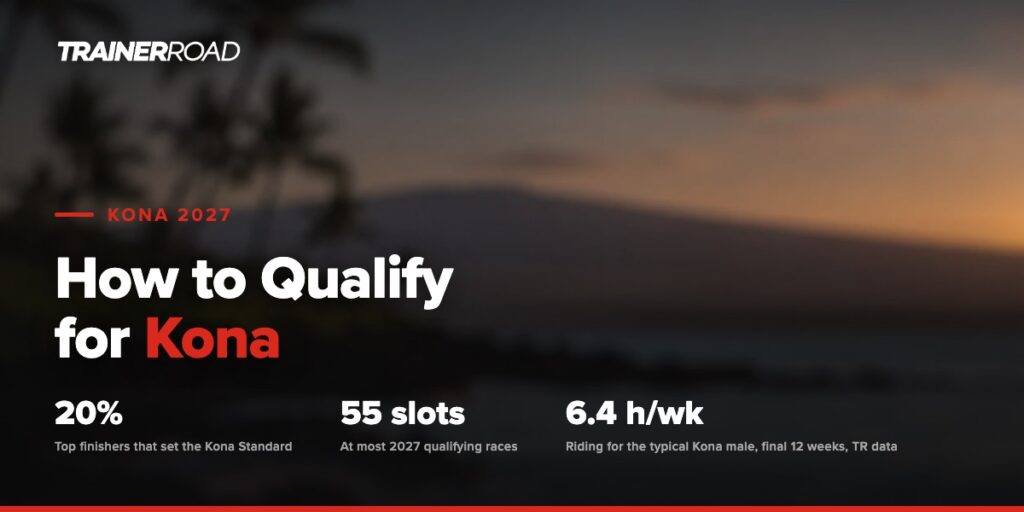
The typical Kona male in our data rode 6.4 hours a week in the 12 weeks before the race, compared with 3.2 hours for active TrainerRoad athletes. The typical Kona female rode 6.3 hours a week, compared with 2.7. They also ran about 3.3 hours and swam about 2.2 hours a week, which puts the whole training week at roughly 12 hours. The run and swim figures only count sessions synced to TrainerRoad, so the real numbers are probably a bit higher. Their FTP went up only about 3% over the year, so they were already strong when the year started. What changed over the year was how much they rode.
Those numbers come from a filtered sample of TrainerRoad athletes with a race-day file at Kona, about 1 in 10 of the field, compared with active TrainerRoad athletes who rode in at least 9 of the same 12 months. These numbers are not a prescription. They are what the people who got there actually did.
The biggest difference is how much they rode, and the final 12 weeks show it best. Kona males rode 6.4 hours a week across 3.4 rides, compared with 3.2 hours across 2.3 rides for active TrainerRoad athletes. Kona females rode 6.3 hours a week across 3.0 rides, compared with 2.7 hours across 2.1 rides. On top of the riding, both groups ran about 3.3 hours a week. Swim time ranged from under an hour to almost 7 hours a week, but the average athlete was at about 2.2 hours. Only sessions synced to TrainerRoad are counted, so the real run and swim numbers are probably a bit higher.
The year before Kona
How Kona athletes trained, compared with active TrainerRoad athletes
Kona athletes rode about twice the hours of active TrainerRoad athletes in the final 12 weeks before the race.
Each bar is a weekly average over the 12 weeks before race day, taper included. Kona athletes here are a filtered sample of TrainerRoad athletes who synced a race-day file from Kona, about 1 in 10 of the field. Active TrainerRoad athletes are the comparison group, meaning those who rode in at least 9 of those 12 months.
Kona males were riding about 3.5 hours a week a year out from the race. By the last two months before Kona they were up to 6 to 6.5 hours a week, and then they tapered in the final month. Kona females dropped to about 2.5 hours a week in midwinter and were up to about 6.5 hours a week in the second-to-last month. Active TrainerRoad athletes did the opposite. They rode the most in summer, about 4 hours a week, and were under 3 hours a week by October. Switch between men and women below to see how the two groups split apart.
The qualifying year
How Kona qualifiers build toward race day
How many hours a week each group rode, month by month, over the year before Kona. Filtered sample of TrainerRoad athletes.
Bike hours a week
6.4h
final 12 weeks; active TrainerRoad athletes rode 3.2 h
Swim hours a week
2.2h
final 12 weeks, synced swims only
Rides a week
3.4
final 12 weeks; active TrainerRoad athletes did 2.3
Run hours a week
3.3h
final 12 weeks, synced runs only
Kona athletes here are a filtered sample of TrainerRoad athletes who synced a race-day file from Kona (men from 2024, women from 2025), about 1 in 10 of the field. Active TrainerRoad athletes are the comparison group, meaning those who rode in at least 9 of the same 12 months. This shows what each group did, not what caused it.
View as table
| Month | Kona athletes | Active TR athletes |
|---|---|---|
| 11 months out | 3.4 h | 2.5 h |
| 10 months out | 3.5 h | 2.2 h |
| 9 months out | 4.5 h | 2.8 h |
| 8 months out | 4.9 h | 3.0 h |
| 7 months out | 5.1 h | 3.1 h |
| 6 months out | 5.8 h | 3.7 h |
| 5 months out | 5.5 h | 3.9 h |
| 4 months out | 5.6 h | 3.8 h |
| 3 months out | 6.1 h | 3.9 h |
| 2 months out | 6.1 h | 3.5 h |
| 1 month out | 6.6 h | 3.2 h |
| Race month | 6.2 h | 2.7 h |
Bike hours a week
6.3h
final 12 weeks; active TrainerRoad athletes rode 2.7 h
Swim hours a week
2.2h
final 12 weeks, synced swims only
Rides a week
3.0
final 12 weeks; active TrainerRoad athletes did 2.1
Run hours a week
3.3h
final 12 weeks, synced runs only
Kona athletes here are a filtered sample of TrainerRoad athletes who synced a race-day file from Kona (men from 2024, women from 2025), about 1 in 10 of the field. Active TrainerRoad athletes are the comparison group, meaning those who rode in at least 9 of the same 12 months. This shows what each group did, not what caused it.
View as table
| Month | Kona athletes | Active TR athletes |
|---|---|---|
| 11 months out | 3.6 h | 2.2 h |
| 10 months out | 3.1 h | 1.8 h |
| 9 months out | 2.5 h | 1.8 h |
| 8 months out | 3.6 h | 2.1 h |
| 7 months out | 4.2 h | 2.2 h |
| 6 months out | 5.1 h | 2.8 h |
| 5 months out | 4.7 h | 3.0 h |
| 4 months out | 4.9 h | 3.0 h |
| 3 months out | 5.8 h | 3.2 h |
| 2 months out | 5.8 h | 2.9 h |
| 1 month out | 6.7 h | 2.7 h |
| Race month | 6.0 h | 2.4 h |
Qualifiers were already strong a year out. What changed was how much they rode, not their FTP
The typical Kona male held 3.6 W/kg before the race, compared with 3.0 for active TrainerRoad athletes, and the typical Kona female held 3.4 W/kg, compared with 2.6. That puts both at or above the 80th percentile for power to weight, stronger than about 80% of athletes. That power shows up as speed on the road. Both sit at the 88th percentile for outdoor speed, faster than almost 9 in 10 active TrainerRoad athletes.
Their FTP barely moved during the year. Among Kona males with an AI FTP Detection near the start and the end of the year, the typical change was about +3%, compared with about +2% for active TrainerRoad athletes measured the same way. The year before you qualify is about riding more on top of fitness you already have, which is also what Norman Banick described about his 9:11 at Kona. If your FTP is a long way below 3 W/kg today, the work to raise it comes first, and it can take more than one season.
A third of the riding was indoors
Kona males rode 35% of their hours indoors, compared with 22% for active TrainerRoad athletes, and Kona females rode 28% indoors, compared with 19%. The year is mostly outdoors for everyone, but qualifiers kept a bigger share of their riding on the trainer than active TrainerRoad athletes did. Just under half of the Kona males did at least one TrainerRoad workout during the year. The sample includes people who do not subscribe, so it cannot say whether qualifiers train with more structure than anyone else, only that a lot of them did a good share of their riding indoors.
Kona qualifiers rode about twice the hours of the typical athlete in the final 12 weeks before the race. TrainerRoad builds those hours into your plan and adds to them as you get fitter.
Build Your Qualifying YearHow should you train to qualify for Kona?
Build the riding hours and the run off the bike, keep the weekday riding structured, and arrive at race week used to the heat with a pacing plan you have rehearsed. The data above says qualifiers rode about twice the hours of everyone else in the final 12 weeks, so that is where your year should go.
Build the hours steadily. Kona athletes averaged more than 6 hours a week on the bike in the final 12 weeks, and the build toward that started months earlier. If you ride 3 hours a week today, add time gradually and hold each step for a few weeks before the next one. Dynamic Endurance grows your endurance rides over time, and riding them steady matters as much as riding them long.
Run off the bike, and keep swimming. Qualifiers ran about 3.3 hours a week and swam about 2.2 hours a week in the final 12 weeks, and their longest run of the year was the marathon itself. Your ranking is your whole-day time, and a strong run off a steady bike is where a lot of age-group time is won or lost.
Keep the bike structured when time is short. A third of qualifiers’ riding was indoors, and that is where the midweek work gets done. Those sessions raise the power you can hold, so your endurance rides get faster at the same effort. Hard Work Pays Off is a good example of an IRONMAN Wisconsin bike split built on indoor weekday training, and structured training is a reliable way to raise your W/kg.
Prepare for the heat. Your qualifying race may be cooler than Kona, but it can still be hot, and heat training is one of the cheapest gains you can get in the last few weeks before either race. Ray Brenkus walked through the heat protocol he used in his qualifying year.
Pace the bike for the run. Athletes in our race-day data ride full-distance bike legs at about 70% of FTP, Kona included, because a marathon follows. Build a pacing plan around that number and rehearse it on the long rides, so the only decision on race day is to stick to it.
Pick a race that suits you. If you pace evenly and run well, pick a flat course. If the bike is your strength, pick a hilly one. And if you can win your age group somewhere, that is your race.
If you want help with the bike part, tell TrainerRoad which race you are doing and how many hours you have. It builds the year, picks every workout, and adjusts as you get stronger. The full-distance triathlon plans include the long rides, with the run and swim sessions around them.
Build the bike fitness a Kona slot takes. TrainerRoad plans your training around your qualifying race and your hours, picks every workout, and adjusts as you get stronger.
Check Out TrainerRoadFrequently Asked Questions
How hard is it to qualify for Kona?
A typical qualifying race gives out 45 to 55 age-group slots to a field of a few thousand, so qualifiers are roughly the top 2% of the race. In a filtered sample of TrainerRoad athletes who raced Kona, the typical man held 3.6 W/kg and the typical woman 3.4 W/kg, and both rode outdoors faster than almost 9 in 10 active TrainerRoad athletes. Age groupers have reportedly raced close to four full-distance events on average before they qualify.
What is the Kona Standard?
The Kona Standard is the set of factors IRONMAN uses to compare finish times across age groups and genders. Each factor comes from the top 20% of Kona finishers in that age group over a rolling five years, with men 30-34 and women 30-34 each as the reference at 1.0000 for their gender. Your finish time multiplied by your factor is your age-graded time, which is what the Performance Pool ranks.
Do you still get a Kona slot for winning your age group?
Yes. Every age group at a qualifying race has one automatic slot, and the winner gets it. If the winner declines, it rolls to second place and then third. Beyond that it goes into the Performance Pool rather than rolling further down the age group.
What happens if the age-group winner declines their Kona slot?
The slot is offered to second place, then to third. If all three decline, it is added to the Performance Pool for that gender and goes to the next athlete on the age-graded ranking. The slot never rolls to fourth place in the age group.
Can you qualify for Kona at a 70.3?
No, with one reported exception. 70.3 races qualify you for the IRONMAN 70.3 World Championship, which has its own 70.3 Standard and its own race, reported for Chattanooga in August 2027. The one exception is IRONMAN 70.3 Hawaii, which carries slots for that year’s Kona. In 2026 it had 28 of them.
Is there still a Kona lottery?
No. The public Kona lottery ended in 2015 and there is no lottery for 2026 or 2027. The remaining routes besides qualifying are the Legacy program for athletes with 12 or more full-distance finishes, the PC/ID Open draw for athletes with a disability, IRONMAN Foundation auction and fundraising entries, a resident draw for people who live in Hawaii, and the paid Xclusive Challenge.
Where do you check the rules for Kona 2027?
Check ironman.com. The qualifying page carries the Kona Standard, the slot counts, and the Legacy and Foundation details, and each race page lists its slots and ceremony time. If something you need is not posted yet, or your situation is not covered, contact IRONMAN athlete services directly rather than relying on forum reports, including this guide.
How much does it cost to race Kona once you qualify?
The entry fee for Kona 2026 was $1,834.33, paid at the slot allocation ceremony when you accept the slot. The 2027 fee has not been announced, so check ironman.com for the current figure. On top of that come flights to Hawaii, accommodation at race-week rates, bike shipping, and food for a week or more on the island. If you live outside the US, the exchange rate adds to all of that.
How many hours a week do you need to train to qualify for Kona?
In a filtered sample of TrainerRoad athletes who raced Kona, the typical man rode 6.4 hours a week and the typical woman 6.3 hours a week in the 12 weeks before the race. They also ran about 3.3 hours and swam about 2.2 hours a week, so the whole week came to roughly 12 hours. Only synced sessions are counted, so the run and swim numbers are probably a bit higher.
- IRONMAN press release, July 2, 2025, via Endurance Sportswire: the performance-based system and first-to-accept roll-down.
- Slowtwitch, July 2025: automatic slot roll-down to third, the Performance Pool definition, the top 20% rolling five-year benchmark, and the full Kona Standard table.
- Slowtwitch, November 14, 2025 and opinion follow-up: separate men’s and women’s pools and the 50-slot example.
- Triatlón Noticias, October 5, 2026: the 2027 qualifying race list with slot counts, the 2027-dated races pending, and the in-person ceremony requirement.
- TriRating Kona 2027: the October 9, 2027 date, pro slot estimates, and champion slots. Triathlon Magazine Canada: 56 men’s and 55 women’s pro slots in 2026.
- Slowtwitch forum, KQ 2026 Performance Pool thread and Hamburg thread: reported age-graded cutoffs at Copenhagen, Thun, and Hamburg.
- Hopper Sports Performance: the worked roll-down example and the top-three-decline rule.
- Brightstar Events and CT Heat: Legacy program rules, the $50 application fee, and validation.
- iRace: PC/ID Open draw, the end of the lottery, and Team IMF fundraising.
- Slowtwitch, 2026 Laulima Auction: auction bids and Buy Now prices.
- Kauai Now, October 4, 2026 and Triatlón Noticias: the Kona 2026 field of 2,548 athletes, 85 countries, and 110 pros.
- Slowtwitch, Ryan Heisler, July 2025: how course type shifts who the Performance Pool favors.
- Reported, not verified against a primary source: the 2027 70.3 Worlds date (TRI247), the 400 Legacy athletes in 2024 (a participant’s report), handcycle qualifying at three 70.3 races (Triatlón Noticias), the 15-slot Hawaii resident draw (iRace), and the historical 25 Xclusive Challenge slots (Triathlete).