Monitor last night. Felt really good throughout and tacked on some endurance miles at the end.
I know miles don’t necessarily mean anything because I’m on the trainer, but wouldn’t it be nice if TR would give you an approximate mile count throughout the workout? Seems like it would be a nice metric to use to help establish weekly mileage goals if you have those.
Sustained Power Build week 1 crunched into 4 days and dropped Fletcher. Round Bald was pretty tiring to get through but got there. Time to go freeze my butt off at an avalanche safety course for the weekend!
I did my best to match flywheel speed from ERG to RES modes. I did end up shifting in the RES mode to hit the power. This also lead to slight difference in cadence, but not terribly much.
A) Definitely easy to see the High Flywheel Speed leads to much more power data fluctuation.
B) Also possible to see that if you are steady on cadence (I was most of the time with a 3 watt range once I settled into each step), you can really keep the power smooth in RES, possibly smoother than ERG, at least with Lower Flywheel Speed.
I have Tunnabora tomorrow and may try some more versions like this.
If you link your TR account to Strava or Garmin Connect it will display miles/kilometers for indoor rides.
You could mark them private on those platforms if you’d rather not post the workouts on it.
It doesn’t help with the milage while you are doing the workout, but you can keep track of it afterwards.
Kaweah today, had the misfortune of having the TR android app shutting down by itself (no error message or anything) just when I was about to finish the second to last interval:
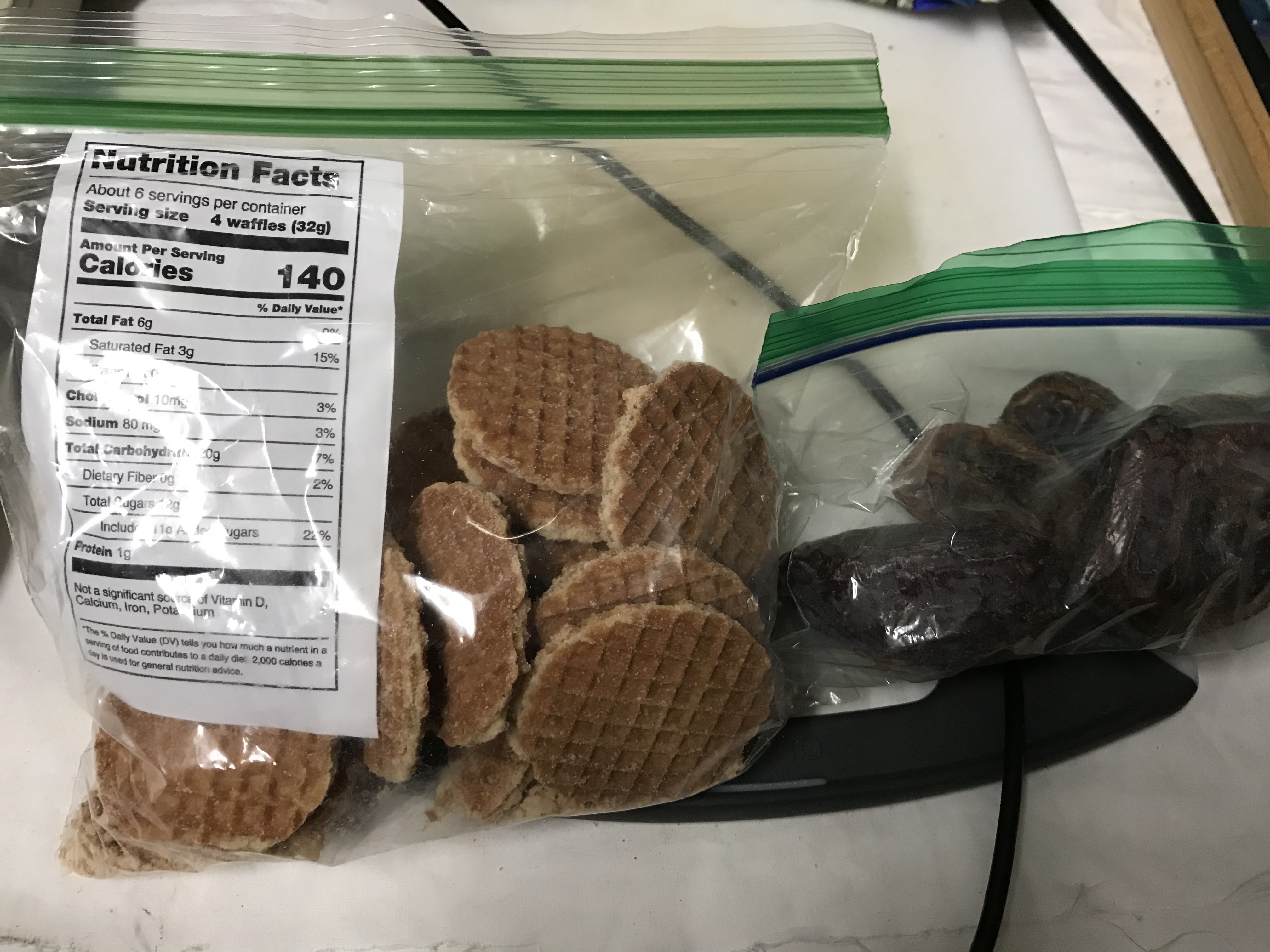
Pretty tasty although I have to admit to losing my sweet tooth. Five years ago I would have inhaled the entire bag in about 20 seconds. I’m really digging the Medjool dates.
I used to have cliff bars on the bike, but it got just too expensive. I can buy 10 stroopwaffels for the price of 1 cliffbar.
Looking at the labels (energy wise) two waffles make about one cliffbar. Although cliffbar is lower in fats and will mostly likely be cleaner in terms of less added stuff than the waffles.
I actually opt now for sea salted caramel stroopwaffels, the original ones are too sweet for me on the bike
Yeah, partly. I did it spurred by the resurgence of the ERG vs RES discussion, and my general interest in learning more about how this all works.
I had that in mind during the warm up, and hatched it in the very moment. Figured out the RES setting that allowed the same gearing to match my ERG cadence to try and match variables reasonably close.
Then after the first interval, I realized I could do double duty to see what flywheel speed would do. This was all very quick and in the moment, but I tried to balance things like flywheel speed, cadence and my usual standing breaks as evenly as I could.
Finding the right RES setting to hit the gearing was a challenge and messed up the start of some intervals, but the last half of each set is pretty dialed for off the cuff implementation.
I am just playing with variables in a pseudo-attempt to control them and see the impact.
Sure possible to see the variability in power data via flywheel speed changes. I should load a real power meter on for some of these workouts to see what it picks up vs the trainer. We have seen some interesting data reported from Shane and Tariq, that show deviation from “real” power as the speeds increase. No idea if it’s a problem with my Kickr17, but it follows the trend we see in the other trainers (Neo, Hammer).
I would guess that is true for flat road and dealing with variable wind. I wonder about things like longer and mild climbs, if those tend to be more stable? I’d need to filter through some ride data from last year. I have a several hour climb with sustained pitches in the 3-5% range, but wind can be an issue there too.
Yeah, always interesting.
I am trying to determine that for me. I do a fair bit of gravel and MTB riding, and I am a light road rider (66kg), so I think I have a lower overall inertia in my outside riding than some larger riders, or ones that ride mainly smooth road.
This is one of those things that is likely to vary with all the rider type, and possibly trainer variation (flywheel effectiveness in particular).
Agreed. It would be need to see studies with real control evaluation. I doubt it would make much difference unless you end up with large percentage devaition, while holding to an identical average.
Wattage swings around 5% or less (totally wild guess) are probably non-issues and lead to the same as a steady load.
I wonder where it could lead to issues if you had larger differences? Coupled with that would be the timing of those swings, along with the magnitude. At some point, it could lead to at least more rider fatigue, even if the resulting strain and adaptations matched.
But with this workout, I doubt I would see any differences.
My goal in low flywheel speed was never about “smooth” graphs for flat power. As seen above, I nailed some of the RES mode sections with less deviation than the ERG versions. I can do the same anytime I am willing to devote the attention to do so.
But I like the partial freedom of ERG to not pay attention to that degree all the time, and still get a reasonable deviation that I trust is getting me the stress I need.
For me, it is an attempt to mimic my outdoor riding conditions more closely. As mentioned, I believe I am a low inertia ride for a couple of reasons. As such, I try to train with that in mind.
I do mix in high and low speed work, depending on the time of year, events on the horizon and in attempt to keep my body guessing a bit.
All that said, it would be awesome if trainer makers would provide the data so we could compare a given gearing / flywheel speed to our own body weight, and potentially a range of road pitches (0% to 20% in 2% steps), so we could more accurately consider what is the closest for our needds.
Right now, I am guessing and going on some rough assumptions about what it “feels” like.
Having said that, and considering I started my ERG life in the big ring, I found some serious issues with super steep and long climbs. After hearing Jonathan and Nate discuss the whole inertia thing, I did a ton of playing at the time (CycleOps PowerBeam Pro initially, then the Hammer) to see what the range of gearing felt like.
I settled on the lower gearing (small ring, mid-cassette) and have had much better luck with the punchy steep stuff, as well as the longer gravel grinder climbs that we have around here.
And I am still happy with my flow and speed on the road stuff, especially with my Duathlon bike legs, that I can seem to really nail in the last 2-3 years since using low speed more often. I’d guess I am a 75% low, 25% high flywheel speed in the mix of my training.
I like it fast sometimes too. The RPE and even HR were likely lower in the last 2 intervals. I should have had more fatigue at those points and likely see a higher HR in similar efforts with just low speed. But I suspect finishing with that “helped”.
I plan to try and test that by starting in high speed in future tests, and finish with low speed.
All in all, no concrete conclusions, but some things that may be shedding a light on things I can leverage for my needs. Just figured it might be interesting for others too
And overall, I do expect just about any outside activity is bound to be more variable. Potential influences from wind, road conditions and such are going to lead to those peaks and valleys.




 and don’t understand using low flywheel speed on inside rides to keep power (unnaturally) smooth