Sorry its Friday and I’m feeling a little lazy, will you or @Dr_Alex_Harrison help me a bit on the math and my logic chain? Lets use this recent Two Hour Tuesday with some guesses on carbs from Xert/INSCYD:
- 2:03:06 duration
- 184W avg power, 188W normalized
- Xert: about 200g carbs
- INSCYD: about 170g carbs
Because I’d like to use that as a baseline for thinking thru longer 3 and 4 hour endurance workouts. And yeah, endurance workouts use less carbs than races and longer sweet spot / threshold workout sessions.
Ok so Xert and INSCYD ballparks are in the same field, lets use 200g to make it simple.
Which then leads me to consider what was on-board before starting. What about muscle/liver glycogen stores, assuming they are topped off pre-ride? I’m 90+kg with relatively good 8+ hour/week aerobic fitness for my age, and eat a high carb diet. Something like this:
- roughly 700g muscles
- roughly 100g in the liver
right?
But for muscles that’s whole body stores.
Cycling uses less active muscles, and I don’t know how to estimate the amount of muscle in my legs. So I’m gonna ballpark it at 400g based on some random reading of INSCYD.
So if my leg muscles have 400g, and I burn 200g from muscle stores during the 2 hours, that’s half still in my muscles. That’s the no fueling during ride scenario (ignoring glycogen from liver), right?
Going to back to the study now, I don’t know my gas exchange threshold or respiratory compensation point. So I want to roughly translate that to % IF so I can possibly use it. In the study, 3 hour power was at 95% GET. Lets be sloppy and use 328W average RCP as roughly FTP (its not), and exercise was performed at average of 256W. So that’s roughly a 78% IF, really really rough the exercise was 3 hours at low tempo. Right?
Well 256W for an hour would be a good day for me, a really good day would be 270W for an hour. Three hours? That’s more like 175-200W and 65-75% IF. This year I’ve had some strong 2 and 3 hour endurance training efforts around 75%. So roughly similar intensity as the study, not the same absolute energetic requirements but assuming some linearity I might be able to use some ratios for a rough broadside approximation for myself.
So again, going out on a limb, lets assume at 75% my ratios of exo/endo carb oxidation would be vaguely similar to those in the study:
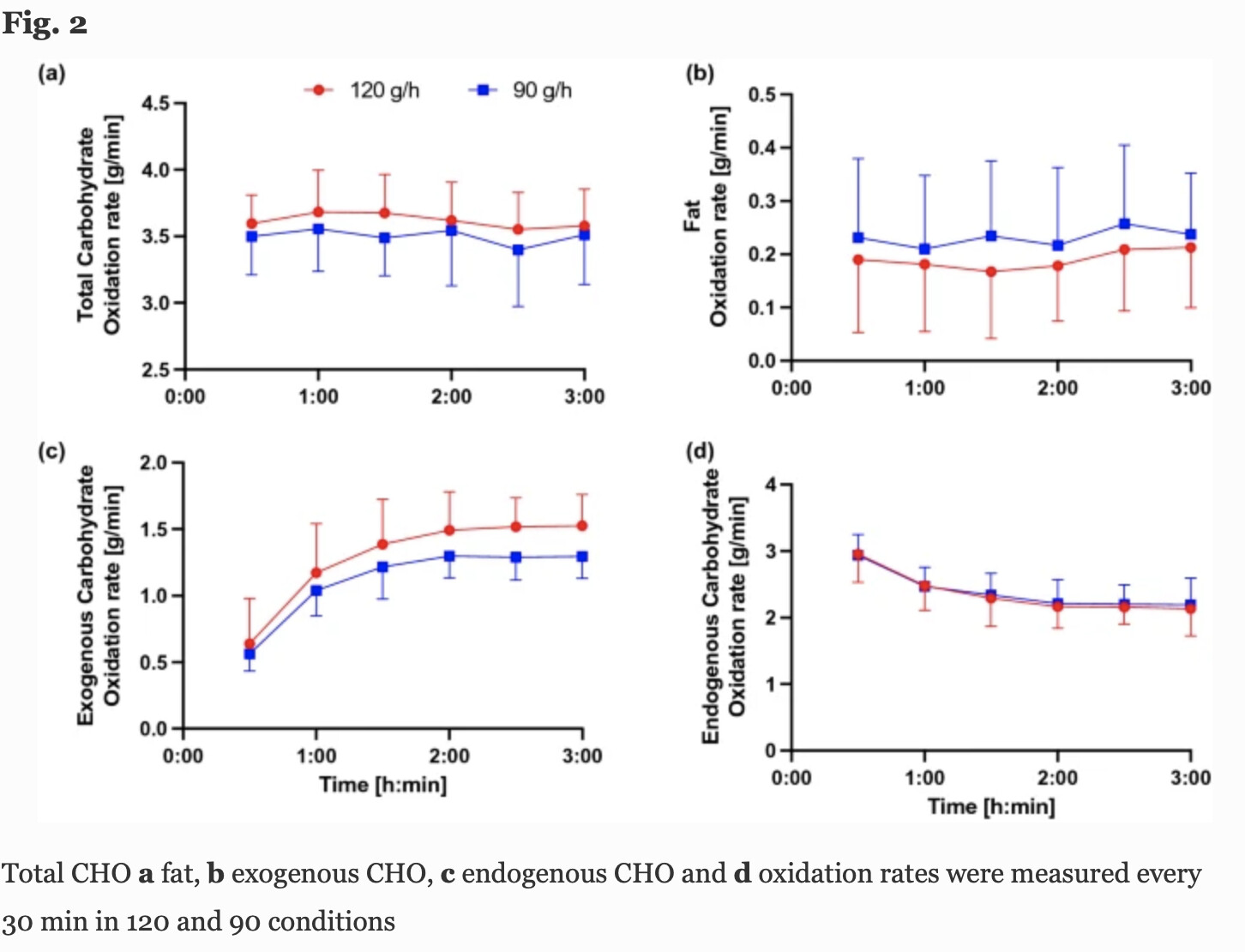
Again those cyclists have higher vo2max and absolute power, burning a bit more absolute, but since they were lower tempo and I was at zone2/tempo border humor me that the ratios might be considered a ceiling for my effort.
So from the study graph I posted above, lets ballpark my endogenous carb oxidation rate at 2g/min, or 120g/hour. So for 2 hours that would be 240g. Clearly that starts to empty the tank - the 400g stored in muscles at start. And it gets dicey at 3 hours for sure.
Going with these admittedly pseudo random ballpark numbers, what’s to gain increasing from 60g/hour Roctane (not sure of ratio) to 120g/hour carbs at 4:5 fructose-to-glucose (0.8:1) ratio?
Also, one thing I did not see considered in the article is recovery (replenishing stores). Just being captain obvious, and seems like a much harder thing to quantify.