How Many Hard Days a Week? Two vs. Three for Cyclists
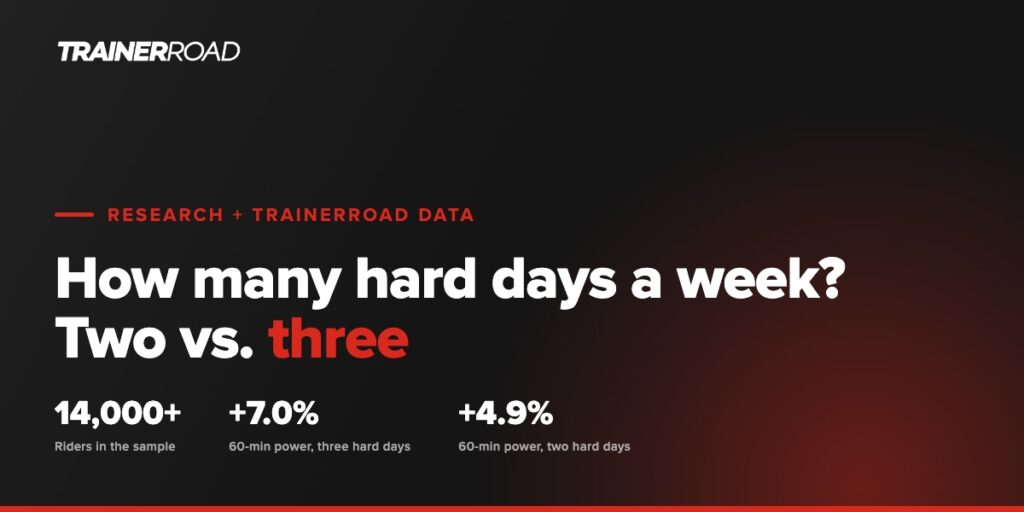
If you ride about five hours a week, three hard days a week looks like the better choice. In a filtered sample of more than 14,000 TrainerRoad riders, riders who did three hard days a week improved their 5- to 60-minute power more than riders who did two. Their 60-minute power went up 7.0%, compared with 4.9% for riders on two.
Both groups got faster. The gap was biggest for riders under five hours a week and riders in their 20s, and smallest for riders in their 50s and riders over 10 hours a week. A hard day here means a day with a completed sweet spot, threshold, VO2 max, or anaerobic workout.
Where Does the Two Hard Days Rule Come From?
Two hard days a week is standard for pros, and it’s commonly recommended for masters riders. The advice comes from two places: how elite endurance athletes train, and the idea that older riders need more time to recover.
The elite part comes from athletes who train 15+ hours a week. The best-known study looked at Olympic and world champion cross-country skiers and biathletes. They did about two hard workouts a week for most of the year and added a third only in the last two weeks before a peak race.
Those athletes differ from you in two ways. They train about three times as many hours, and they do a different sport. Cross-country skiing uses your arms and legs together, so what works for a skier doesn’t carry over to cycling one for one.
The masters part makes sense on its face. Recovery changes as you age, so masters riders need to watch it closely. That still doesn’t tell you how many hard days a masters rider can recover from.
Does the 80/20 Rule Work on Five Hours a Week?
Not the way it works for elite athletes. The two hard days rule goes with polarized training, the idea that about 80% of your training should be easy and 20% hard, or 90% and 10%. Those splits come from athletes training 15+ hours a week.
Here is what those splits look like in hours. The skiers did about 1.3 hours of hard training a week, close to a 90/10 split. At 15 hours a week, 90/10 is 13.5 hours easy and 1.5 hours hard. The same split on 5 hours a week is 4.5 hours easy and 30 minutes hard. At 80/20, it’s 4 hours easy and 1 hour hard.
The math
The same split on fewer hours
A 90/10 split gives an elite athlete 1.5 hard hours a week. For an average rider on 5 hours a week, it gives 30 minutes.
Bars share one scale, 0 to 15 hours a week.
Thirty minutes of hard riding isn’t the best use of five hours. The elite athlete gets a lot of fitness from 13+ easy hours. You don’t have those hours, so copying their split leaves you with little of either.
Fewer hours also means less to recover from. A 15-hour week is a lot to absorb, so hard days have to be rationed. On five hours a week, you can recover from more hard work. In the TrainerRoad sample, riders on two hard days spent a little over a third of their riding time in hard workouts, and riders on three spent about half.
Why Would a Third Hard Day Make You Faster?
A third hard day gives your body one more push to adapt each week. A hard workout sets off a lot of changes in your muscles, and one of the most important is a signal called PGC-1α. It tells your muscle cells to build more mitochondria, the parts of the cell that use oxygen to make energy. In one study, PGC-1α rose more than tenfold within about four hours of a hard interval workout and was back to baseline by the next day.
That signal is short, so your fitness comes from repeating it. Three hard days send it three times a week instead of two. A third hard day doesn’t have to mean riding more. You can turn one easy ride into a hard one.
In a study of 78 healthy adults, the more often people trained, the more of them improved. They trained one to five times a week for six weeks. On one workout a week, 69% did not improve on a ramp test. On three, 29% did not. On four or five, everyone improved. Those were untrained adults on a short program.
You still need time to recover between hard days, because recovery is when your body builds the fitness. You can’t do five hard days a week for months and keep improving. You would build up fatigue, plateau, and then get slower. The right number of hard days is the most you can recover from.
What Does the Research Say?
The research leans toward three hard days on limited hours. Studies where athletes did three hard workouts a week on modest hours kept producing gains, often 5 to 10% in VO2 max or 40-minute power over 6 to 12 weeks.
The few studies that compared two and three directly used runners and active adults, and they found the two close. In one, VO2 max rose about 9% on two hard workouts a week and about 11% on three, too small a difference to be sure of. Two hard days also works for highly trained cyclists who ride high mileage.
None of these studies compared two and three hard days in trained cyclists riding 4 to 8 hours a week. The TrainerRoad data helps fill that gap.
Do Three Hard Days Make You Faster?
In this sample, yes. Riders who did three hard days a week improved their power more than riders who did two at every duration from 5 to 60 minutes. The gap was biggest at 60 minutes: 7.0% compared with 4.9%. You can check your own power at each of these durations in Power Records.
TrainerRoad data
How much power went up, two vs. three hard days a week
Both groups got faster. From 5 minutes up, riders on three hard days improved more, most of all at 60 minutes.
Median increase in power at each duration. Bars share one scale, 0 to 10%.
Riders on three hard days also rode slightly more hours and started slightly fitter. After accounting for age, starting power, and hours, the gap was still about 1 point at 5 minutes and 2 points at 60 minutes. More of them improved, too. At 60 minutes, 70% beat their best from before the plan, compared with 65% of riders on two.
One-minute power was the exception. Both groups improved about the same, and once age, starting power, and hours were accounted for, riders on two hard days came out slightly ahead. A one-minute PR needs fresh legs, and three hard days a week leave fewer fresh days to set one.
Does It Depend on How Many Hours You Ride?
Yes. The fewer hours riders had, the bigger the gap. Under five hours a week, 60-minute power went up 8.6% on three hard days, compared with 5.8% on two.
TrainerRoad data
How much 60-minute power went up, by hours a week
The fewer hours a week riders had, the bigger the gap between three hard days and two.
Median increase in 60-minute power. Bars share one scale, 0 to 10%.
Between five and ten hours a week, it was 6.0% compared with 4.3%. Over ten hours a week, the gap was small at most durations. That group is small, so read it as a direction.
That doesn’t mean riding fewer hours makes you faster. Riders under five hours a week improved more on two hard days as well, probably because they had more room to improve. The number to look at is the gap between two and three hard days for riders on the same hours.
On a few hours a week, hard workouts are most of what your body has to adapt to, so a third one adds a lot. On 10 or more hours, your aerobic base and easy riding, including Zone 2, already do more of the work. If you’re short on time, this is where the third hard day paid off most.
Should Masters Riders Stick to Two Hard Days?
Possibly, but this data doesn’t rule out three. Riders in their 40s and 50s on three hard days improved more than riders on two. The gap was smaller for older riders. It was biggest for riders in their 20s and smallest for riders in their 50s.
TrainerRoad data
How much 60-minute power went up, by age
Riders on three hard days improved more in every age group. In the 50s, the gap was about 1 point.
Median increase in 60-minute power. Bars share one scale, 0 to 10%.
At 60 minutes, riders in their 40s improved 7.4% on three hard days, compared with 4.9% on two. Riders in their 50s improved 5.0%, compared with 4.0%. The 50s group on three hard days is small, so that number is less certain.
This sample can’t tell you why the gap was smaller for older riders. Slower recovery is the likely reason. If you’re a masters rider, space your hard days at least 48 hours apart and back off if hard workouts start failing.
Is Three Hard Days a Week Too Much?
For the riders in this sample who did it, no. Riders on three hard days completed about 26 hard workouts during their plan, compared with 19 for riders on two. Both groups failed hard workouts at the same rate, about 2%, and riders on three hard days skipped fewer workouts.
Two hard days a week
Riders on two
- Hours a week
- 4.8
- Hard workouts completed
- 19
- Hard workouts failed
- 2%
- Workouts skipped
- 2.4
Three hard days a week
Riders on three
- Hours a week
- 5.0
- Hard workouts completed
- 26
- Hard workouts failed
- 2%
- Workouts skipped
- 1.3
Hours a week are medians. Workouts completed and skipped are averages per rider over the plan. Failure rate is across each group’s hard workouts.
These are riders who kept up three hard days. Riders who struggled with three and dropped back would be counted in the two hard days group. So the data shows that three hard days worked for riders who could recover from them.
Extra hard days go wrong when you add them without taking anything away. If your third hard day goes on top of an already full week, with no easy ride swapped out and no extra rest, you pile up fatigue and stop improving. That is how overtraining starts.
How to Add a Third Hard Day
Turn one easy ride into a hard one, space your hard days about 48 hours apart, and make the third one the easiest of the three.
- Swap an easy ride for it. Your week doesn’t get any longer. Riders on three hard days in this sample rode only about 12 minutes a week more than riders on two.
- Space them 48 hours apart. Tuesday, Thursday, and Saturday works. Ride easy or rest in between.
- Make the third day sweet spot or threshold. It still counts as a hard day, and it takes less to recover from than another VO2 max day.
- Watch for two warning signs. Hard workouts you fail or cut short, and still feeling tired 48 hours after a hard day. If either lasts two weeks, go back to two.
Stick with two hard days if you ride more than about 10 hours a week, if sleep or stress is cutting into your recovery, or if you’re new to structured training. Add the third once two feel routine and you’ve stopped improving.
Frequently Asked Questions
How many hard days a week should a cyclist do?
If you ride about five hours a week, three hard days a week looks like the better choice. In a filtered sample of TrainerRoad riders, riders who did three hard days improved their 5- to 60-minute power more than riders who did two, and the gap was biggest for riders under five hours a week. Over ten hours a week, the gap was small.
Should masters cyclists do two or three hard days a week?
Two hard days may be the right call for some masters riders, but the data doesn’t rule out three. In a filtered sample of TrainerRoad riders, riders in their 40s and 50s on three hard days a week improved their 60-minute power more than riders on two. The gap was smaller than for younger riders, about 1 point in the 50s compared with almost 4 points in the 20s. Masters riders should space hard days at least 48 hours apart and back off if hard workouts start failing.
Does sweet spot count as a hard day?
Yes. In the TrainerRoad data behind this article, a hard day meant a completed sweet spot, threshold, VO2 max, or anaerobic workout. Sweet spot is also a good choice for a third hard day, because it takes less to recover from than another VO2 max workout.
How much rest do you need between hard days?
Plan about 48 hours between hard days, with easy riding or rest in between. A Tuesday, Thursday, Saturday week fits three hard days with 48 hours between each one. If you still feel tired 48 hours after a hard day, give yourself more time.
Does the 80/20 rule work for cyclists who train 5 hours a week?
A strict 80/20 or 90/10 split leaves a rider on 5 hours a week with only 30 minutes to an hour of hard riding. Those splits come from athletes training 15+ hours a week, whose easy hours do much of the work. On 5 hours a week you have less training to recover from, so you can handle a bigger share of hard riding. In a filtered sample of TrainerRoad data, riders on two hard days spent a little over a third of their riding time in hard workouts, and riders on three spent about half.
Do I need to ride more hours to add a third hard day?
No. TrainerRoad riders on three hard days a week rode about 5.0 hours a week, compared with 4.8 hours for riders on two. For many riders, a third hard day means swapping an easy ride for a hard one.
Whether a third hard day pays off comes down to your hours, your age, and how well you recover. TrainerRoad builds your training plan around the days and hours you have, AI Workouts picks the right workout for each of those days, and Fatigue Detection flags when you need more recovery before failed workouts tell you.
Get a plan that fits the hours you have and adjusts when your recovery needs it. Your first 30 days are covered by a money-back guarantee.
Check Out TrainerRoadStudies referenced
- Tønnessen E et al. 2014. The road to gold: training and peaking characteristics in the year prior to a gold medal endurance performance. PLoS One.
- Perry CGR et al. 2010. Repeated transient mRNA bursts precede increases in transcriptional and mitochondrial proteins during training in human skeletal muscle. J Physiol.
- Montero D, Lundby C. 2017. Refuting the myth of non-response to exercise training. J Physiol.
- Helgerud J et al. 2007. Med Sci Sports Exerc. Sylta Ø et al. 2016. Med Sci Sports Exerc. Paquette M et al. 2017. Scand J Med Sci Sports.
- Zhang et al. 2026. Front Physiol. Lenk et al. 2025. Physiol Rep.
- Laursen PB et al. 2002. Med Sci Sports Exerc.
This is a correlation. Riders chose their own plans, and riders who completed three hard days rode slightly more and started slightly fitter. Accounting for age, starting power, and hours narrows the gap but cannot rule out differences like motivation or recovery. The 50s and over 10 hours groups on three hard days are small, so read those as directions. The research described here comes from small, short training studies, and none compared two hard days with three in trained cyclists on limited hours.