How to Ride Zone 2 Outside: What the Fastest Riders Do Differently
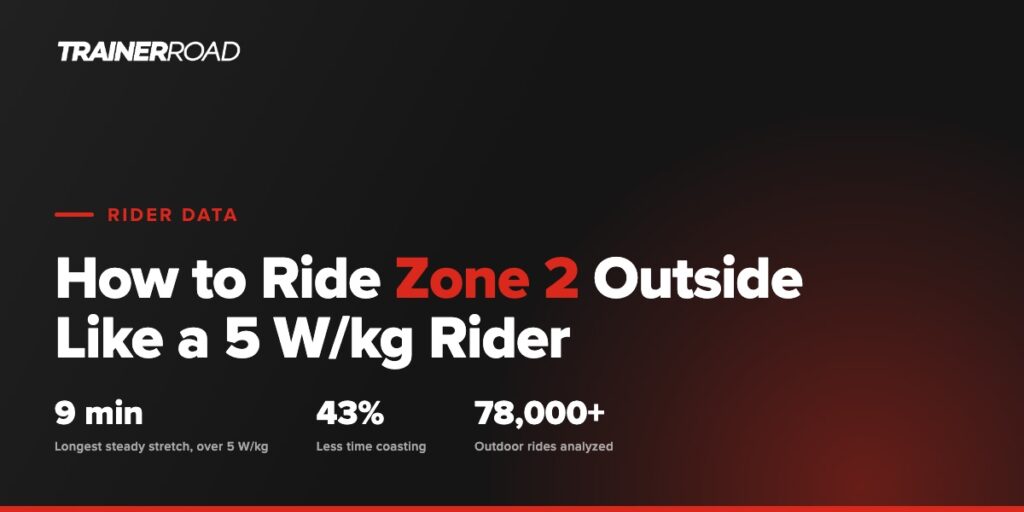
To ride Zone 2 outside like the fastest cyclists, do two things: hold your power steady instead of letting it spike, and keep pedaling instead of coasting. In a filtered sample of 78,000+ long outdoor rides, riders over 5 W/kg held steady Zone 2 power more than twice as long at a time as riders under 2.5 W/kg, and they coasted 43% less.
These were normal rides: 90 minutes or longer, recorded with a power meter, no workout loaded. We read every file second by second and compared riders at the two ends of the power-to-weight range. Steadiness was the clearest difference between the two groups. Better yet, the data shows it is a habit, not a fitness level, which means you can copy it.
What Do Riders Over 5 W/kg Do Differently on Endurance Rides?
They hold their power steady. Riders over 5 W/kg hold unbroken Zone 2 power for 2.19 minutes at a time, on average. Riders under 2.5 hold it for 1.31 minutes, which means their power spikes out of the zone about every minute and a half.
Those spikes add up. On a typical ride, the over-5 group’s longest steady stretch is about 9 minutes. The under-2.5 group’s is about 4. The gap gets even bigger when you look at long stretches: nearly 20% of the over-5 group’s Zone 2 time comes in stretches of five minutes or more. For the under-2.5 group, only about 5% does.
Rider data
How long power holds steady before it spikes
Riders over 5 W/kg hold steady stretches 68% longer on average, and their longest stretches are more than twice as long.
You might wonder if these numbers just mean one group has their FTP set wrong. They don’t. Power fluctuation measures how much your power swings around its own average, and it never touches FTP. The over-5 group’s power fluctuation is 18% lower.
All that steadiness means more training from the same ride. The over-5 group gets 73 minutes of Zone 2 in a typical long ride. The under-2.5 group gets 39, from rides of about the same length.
How Much Does Coasting Matter?
Coasting is the biggest gap we measured between the two groups. Riders under 2.5 W/kg spend 18.4% of a long outdoor ride at zero watts. Riders over 5 W/kg spend 10.5%.
The interesting part: both groups spend about the same share of the ride below Zone 2, roughly 40%. The difference is what they do with that easy time. Fast riders soft-pedal through it. Everyone else stops pedaling. Soft-pedaling keeps easy aerobic work coming in, and it carries you through a short downhill or a corner without breaking the steady stretch you were holding.
Rider data
Share of the ride spent coasting
Riders under 2.5 W/kg spend nearly a fifth of the ride at zero watts. This is the most fixable gap in the data.
Some coasting is unavoidable. Descents, traffic, and stop signs halt everyone’s pedals, and even the over-5 group coasts for a tenth of the ride. But most coasting is a choice, and fast riders make that choice far less often.
Can You Ride Zone 2 This Steadily Without Being That Fit?
Yes. We measured each rider against their own rides, and here is what came out: on their better days, riders under 2.5 W/kg ride about as steadily as riders over 5 W/kg do on a normal day. Their power fluctuation on those better days is 0.37, and the over-5 group’s everyday number is 0.36. Practically identical.
Rider data
Your better days already look like their ordinary days
Each athlete measured against their own rides. Lower power fluctuation means steadier riding.
| Under 2.5 typical day |
Under 2.5 better days |
Over 5 typical day |
Over 5 better days |
|
|---|---|---|---|---|
| Time in Zone 2 | 24.4% | 33.5% | 37.1% | 56.0% |
| Longest unbroken stretch | 2.5 min | 4.2 min | 5.0 min | 11.3 min |
| Power fluctuation | 0.44 | 0.37 | 0.36 | 0.27 |
That table is good news. You already ride steadily on some of your rides. The habit to build is doing it on most of them. The over-5 group gets even steadier on their better days, so there is room to improve at every level. But the everyday gap between the groups comes down to habits, not ability.
How Do You Hold Steadier Power on Your Next Ride?
Pick a flat stretch of road and hold Zone 2 power, 55 to 75% of FTP in the standard power zones, for five minutes without letting it spike. That is one minute longer than a typical under-2.5 rider manages, and it is completely free.
- Soft-pedal instead of coasting. Keep the pedals turning through short downhills, up to stop signs, and after hard efforts. This is the biggest gap between the groups, and it is completely in your control.
- Don’t stare at your current power. Instant power jumps around too much to chase. Set your head unit to 5 or 10 second power, notice how that effort feels, and hold the feeling. Check back in every so often to see if your power has drifted up or down.
- Use the lap button to check yourself. Hit lap, ride for 10 minutes, and hit lap again. If the lap’s normalized power and average power are nearly the same, you rode it steady. The bigger the gap between them, the more you were spiking and coasting.
- Pick roads that let you hold power. Flat roads, steady climbs, and quiet routes make this much easier. Route choice matters more than most riders think.
- Build up over weeks. Start with five steady minutes, then work toward nine, which is what a 5 W/kg rider holds on a normal day. One honest stretch per ride is enough.
- Let a workout set the target. A structured endurance workout gives you a number to hold instead of a vague intention. TrainerRoad’s Outside Workouts send those targets to your Garmin, Wahoo, or Hammerhead.
Frequently Asked Questions
What is Zone 2 in cycling?
Zone 2 is the Endurance zone, 55 to 75% of your FTP. It is easy, fully aerobic riding that builds aerobic fitness while creating very little fatigue, which is why coaches build long endurance rides around it.
Is coasting bad on an endurance ride?
Coasting is not harmful, but it adds up faster than you think. In a filtered sample of 78,000+ long outdoor rides, riders under 2.5 W/kg spent 18.4% of the ride at zero watts, and riders over 5 W/kg spent 10.5%. Soft-pedaling through the easy moments instead of stopping the pedals keeps the aerobic work coming in without adding real fatigue.
How long should a steady Zone 2 effort be on the road?
Aim for at least five unbroken minutes at 55 to 75% of FTP. On typical long outdoor rides, riders under 2.5 W/kg top out around 4 minutes, while riders over 5 W/kg hold about 9. Building from five minutes toward ten is a realistic goal for a season.
Do you need a power meter to ride Zone 2 steadily outside?
A power meter is the only way to measure steadiness precisely, but you can still practice it without one. Ride at an effort where you can speak in full sentences, and focus on even, constant pressure on the pedals. TrainerRoad’s RPE-based Outside Workouts are built for exactly this.
Why is Zone 2 harder to hold outside than on the trainer?
Terrain, wind, traffic, and stop signs all push your power around, so everyone’s power is more variable outside than on the trainer, even riders over 5 W/kg. The difference between riders is the size of the swings. Fast riders let power drift a little. What they avoid is the big spikes and the full stops at zero watts.
Does riding steadier make you faster?
Honestly, this data cannot prove it. It compares riders at one point in time, so it shows that steady riding and high power-to-weight go together, not which one causes the other. What it does show is that slower riders already ride steadily on their better days. Of everything fast riders do, this is the easiest habit to copy, and it costs nothing.
Steady riding will not replace the training that raises your FTP, but it makes every endurance hour you ride count for more. Try it on your next ride: one flat road, five steady minutes, pedals always turning.
Turn steady riding into a plan. TrainerRoad builds your training around your goals and sends structured workouts to your head unit for the road.
Check Out TrainerRoad