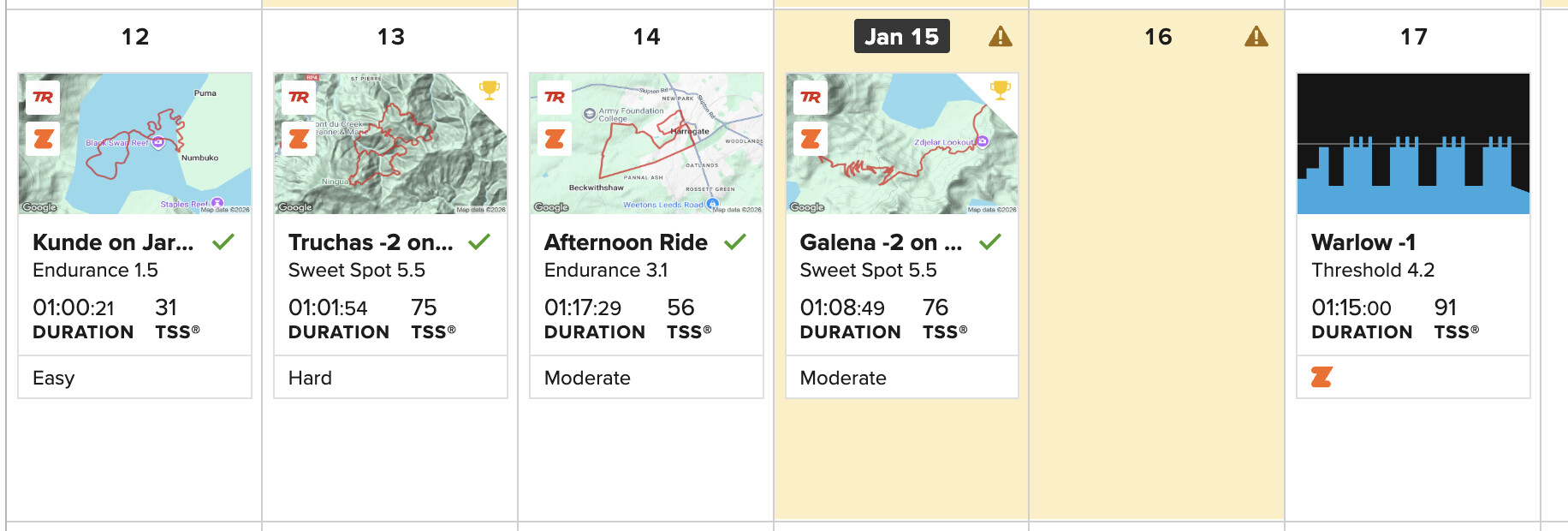
I wish there was some explanation of why an adaptation is recommended. It’s not uncommon for me to complete a scheduled ride ‘as per’ and immediately find that the next scheduled ride has an adaptation. And then, a day or two later when I initiate that next ride, it has yet another adaptation pending.
I can understand the plan changing when I miss a ride, or I decide to change a ride for whatever reason, but oftentimes the adaptations seem fairly random.
I find it difficult to decide whether to accept an adaptation when I’m given no explanation of why it was made.
I got adapted to the same exact workout today and had the same feeling. Eventhough I do my own warmup of about 5 to 6 min before I actually load TR. The TR warmups are just not long enough for me. But like you said I started feeling better and the last repeat didn’t feel that hard. But I have also learned to report it as difficult or else I would get a huge bump in PL on the next ride.
Maybe this has already been asked for but I’m new to this thread and it’s 1300 comments deep…
Anyways, I’m on a plan that has 3 intensity days/week and I do 2 fill in Z2 type rides. This is how my week has gone. Normally I try to not ride more than 3 days in a row to spread out my 2 off days but life happened this week.
Tuesday:
Truchas-2 (SS 5.5) was on Tuesday. Did it and it was hard (rated a hard) and my SS ride on Thursday stayed as Galena-2 (SS 5.5). I didn’t even have a yellow day on Wednesday after completing Truchas-2 on Tuesday.
Wednesday:
Added in a 1:15 endurance ride right at my PL. When I added it to the schedule, Thursday/Galena-2 was still showing white/not Yellow. However, after completing the endurance ride on Wednesday, TR made Thursday yellow and recommended Galena-2 be changed to a Z2 ride or a rest day entirely.
Thursday:
Me being the knucklehead I am, I still did Galena-2 anyways and it was actually a Moderate for me.
Feature Request:
When I add a Z2 ride like I did on Wednesday, it would be nice if TR flagged me that if I did that ride, it would jeopardize my readiness for Thrusdays key intensity workout. I want to add volume but not if it means I can’t do my key intensity sessions. I would’ve adjusted my plan if I had known TR would change Thursday’s key workout BEFORE doing the Z2 ride on Wednesday (shortened Wednesday’s ride till it didn’t change Thursdays workout, or cancel it entirely). Obviously you can’t undo a ride after doing it. It would be nice if TR said something like ‘Hey, if you do that ride, we recommend Thrusday becomes a rest day’
I would like a feature that allows me to sync my data from my Garmin scale and my Oura Ring. Ideally, these combined data could then be used to provide insights into which workout I should do the following day.
In addition, I would like a feature where I can define myself as a certain type of rider — for example, a sprinter, puncher, climber, etc. Based on this profile, “TrainNow” could then recommend workouts that align with the type of athlete I want to become, while also taking my current progression stage into account.
This came to my find after beta-testing the AI-updated Trainerroad:
Please add a context menu to the after training survey, which explains how to rate the effort. This might result in a higher quality set of training data for the predicted dfficulty of upcoming workouts (given TR works the way I think).
Hey, This is actually something they have planned in the new update! I just added a 5 hour z2 ride to my calendar and the next day is now marked as yellow
I’d love a feature that shows a simple Adherence / Consistency Score (as a %) for how closely I’m following the prescribed workouts. If I swap workouts, reduce intensity, shorten intervals, or skip key sessions, the score drops (ideally weighted so key workouts matter more).
I think this would be a better KPI to follow than FTP. It would also help explain why I didn’t hit the AI-predicted FTP—like if my adherence was 70–80% because I kept dialing down intensity or missing key sessions.
“Working Sets refer to the number of individual sets from your Strength Training sessions. These tracked sets should be challenging, not including warm up, with each working set going to failure or within 1-2 reps of failure.”
Hi there, hopefully this is a minor request, but I’d like to see a hotkey to reset the resistance back to 100%. If I increase the intensity using the up or down arrow, it requires some mental and physical gymnastics to get it back to 100% while doing an interval. Thanks!
Is there any way to adjust the calendar view options and if not, are there any plans to introduce them? At a minimum, I would welcome the ability to disable the image element in each activity.