TrainerRoad - Feature Requests of what athletes expect / want in the future

I don’t say it’s a more accurate measurement of ftp the key word is then

Differences and Relationship
FTP reflects the highest power a cyclist can sustain for about an hour, most commonly estimated by taking 95% of a 20-minute maximal effort test. It is an empirical value, designed to be practical and straightforward for training prescription.

CP is calculated through multiple all-out efforts of varying durations (usually between 2 and 60 minutes), and modeled mathematically to fit the power–duration relationship in a hyperbolic curve. CP represents the threshold above which fatigue becomes inevitable and below which exercise can theoretically be sustained for a very long time.

CP is not a model “of” FTP; rather, CP and FTP are independent but related methods for estimating a cyclist’s maximal sustainable power, each with its own strengths and weaknesses.

Yes, generally around 30 to around 70 minutes.

CP is typically tested with shorter duration efforts, if you are doing all out efforts between 30-70m then your don’t need a model to determine your ftp…

Also known as FTP or MLSS however you want to call it.

I directly quoted what you wrote. (Which was than).

Ok the key was than ftp which is different than what you claimed was of ftp you can get that ?

You can go around in circles all you like they are different but related and not the exact same I can’t do any more to help you grasp that.

Please go read at least the first paper. It explains all the issues with cp quite clearly using math.

Now you’re changing the narrative.

I wish there was a way to swap weeks. I’ve got a week of work travel coming up where I won’t really be able to ride and it’s the week before a rest week.

Wish I could pull the first week of the next block forward and then do the rest week when I’m on that week of work travel. Instead I’ll likely get stuck with missing a week of block and then getting a rest week when I’m back.

Haha that’s the dream…….sooooooo many people want this

Yep, count me in the group of people that would love smarter adaptation around time off that takes into account the timing of rest weeks and your week off for travel, etc.

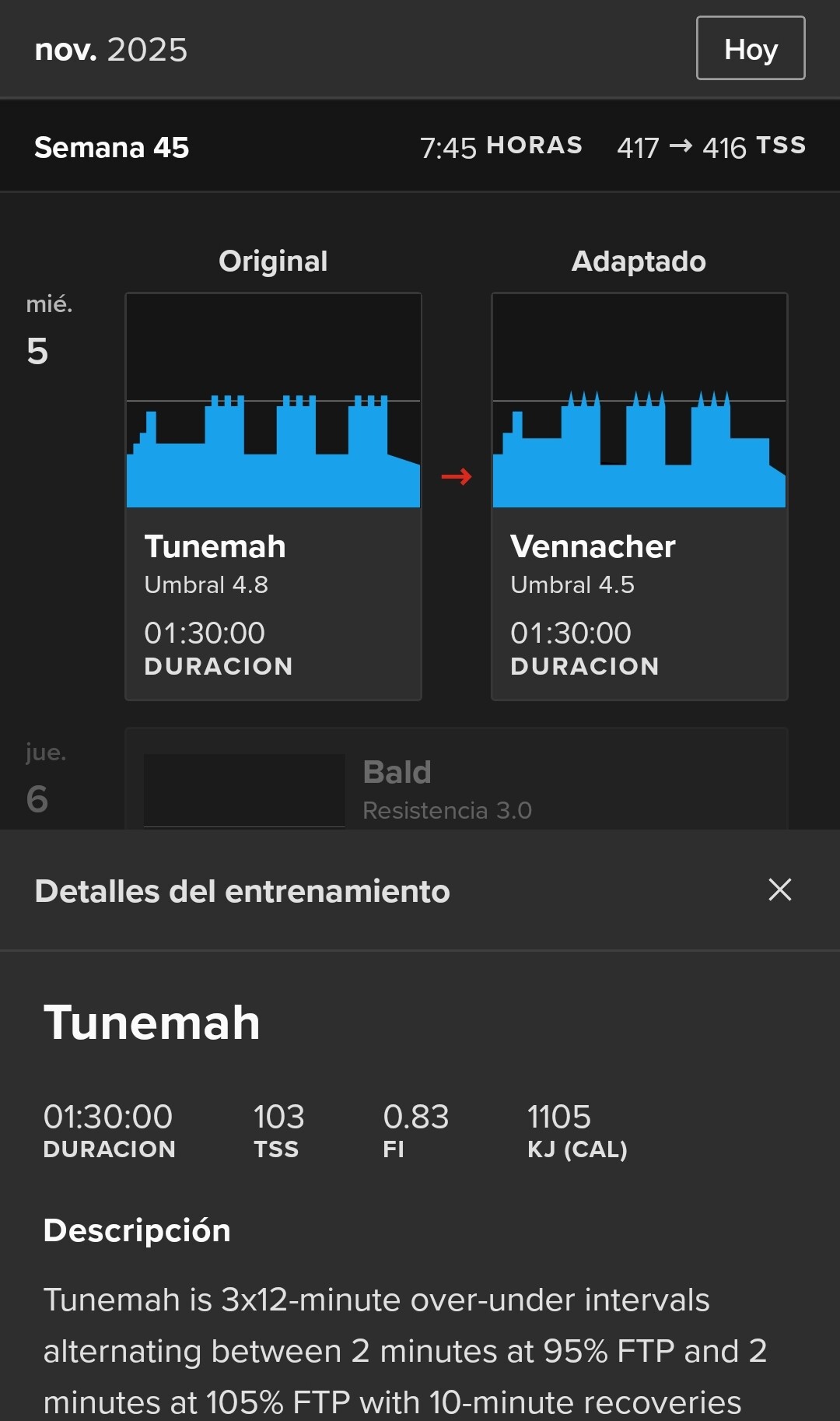
In the mobile version, I would like it if, when it suggests a adapted workout, you could click on both workouts (the scheduled one and the suggested one) and see the watts for the intervals, to get an idea of whether you are capable of doing the scheduled one.

It would also be good if you could discard the individually tailored training recommendations, rather than accepting everything or discarding everything.

Maybe already requested but also too lazy to search or check previous threads, but now that Zwift + TR integration is in place, would like to see/know if TR + TPV (TrainingPeaks Virtual) is here and if not, would request this if possible.

agreed, If you are intergrating with another training platform anyway, why not include a real life video product like TP Virtual or Rouvy?

AI is good but still has its shortcomings. For instance when making a plan the first thing a coach should do is pencil in the nonnegotiable. Weddings, birth of a child, etc. Then you pencil in your races and work backwards from the “A” race. It seems most programs plan from the origin date and just delete the training time that falls on the dates you need adjustments. May get there one day but not there yet. Go humans! :rofl:

I replied to another topic when it came up, but I’ll link it here since this is where it belongs. The workout search and filter features could use some improvements to help sort through the thousands of workouts more effectively. Read that link then the extra that I add below.

In fact I’ll add another feature request to it: give us the ability to search by interval duration as a filter. Although you can kinds of search for interval duration today, it doesn’t work great:

  1. If you want 10 minute intervals you can type “x10” in the search box. I bet >95% of users didn’t know that. But I believe that search will also get you 10 second intervals.
  2. I think the search also will miss workouts that have 10 minute intervals but don’t include “x10” in the description. I’m not patient enough to test that hypothesis but I believe it’s only searching the text and not the actual power profile.
  3. If I’m searching for 10 minute intervals then I might also be interested in 9 or 11 minute intervals since they are close enough. There’s no way find those as well besides doing multiple searches AFAICT. It would be nice for TR to offer interval lengths in the filter list like <30 seconds, <=60s, <=2min, etc. Worst case if I want 1 and 2 minute intervals then I check two boxes instead of one.
  4. There’s no good way to search for time in zone. If I want 60 minutes of SST I have to search for 1x60, 2x30, 3x20, 4x15, 5x12 as separate searches. PLs somewhat mitigate that, but then it’s a big mix of intensity and TIZ so a lot of workouts show up. Plus I have to do trial and error to find the right PL for the workout that I’m looking for. Again having a filter for ranges of time in zone would be very helpful.

Agree with this. Would be great if progression levels were updated for unstructured workouts - commutes, group rides etc. Surely should be doable, as TR has all the data from these rides.

That’s wl V2 and it’s much much harder than we’d think, it’s been worked on for ages, it’s allowed for Red Light Green Light but they’ve not cracked that code yet.

They’ve been working on it for years. I don’t think the problem is in identifying what zones you hit and for how long, but rather how the structure of the ride relates to progression levels specifically, which is a problem unique to how TR operates. It seems simple on the surface, but the system currently cannot accurately assign PL’s to user created custom structured workouts. Given that, assigning PL’s to completely unstructured rides must be extremely difficult.

I think wl V2 is one of those “simple != easy” things.

Yes you can get the zones I was working in and for how long but actually linking them to progress and future workouts is much harder.

I would love if TrainNow could recommend a workout in each zone.

Maybe I want to do some sprint work and want the TR AI to give me an appropriately challenging ride. Maybe I want to do tempo today. I’m still happy for TrainNow to recommend the zone it thinks I should be in, but having at least a choice from each zone would be nice.

As it is now, if the zone you are looking for isn’t on your plan for the day or one of the defaults of TrainNow, I don’t think there’s a way to get an AI recommendation.

That’s why I think the concept of PLs is inadequate / over simplified. It doesn’t really measure training volume per se, just time X intensity in one zone (and maybe an adjacent one too).

Mathematically someone on 6 hr/week can have the same PLs as someone on 20 hr/week. But we know who’s closer to their genetic potential assuming all other factors the same.

TR doesn’t give any indication of training volume in the concept of PLs. Sure RLGL considers whether to scale up or down your training intensity but it still is doing that relative to your current volume. There’s not really progression nor tracking of volume. Adaptive training doesn’t really consider at volume/CTL as far as I understand, other than to keep it steady. It’s basically looking at things on a session by session basis.

If instead it looked at volume and quality of training as separate concepts, then I think it would be a better approach for combining interval training and real world training/racing. A race or group ride is volume. And it may be as effective as or much less effective than an interval session of the same duration. Interval session or not, it might train a few very different areas of fitness (long threshold with attacks sprinkled in there).

If it were me, I’d create a system that broke the ride into loosely defined intervals and rate how close they were to good intervals, assigning them an effectiveness. That part is very tricky and is the perfect application of big data and machine learning. See how it really affected the athlete’s improvement when compared like to like against their other training and peers. You can even do that for TR indoor workouts to judge the effectiveness both of the workout itself and of the benefit to the individual athlete.

Do likewise for volume as well. Then you can show benefit for any workout and indicate to the athlete qualitatively whether they should focus more on training more effectively (intervals) or more volume, and what specific zones are more important to target right now.

Now, this isn’t going to be really precise as far as the expected impact of training. But we don’t have precision today anyways. It’s just “trust the process” and “this is science based” and “excellence tells us that…”. That’s OK but it’s also limited to keeping things fairly simple in order to be easily quantified (intervals, TIZ, TSS, CTL). Any big picture stuff is completely left up to human interpretation or requires fairly strict adherence to a plan.

With my approach I believe that it’s possible to quantify, albeit with larger error bars, how various races, group rides, commutes and just riding around affects training in the big picture way. It also becomes easier to see how an individual responds to different training, including what works for improving compliance to key sessions.

With this approach it becomes easier for adaptive training to adapt not only to moving around workouts but better counting and using non-interval sessions as part of the training program instead of just treating them only as bad (TSS without advancing your training progress, PLs).

This wouldn’t be trivial and it’s got to be done right. How to convince us highly analytical and skeptical toes without giving away the secret sauce is another complexity to this. Plus it could take a lot of resources to figure this out. But it would make a fantastic product.

If I were younger I’d be trying to make this product myself. Hopefully the long delayed WLV2 is something akin to this. That’s the only way it would be justified in taking so, so long to come out IMO.