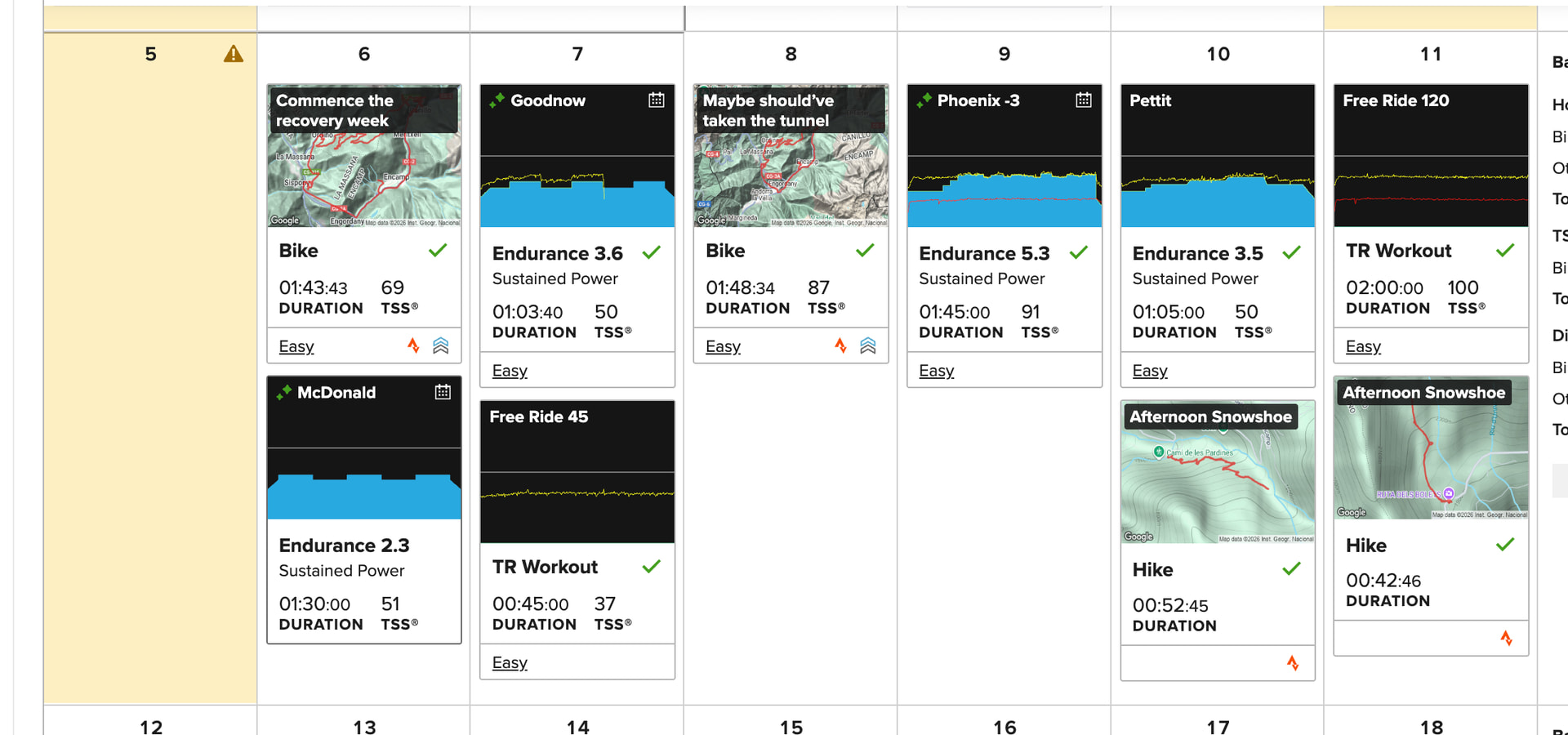
I live between Andorra (±1300m) and Paris (0m) - obviously, TR doesn’t know that at the moment, but I’m wondering if that confuses TR AI in my case on how to detect the correct workout/intensity to set?
For example, I spent the last 5 weeks in Andorra and TR actually estimated a 15w decrease in FTP once I’m back in Paris a week ago. (While I had a slight FTP bump the week before when I was in Andorra)
IDK, but I suspect the AI simply sees variations in performance and adapts as if that’s all they are, not making any causal inference or adjustments. I could see that lead to less than optimal training…like workouts after locating to lower altitudes being too easy and those after locating to higher altitudes being too hard. Here, I live at 1825m but outdoor rides can vary between 1500 and 2750m. If the New and Improved AI is now using unstructured ride data for adaptations, this will add some noise to its inputs.
I think a cool enhancement request would be to start incorporating altitude. Both for users’ benefit, but I think over time it could impact TR’s AI Model where they might be able to start showing insights about performance at altitude.
For example - Allow every user to set a base / default altitude in their profile. If not set, this defaults to Sea Level. For individual workouts, or a time period on the calendar, allow them to set a different altitude. Use the data / general calculations on % of Aerobic Capacity by altitude to adjust.
For example, I live at sea level and the bulk of my training and riding is here. But I also will spend 2.5 weeks in Leadville, CO this summer at an altitude of 10,200’. When I’m there, my FTP has to be lowered by 16-18% to reflect my reduced aerobic capacity, but it’s also temporary. Basically, when I’m there, the system thinks I’m way underperforming, heart rate is out of control for the power I’m putting off, TSS / IF are skewed, etc.
Might be too much effort for too little payoff, but I think it’s a cool idea.
I asked about this in one of the launch threads and didn’t get an answer but am very curious how this could be implemented (I’m assuming the system currently doesn’t address altitude). I live at 6000’ but regularly make riding trips to sea level destinations - that data would definitely be misleading, especially since those are often races or hard group rides so the efforts can be quite high.
It would be difficult as we know everyone responds to altitude differently but I would love if TR found a way to incorporate…