šŸŽ‰ šŸŽ‰ šŸŽ‰ Introducing Adaptive Training! šŸŽ‰ šŸŽ‰ šŸŽ‰

How will adaptive training handle the fact that I manually adjust down the FTP (by about 4%) produced by the ramp test? I am clearly not alone here, and I don’t want to just stick with the number the ramp test gives me because I know it’s wrong.

I’ve looked at the workouts with low progression level ratings, and take threshold for example: A low level threshold workout looks nothing like a mid level threshold workout for a lower FTP. Those low level workouts have really short time in the target zone, and isn’t that what’s important here? So, if the ramp test overestimates my FTP, that low level threshold workout could actually be a moderate V02 workout, missing the point.

@Nate_Pearson and @IvyAudrain: The wide range of progression levels is interesting, but shouldn’t AT be more focused on finding the correct FTP and steering users toward the middle of the progression levels? Otherwise, for those of us where the Ramp Test (or any other method) sets our FTP too high, we could come up way short on time in zone, or even worse, we could be training the wrong zone entirely.

if someone is training at a progression level of 1, and another is training at a level of 10, those workouts are drastically different, and it’s highly likely that their FTP estimate is off. That user at a level of 1 is getting some good V02 work and the person at 10 is getting in some good SS work. I know you are working on a FTP estimate feature, which should allow for some needed tightening in the ranges.
3 Likes

Theoretically you’ll never need to adjust it when AT is working for you because the adaptations will take up the work and progress you more effectively. In a lot of ways, FTP will be come quite irrelevant because you’ll be chasing power and duration by zone rather than always chasing FTP gains. Sure, FTP informs those workouts since everything is at %FTP, but there are enough workouts with enough variability in %FTP for each zone that it’ll just prescribe one that works better for you.

1 Like

This doesn’t make sense to me. FTP setting is everything because you need the right intensity. If you’ve progressed from a 3 to a 10 on threshold, you are not doing threshold anymore, you are doing SS. Much of your ā€œV02ā€ is now at threshold level threshold (but without much time in zone), and you may not be hitting the V02 system at all. I could raise my fitness by 10%, leave the too-low FTP number in there, and do all the zones at level 10+ without much difficulty. Then what?

1 Like

I am still not happy that the tri plans kept the same running…

If the AT plan changes because it detect that i am failing, it will not change the running… And maybe I am failing because the running? Or running is also suffering and need to be adjusted…
Granted… I am better at self adjust running than cycling… but still…

1 Like

Zones aren’t static and they overlap. You’ll still get adaptations in the fringes, and based on my experience with AT so far, the FTP number is so far in the background that I simply don’t worry about it.

1 Like

Obviously mileage will vary, but again, I don’t think this is an AT issue. You would have the same issues without AT and perhaps AT will actually make this better by default as it will try to take this into consideration based on your responses, whereas the standard plans will just continue to progress you until crack and then go back to the drawing board.

Even if you have a ā€œperfectly assessed FTPā€, it is not everything. FTP is used for general scaling of workouts to include Threshold efforts, but also ones above or below Threshold. Notably, that is ā€œold schoolā€ approach where that one value sets ones at wider ends of the training spectrum.

We know that people have different correlations between their FTP and over threshold efforts like VO2 and Anaerobic. The same is true for Endurance, Tempo and such. Knowing FTP can get you close, but not everyone has the same exact percentage from FTP to those outer zones.

That whole issue is one thing that Adaptive Training aims to address, with the help from the individual Progression Levels for riders at each training zone.

If you are talking about moving from a 3 to 10 Progression Level of Threshold for a rider, I don’t think that is true. Ability to hit a 3 PL for Thresh may mean the ability to do something like a 4x5-minute workout at Threshold. Steps from that might be a 3x10-min Thresh, next to 4x10-m would mean more of a middle to high PL around 5-7. Eventually, something like 1x40-min or 1x60-min would be around 9-10 PL for Threshold.

As they said, the Progression Level maxes at 10 and Workout Levels mostly max at 10. Presumably, if you can knock out a workout at 10 (at something lower than a 5-All Out rating), you are near max capability in that zone. It may also mean your FTP is likely higher and in need of re-assessment.

All that is just looking at Threshold. The reality alluded to above, is that we all have different abilities at the range of zone around. The old reliance on FTP to be the one number that matters is changing with what TR is doing here. The Progression Levels in each of the 7 zones will help refine workout selection to a more tailored experience with hopefully better return on time, compared to the singular focus on FTP.

Other apps like WKO5 have included stuff like this with their over threshold tools and assessments and they are not the only ones (SUF, Xert and others too). Essentially, the industry is moving to get a more accurate picture of the rider as a whole, which stand to benefit each rider as the training gets more direct to their specific needs.

5 Likes

I disagree only in that without AT I’d survive the week and be fine the week after for my normal trajectory (this is exactly how it has played out because ignored the adaptations). With AT I’d survive the first workout in each zone and then it’d compromise my next couple of weeks training by reducing my levels heavily.

Looking at the actual examples here, in some cases it was trying to get me to drop 4 levels off my workouts. Sure, I could back to where I should be in theory, but it definitely wouldn’t be instant, even in the event I somehow found the new sessions ā€œeasyā€.

Again, I’m not making out AT is a bad thing. I’m just being clear that it’s not the right system for all circumstances. I’m genuinely excited to use it when it’s done as I’ve always had a problem with the suggested progressions for things like VO2max (I progress very slowly there).

There’s some overlap into this AT thread about Workout Levels and new plans, so I’m dropping the link to some really helpful FAQs below that will help clear up some confusion.

2 Likes

Thanks for the thoughtful response. If someone can barely complete a 4x5 minute workout, are you really going to argue that they are doing threshold? I think that the progression levels in conjunction with FTP are a great way to structure training plans. My argument is that the range is way to wide. I’m not sure that anyone can ever convince me that someone that can barely complete a 4x5 workout is operating anywhere near the same zone as a rider that can complete 1x60 at the same power. Accommodating FTP settings that are way off rather than assuring they are more appropriately set isn’t helping the rider. The podcasters harp time and again about ā€˜time in zone,’ and if your progression levels are low, unfortunately, you just don’t get enough. You could work your way to longer intervals, but what if you’re already highly trained and/or your fitness drops? 2 minute ā€œthresholdā€ intervals?

Would AT be workable for someone who manually adjusts their FTP down by 4% immediately after accepting a ramp test result, or would it be best to not accept and just change it manually? I’ve done enough indoor training over the last three years to see a pretty solid plateau. Gains will be marginal from here on. Like Nate, I like to have the objective ramp test as one of the ways I assess my fitness, and I ramp test very well. Unfortunately, I know that if I use the default calculated result, my progression levels will be quite low, and that will leave me with much less ā€˜time in zone’ than I will need to make more fitness gains.

Note that my quick examples are hacked together and not necessarily the precise way TR is applying PL in AT. I made a hand crafted example that may be total trash for actual numbers, but tried to get to the idea that knowing your FTP doesn’t lead to immediate ability to nail that in practice.

I was merely trying to get to a basic point that, even if you test and have an ā€œaccurateā€ FTP value, especially from an abbreviated method like the Ramp, 1x20m or 2x8m tests, it may not be practical to expect someone to manifest an ā€œhour of powerā€ type of effort right from the gun. Doing that type of effort takes some mental fortitude at the least.

Essentially, there has to be some range of ability at threshold or there would be no need to have an PL for Thresh at all.

All the other questions you are asking, I can’t answer. Those are deeper in the hidden aspects of AT that I simply don’t know.

2 Likes

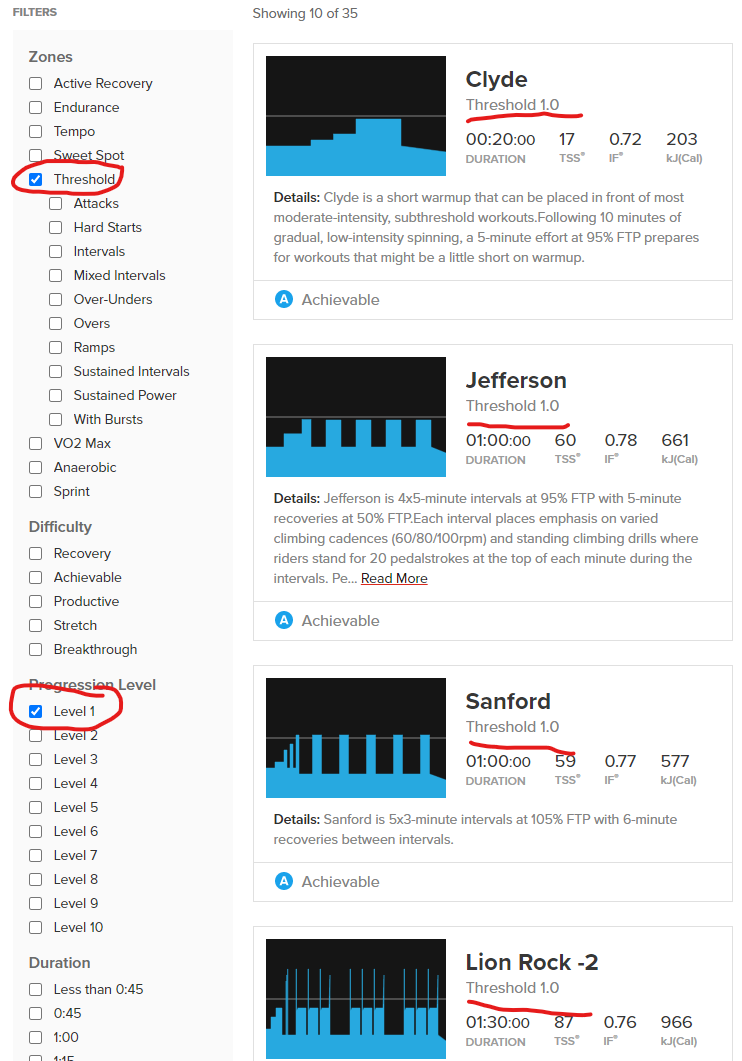
I’d be interested to see what typical 1, 2,… 10 threshold workouts look like.

Mike

You can do this right now. Open the Workouts on the web, set some filters and have a look:

Just change the Progression level to whatever Level you want to filter and you see a list for all with that level, scroll down to see the entire group of those settings.

Essentially, these Workout Levels will align with an even Progression Level as being around Achievable to Productive for a rider with matched WOL and PL.

2 Likes

I’m not in the beta, or even a TranerRoad subscriber. Just an interested spectator.

Mike

1 Like

Right, but Workout Levels just got released for EVERYONE on Monday. So you have full access to the Workout Levels I referenced. You won’t see the ā€œAchievableā€ info, but you don’t need it for what you are asking.

Again, if you are a Progression Level of 3, a Workout Level 3 workout is right in the Achievable/Productive range. So, if you see a workout with a 10, it means you’d need to be around a 9 to have a shot at completing it without your eyes bleeding at the end.

You can get a decent idea of the range of Threshold by simply seeing the workouts associated with whatever Workout Level interests you. Does that make sense?

You won’t see your own Progression Level right now, but I didn’t think that was what you were asking about.

I’m not a Trainerroad subscriber so can’t see any of that.

Mike

DOH, I missed that last part, sorry.

So, seeing the Level 1 above, here are a couple more to show some of the WOL range for Threshold.

2 Likes

Star man. Cheers

1 Like

Happy help! :+1:

I needed to make up for my poor reading and comprehension above :rofl:

1 Like