I guess the DMs should have been a red flag to hit the print to pdf button and archive it, if you thought it had some real insights.
1 Like
Not really. It’s just a bike forum. We’ll all live on without that topic and the antagonist.
4 Likes
Back on the San Millan topic…
I recently began implementing the “San Millan” style of training. Just for fun and a change. I even did a lactate test to make sure I was at the right sort of level.
The interesting bit, it’s not what most would think of as Z2. It’s basically tempo for me. If I redline it and sit right on LT1. It’s proper. If I could do 4hrs at LT1 I’d be as strong as a bull.
Unsurprisingly, I’ve gotten stronger, likely purely because I’m doing way less noodling Z2 rides.
I suspect that many think he means Coggan Z2. Bottom of the zone, middle of the zone, whatever. Miles from what actually riding around right on LT1 feels like. It’s work. You know you’re training. Focus is needed.
I would sum it up as, the power where it goes from normal endurance riding, I’m pretty happy, to this is kinda uncomfortable.
If Pogacar is riding around at LT1 for 6hrs, no wonder he’s a monster.
No wonder Tim Wellens said his new training is hard, it is hard.
I’d officially call San Millan Z2… not zone 2. Zone 3 for me.
Legit.
7 Likes
For how long did you implement it? In dimension of weeks. Asking because of overload/accumulating fatigue. Depending on my/your fitness that is not an easy task.
Funny you should say that. I’ve come to exactly that conclusion. In my case my Aerobic Threshold falls at approx 150W whereas my LT1 at 0.5 mol above base falls at 175W. 160-175W is low Z3 for me and squarely where I interpret ISM Z2. It is not a place that is long term easy for me.
1 Like
Nice for more confirmation i.e. someone else point this out.
I pointed this out years ago in the polarised thread I think (in that context Z1 pol, three zone), but maybe worth a mention here.
Low getting towards mid Tempo has been the cut off for Z2 (non coggan) for a loooong time, it is nothing new as far as I am concerned.
The 80/20 zones have the upper limit of 83% this dates back to about (at least) 2018.

1 Like
This 
I‘ve been at it 3 months now, and can sustainably hit 3 hours in that zone 3 times a week, plus 2 long weekend rides.
That first 15 minutes is invariably „Jeez, no way I can hold this power today“. The last hour is usually „I really wish I didn’t have to stop for work, this is such a nice workout“. Go figure! I do bake in some VO2 work in one or two of these rides, as ISM recommends.
Last week AIFTP assigned me my highest FTP ever (351W vs previous PB at 346W), and yesterday I hit a 30s lifetime PR at 920W.
ISM Z2 ~ low tempo simply works for me…
The groans of the field once you crest a hill and happily settle right back at your ISM Z2 watts in a race are so worth it, too 
2 Likes
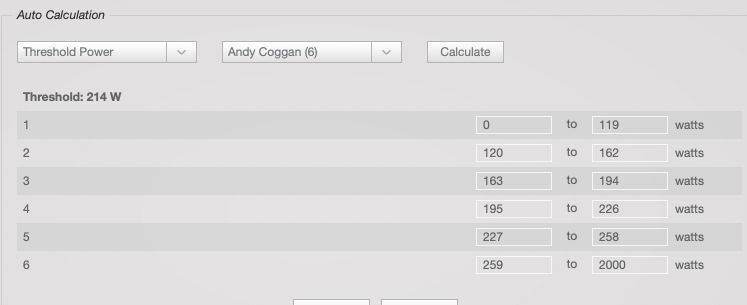
I just pulled that calculator up and it gave me exactly where I should be with ISM Z2 matching the 80/20 (or vice versa) whereas it straddles the Z2/Z3 boundary in Coggans zones. As as been said before in this thread ISM’s Z2 is very individual.

1 Like
Never tested lactate, and don’t call it ISM training, however I could quote a lot of what you wrote  with two exceptions:
- most of my endurance rides I “let the power come to me” and go for a negative split
- I’m targeting the border of Coggan z2/z3 in order to get the repeatable yet challenging (both in ride, and recovery) level of power
it really does “grease the groove” so to speak, and after a hard effort makes it easier to go back to a solid endurance pace.
2 Likes
Exactly. Coggan is one of the few that talk about a topic and don’t leave a black hole of citation neededs with every paragraph. But most people take everything someone says at face value, never ask for proof and even ignore proof of the opposite (confirmation bias, cognitive dissonance, etc).
I wonder how this works out for different riders.
What percentage of your FTP does this work out to be?
I hit my best numbers last year doing Steve Neal inspired tempo intervals and hardly any VO2.
Do those guys do that? Or do they do intervals? I’ve never really seen much from ISM in the way of a time in zone distribution.
ISM kind of annoys me. Lots of words, a “zone 2” label, all for tempo.
2 Likes
Have you read this? ISM is very clear about how he determines zones. For me, my fatmax is well below LT1, for elite folks, their fatmax is above LT1, so there’s quite a bit of nuance.
https://www.medicineofcycling.com/wp-content/uploads/2016/08/SanMilan-Inigo-Cycling-Physiology-and-Physiological-Testing.pdf
This is a great example.

2 Likes
Is there a lecture somewhere that goes with those slides?
Not that I’m aware of, but I just emailed ISM to ask if a video is available. I’ll share the link if one is available (and permitted).
1 Like
It’s very individual.
It’s hard to have exact precision, as I almost never test FTP.
I’d guess at 80-83% of FTP. I suspect that those that do a lot of interval training or lots of group rides will likely be a bit lower. Or not, it really is quite different from person to person.
I’ve come to the conclusion of late that this metric LT1 / VT1, first turn point, whatever you call it, is possibly more important than your FTP.
Certainly, estimating backwards from a hypothetical FTP is possibly very flawed at the individual level.
Of note, nearly everyone I’ve seen tested had their FTP overestimating their actual tested MLSS. In fact, I don’t think I’ve ever seen it underestimated. So, most are starting with quite flawed data.
The reason I think that LT1/VT1 is so important, is just volume. Hypothetically, if you’re following the current meta for endurance training, you’re doing nearly all of your yearly training, at, near or below this point. So, it makes sense that you should know as much as you can about how your body is responding to it.
Ponder it. As munch as 90% of your pedaling time per year could be very near this point. Meanwhile folks are obsessed with FTP. Mostly because of training software, media etc.
Now, if you’re not training a majority of your time near this point, you either don’t believe in the current science, are very time crunched, or follow one of the many online training platforms that dramatically under prescribe endurance work for zero reasons related to physiology at all.
My current advice is, if you’re lucky enough to have someone very skilled at lactate testing near you, absolutely do it. Make sure you use proper 6-7min steps and follow all the correct protocols.
You’ll get a fantastic snapshot into your actual current physiology. Not some random percentage of an already flawed metric. The heart rate data at the two lactate turn points is very valuable. As, for most, not all, these HR points don’t move much.
Basically, cheaper than a pair of cycling shoes.
5 Likes
I’ve been experimenting with it for about 3 months.
I ride 12 to 16hrs per week.
Mostly endurance.
Just keeping a nice steady fitness. year round
Once or twice a year I do a 3 month build for a race.
I simply began doing intervals at LT1 power during endurance rides.
10mins
20mins
Up to 1hr solid
3 out of 4 endurance rides per week.
I stopped if I felt like I was getting too fatigued etc.
You definitely have to stay on top of fueling. It’s not what most would consider Z2 riding.
In Coggan language, you’re doing low tempo intervals, or long sustained tempo sessions.
I suspect it’s just provided me with the progressive overload I needed.
I think combined with San Millan’s lactate testing he’s just getting riders to ride at a very time efficient point in our physiology. Solid load, recoverable, repeatable. Many more heart beats than sweet spot training as you can do vastly more volume weekly, yearly etc.
Obviously, there’s a tipping point. That could be 6hrs, maybe 7hrs a week? It’s different for everyone. At some point you simply need more intensity if you’re time poor.
I will say that using this method is much safer than endlessly smashing sweet spot / threshold intervals, as the risk of overtraining is far lower.
Definitely worth some experimenting.
3 Likes
The trade off is that for people that race, it’s not optimal because of fatigue of LT1 work plus the hard sessions. If you need to have some punch, you are better off doing endurance at a lower intensity.
3 Likes
Whoever’s been here the longest, anyone want to summarize 1200+ posts for someone too lazy to read them all?  I’ve been nitpicking through the last 50 and the first 50. Really interesting discourse. I’m doing a lot of tempo riding this week and am going to experiment with that while I start picking up running again… reducing bike volume from 10h a week to maybe 4 or 5, so more tempo rides and reintroduce run mileage…
2 Likes
I always test my FTP/MLSS pretty conservatively and accept the WKO modeled FTP. It’s usually right on after a longer test.
I used right in the middle of my WKO/coggan tempo zone which turned out to be 82% of my FTP.
Personally, I think lactate just complicates things for most riders. If you do proper testing, and don’t try to game the test with your ego, the regular zones will probably work just fine.
I still find ISM’s definitions of Z2 (talk test) to be a bit confusing. The talk test is probably a wide range depending on how it’s interpreted by the rider.
3 Likes
Does ISM recommend a talk test for zones?
From my understanding and his PDF, Zone 2 goes from fatmax to fat-carb crossover, which can only be done with a metabolic cart.
The whole thing relies on using metabolic data to define zones.