I just pulled that calculator up and it gave me exactly where I should be with ISM Z2 matching the 80/20 (or vice versa) whereas it straddles the Z2/Z3 boundary in Coggans zones. As as been said before in this thread ISM’s Z2 is very individual.

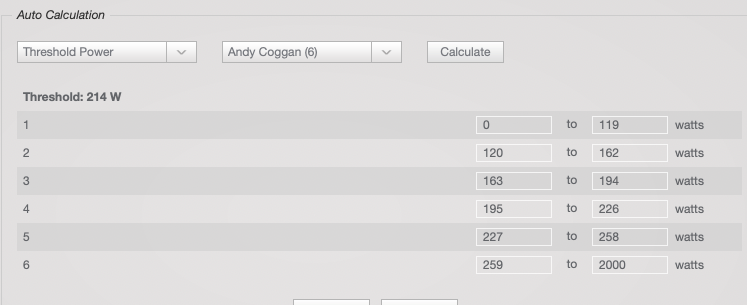
Never tested lactate, and don’t call it ISM training, however I could quote a lot of what you wrote  with two exceptions:
- most of my endurance rides I “let the power come to me” and go for a negative split
- I’m targeting the border of Coggan z2/z3 in order to get the repeatable yet challenging (both in ride, and recovery) level of power
it really does “grease the groove” so to speak, and after a hard effort makes it easier to go back to a solid endurance pace.
Exactly. Coggan is one of the few that talk about a topic and don’t leave a black hole of citation neededs with every paragraph. But most people take everything someone says at face value, never ask for proof and even ignore proof of the opposite (confirmation bias, cognitive dissonance, etc).
I wonder how this works out for different riders.
What percentage of your FTP does this work out to be?
I hit my best numbers last year doing Steve Neal inspired tempo intervals and hardly any VO2.
Do those guys do that? Or do they do intervals? I’ve never really seen much from ISM in the way of a time in zone distribution.
ISM kind of annoys me. Lots of words, a “zone 2” label, all for tempo.
Have you read this? ISM is very clear about how he determines zones. For me, my fatmax is well below LT1, for elite folks, their fatmax is above LT1, so there’s quite a bit of nuance.
https://www.medicineofcycling.com/wp-content/uploads/2016/08/SanMilan-Inigo-Cycling-Physiology-and-Physiological-Testing.pdf
This is a great example.

Is there a lecture somewhere that goes with those slides?
Not that I’m aware of, but I just emailed ISM to ask if a video is available. I’ll share the link if one is available (and permitted).
It’s very individual.
It’s hard to have exact precision, as I almost never test FTP.
I’d guess at 80-83% of FTP. I suspect that those that do a lot of interval training or lots of group rides will likely be a bit lower. Or not, it really is quite different from person to person.
I’ve come to the conclusion of late that this metric LT1 / VT1, first turn point, whatever you call it, is possibly more important than your FTP.
Certainly, estimating backwards from a hypothetical FTP is possibly very flawed at the individual level.
Of note, nearly everyone I’ve seen tested had their FTP overestimating their actual tested MLSS. In fact, I don’t think I’ve ever seen it underestimated. So, most are starting with quite flawed data.
The reason I think that LT1/VT1 is so important, is just volume. Hypothetically, if you’re following the current meta for endurance training, you’re doing nearly all of your yearly training, at, near or below this point. So, it makes sense that you should know as much as you can about how your body is responding to it.
Ponder it. As munch as 90% of your pedaling time per year could be very near this point. Meanwhile folks are obsessed with FTP. Mostly because of training software, media etc.
Now, if you’re not training a majority of your time near this point, you either don’t believe in the current science, are very time crunched, or follow one of the many online training platforms that dramatically under prescribe endurance work for zero reasons related to physiology at all.
My current advice is, if you’re lucky enough to have someone very skilled at lactate testing near you, absolutely do it. Make sure you use proper 6-7min steps and follow all the correct protocols.
You’ll get a fantastic snapshot into your actual current physiology. Not some random percentage of an already flawed metric. The heart rate data at the two lactate turn points is very valuable. As, for most, not all, these HR points don’t move much.
Basically, cheaper than a pair of cycling shoes.
I’ve been experimenting with it for about 3 months.
I ride 12 to 16hrs per week.
Mostly endurance.
Just keeping a nice steady fitness. year round
Once or twice a year I do a 3 month build for a race.
I simply began doing intervals at LT1 power during endurance rides.
10mins
20mins
Up to 1hr solid
3 out of 4 endurance rides per week.
I stopped if I felt like I was getting too fatigued etc.
You definitely have to stay on top of fueling. It’s not what most would consider Z2 riding.
In Coggan language, you’re doing low tempo intervals, or long sustained tempo sessions.
I suspect it’s just provided me with the progressive overload I needed.
I think combined with San Millan’s lactate testing he’s just getting riders to ride at a very time efficient point in our physiology. Solid load, recoverable, repeatable. Many more heart beats than sweet spot training as you can do vastly more volume weekly, yearly etc.
Obviously, there’s a tipping point. That could be 6hrs, maybe 7hrs a week? It’s different for everyone. At some point you simply need more intensity if you’re time poor.
I will say that using this method is much safer than endlessly smashing sweet spot / threshold intervals, as the risk of overtraining is far lower.
Definitely worth some experimenting.
The trade off is that for people that race, it’s not optimal because of fatigue of LT1 work plus the hard sessions. If you need to have some punch, you are better off doing endurance at a lower intensity.
Whoever’s been here the longest, anyone want to summarize 1200+ posts for someone too lazy to read them all?  I’ve been nitpicking through the last 50 and the first 50. Really interesting discourse. I’m doing a lot of tempo riding this week and am going to experiment with that while I start picking up running again… reducing bike volume from 10h a week to maybe 4 or 5, so more tempo rides and reintroduce run mileage…
I always test my FTP/MLSS pretty conservatively and accept the WKO modeled FTP. It’s usually right on after a longer test.
I used right in the middle of my WKO/coggan tempo zone which turned out to be 82% of my FTP.
Personally, I think lactate just complicates things for most riders. If you do proper testing, and don’t try to game the test with your ego, the regular zones will probably work just fine.
I still find ISM’s definitions of Z2 (talk test) to be a bit confusing. The talk test is probably a wide range depending on how it’s interpreted by the rider.
Does ISM recommend a talk test for zones?
From my understanding and his PDF, Zone 2 goes from fatmax to fat-carb crossover, which can only be done with a metabolic cart.
The whole thing relies on using metabolic data to define zones.
He’s said over and over in podcasts that he recommends the talk test for those without lab testing.
I guess I always thought ISM “zone 2” was more similar to coggan zone 2. But if ISM’s Z2 is more like tempo then that is new to me. (Not that it makes much practical difference to me.)
100%, I would definitely bin the LT1 work during a race build.
Possibly, leaving one day of it, depending on fatigue etc.
It’s rider specific. That’s the magic.
He tests his riders, then sets their zones.
Usually, he has his riders pinging right on the edge of Z2. Which, importantly, is his zone 2. Not Coggan’s and not based backwards as a one size fits all percentage of FTP. Doing it that way can be correct, if you test properly and are right on the bell curve.
I’m a good example of it not working perfectly. I’m definitely in Z3 tempo Coggan when I’m at LT1.
Everyone will be different.
I think it’s worth the small time investment to get some precision, if you do a majority of this style of training. Which in the professional ranks, is basically everyone.
I wish I’d done it sooner.
I’ve been doing this type of training for years. It’s very effective for building long sustainable power. I use 83% of max heart rate and begin to push out the intervals.
An example of starting a training block would have me around 270-280w, I will push it out to 60 mins or more. Usually within a couple of weeks my power is 300w. Over the years I’ve pushed that out to around 2hrs in a single interval at the same 83% hear rate.
The problem with this training is that it will make you flat. Being able to hold 300+ for hours isn’t efficient for racing in my area. The surges will take a toll and also the accumulation of fatigue.

Just finished an indoor LT1 ride (ISM Z2). Few months ago did my own lactate test. LT1 around 220w.
So today avg 214wNP (207w) for 110min. PWhr 0.2% so that is ok. Average bpm was 136 (treshold heartrate about 165, max 180 (very rare).
My goal is to bump the duration up at this intensity. I don’t race, only gran fondo.
I have, but it is rare and indicates phycological weakness for the rider not being able to push to potential. Without lactate data you would not see this nor identify the potential to improve because the rider legitimately feels that they are at a high RPE when doing their FtP or MLSS test.
Similarly the currently in vogue “performance is the best indication of performance” doesn’t work for these riders. Because performance, and things like FTP tests, are both physiologic and psychologic. IMO, If you have tools available to isolate the variables of a system you can use them to improve the system and that is the goal.
Lactate data, for all its flaws, remains a quantitative measurement which if used well can add substantially to a training program.
Your post is spot on in so many important ways. It should be pinned.
-Darth
- About 600 posts are ppl getting Zone 2 confused with (surprise) the other Zone 2. It is individual but not as variable as (for example) anaerobic capacity, which can vary widely among riders. Most ppl eventually come around to the reality that it is a “tempo” level of intensity (meaning, there is a level of intensity below this one…namely basic endurance riding). Lots of ppl still hate the term “tempo”.
 so they find other equally useless but colorful ways of labeling it
- It is not a range. Please, please. If we take nothing else from this: it’s not a range. He pinpoints it at a point during a ramped test. You can derive a range from that (and since it’s lactate, you sort of have to…lactate is not that precise, and power alone is a false precision).
- There are indirect ways of getting at this crossover point (and many, many labels), but ISM uses a metabolic cart and some posters use a portable lactate meter. Depends on the precision you think you need. He discusses a talk test with Attia.
- Random and somewhat arbitrary criticisms of podcast appearances (welcome to the internet)
- Not many ppl had tried this training in Sept 2020. A prominent poster (the OP of this thread) was intrigued by these ideas and started to ride this way. The approach most similar at the time (that anyone who posted could find) was a coach named Steve Neal. That’s why his name comes up in these discussions. Lots of coaches and athletes piped up with “we do that too!” but after closer inspection you see they just do sweetspot/threshold stuff. The bandwagon had formed.
- Lots of obligatory if that works for you great, this work for me (we need that in every thread LOL)
- But is it polarized? Pyramidal? That took up a fair bit of wasted time
- Yes, much of what he saying is not new, but he’s Pog’s coach so ppl paid attention, particularly since it went against the grain of the wood in terms of current, popular training approaches
- He provides general prescriptions via TrainingPeaks article and in his podcast appearances. Refer to the TP article for quick overview. That TP article was largely ignored until the wider realization that he wasn’t talking about general endurance riding (Coggan Zone 2). When you realize he’s talking about a sort of low tempo / high endurance, that article gets more eyes on it
- He has addressed intensity a little. He is an advocate of “end of ride intervals”, but don’t expect a “sample build week” from him
I think you’re all caught up.