Goodbye to TR - no motivation to renew subscription

Hi TR team

Very soon my subscription is over. I found no motivation to renew it. I know it souds like a bitter end but I’d like to share my experience WHY I decided to say goodbye to put some more light what isn’t working well in this training platform.

Here are my observations (random order)

  1. Traning plan scenarios.
    Many times I tried to create with TR training plans suited well for my needs and expectations. After few times, I started to see very repetitive pattern in the plans - all trainings were very similar, no matter how I changed my goals, dates, duration, etc. After 5 or more times I found it pointless to try more - the resulted plan was just next variation of the known pattern w/o significant outcome in my fitness level (comaring to previous plans).
  2. Progressive fatigue after longer time of following the training plan.
    I obsverved that after 2-3 months of going with the plan, my training level started to drop slowly, so that THR trainings were too hard for me, even though AI FTP showed increase of FTP. After injury and obligatory 1 month break (only endurance rides) I found, that the tiredness is gone and I feel again fresh to start new trainings.
  3. Adaptive training plans were not enough adaptive.
    I found, that even though I was loosing the form, the changes in adaptive training were too small for me to recover properly, so the tiredness progressed (see pt 2)
  4. Outdoor trainings are too much indoor like.
    Exactly my observations were, that many times after switching from indoor to outdoor training scenario, I was asked to do a ramp power increase steps, almost impossible for me to do it well outdoor
  5. Cound not find simple vo2max training plans like 4x4 or 5x5 what is the holy grail or vo2max trainings. Until now I don’t know why …
  6. Progression levels are not updated with outdoor trainings. I don’t need to write more - it is a common issue during users discussions. Because progression levels are not updated, I feel detached from the TR platform during summer time, even though all my activities are there. This is also a reason why I decided to quit.
  7. AI FTP is too optimistic - I wasn’t ever able to repeat the FTP result with regular 20min test. Maybe this is only my problem, anyway for me this is serious issuse and needs to be addressed.
  8. FTP increase plans for climbers I usually selected for training were too much focused on THR/SS trainings. In my case vo2max was almost forgotten, so I hit the ceiling of inability to increase more FTP. Only after I realized that I should focus on vo2max to level up the ceiling for improved oxygen consumption, my FTP started to grow. But It was an effect of my observations and education - not TR plans.

And Conclusion:

Cosidering the above I no longer trust TR plans. Although in general the plans look good, apparently are not well prepared for particular user like me, so after few months of a progress I was forced to drop the plans due to general tiredness, observe my body, educate how to train and preapre trainings by myself tailored for me.

15 Likes

I think these are all good and fair points. A few observations based on my years with TR:

  • TR plans for a given load setting do tend to be similar. 2-3 “hard” days per week, with those hard days going from SS to threshold to VO2 as the plan progresses. I think this makes sense and works well for most people, particularly those with a more limited experience with training. As you noted, changing the type of plan doesn’t do a ton to change this general pattern.
  • If you experienced progressive fatigue, did you consider changing to a Masters plan? You didn’t mention your age or training history.
  • Really nailing structured training outdoors is hard and super dependent on your terrain and road infrastructure. Likewise applying progression levels to outdoor rides (which are generally less structured and consistent, even if you’re trying to do a workout) is also tough. I have a great local “3 minute hill” and love doing VO2 reps on it, but don’t really try to do many other structured workouts outdoors.
  • TR doesn’t provide really individual plans; it can’t. Identifying your own strengths, weaknesses, and goals is therefore really important. Like, I have great TT/threshold watts, I can hold 95% of FTP for a long time. But I generally suck at spiky efforts and sprinting. I find that when I plateau, adding some anaerobic workouts helps get me past it, even if I’m not specifically training for sprint events. But this is something I’ve figured out about myself, and something a coach might know, but not something I’d expect TR to know.

Ultimately I find TR really useful for its workout library, but I also don’t closely adhere to a plan in many cases; I try to hit 2 intensity days and 2-3 Z2 days per week, and sometimes I game the system a bit (e.g. to get more anaerobic work than TR thinks I need.) I think TR works great for those with little experience, and can work great for those with a lot of experience (who alter its plans to fit their specific needs). It sounds like you might be caught between those states, and I agree that TR doesn’t serve those folks optimally. But, I’m not sure how it could do better; it’s not a human coach.

12 Likes

Just some feedback. Don’t take it as “You’re wrong.”, just as commentary.

A lot of structured training simply is very similar, because it is based on the same overarching principles such as progressive overload and periodization. Hence, this is not specific to TrainerRoad’s plans, but inherent to all training plans.

The base phase is independent of your goals, so identical. Differentiation starts in the build phase, but is small. If shorter > FTP efforts are important for your discipline of choice, then your VO2max intervals will place more emphasis on 30-30s and such. Real differentiation happens in the speciality phase.

Sounds like long-term fatigue kicked in. You should have lowered your training volume and intensity, your volume and/or the number of hard workouts was too high. You can change that even during a training plan on a per-block basis.

Reducing the number of intervals from, say, 3 to 2 and/or increase the number of rest days might have done the trick. It is a common pitfall for people who first get into structured training: I ride 12 hours per week now, why is TR suggesting only 6 hours of training?!? I can surely do more than that. (Answer: 12 hours of riding ≠ 12 hours of training, the latter is much more difficult.)

Adaptations are meant to be fine adjustments to keep you in progressive overload. If volume and intensity of the training plan are too high, then this is outside of the range of AT.

Doing intervals outdoors is much harder than indoors, again, not specific to TR.

At the least you need a proper route that is suitable for the specific type of workout. E. g. for VO2max workouts, a short(er), steep hill works very well, one with little traffic. For longer (10±minute) efforts, you need long, uninterrupted stretches of roads without intersections. Where I live now, those intervals are impossible to do outdoors without endangering myself.

Holding steady power can be much more difficult to impossible outdoors. Where I live now, we have lots of small roads that are lined with trees. On windy days (it is very flat, so there are no geographical obstacles for wind) I can get power fluctuations of ± 30–40 W. When I lived next to the ocean, winds could by gusty, another source of power fluctuation.

Overall, I found doing intervals indoors is much more time efficient, safer and with better outcomes. It was easier to nail my power targets. Learning what workouts to do outdoors/indoors is part of the journey.

Training plan ≠ workout.

TR’s workout library has tons of traditional VO2max workouts with longer intervals. However, these are more difficult (= higher PLs) and likely your VO2max PLs were not high enough.

This is only true when you are talking about unstructured rides. Outdoor workouts are included in the Progression Levels, if you complete them successfully, you will have earned the PL increase.

I’ve done rolling/climbing road race plans several times each. All of them include VO2max intervals.

13 Likes

I don’t think that’s true: TR creates custom plans, taking your goals and workout history into account. You can specify the number of interval workouts, training time, etc.

What it doesn’t do is help you distinguish between e. g. limiters and weaknesses. In your example (you are good at TT efforts, but worse at spiky efforts), nobody except you knows whether this is actually a bad thing. If your goal is a TT, then you should not attempt to improve your capability to handle spiky efforts. Even for things like crit races where spiky efforts are the norm, you might now want to focus too much effort on being able to handle sharp, short efforts. Instead, you might simply adapt your race strategy accordingly.

5 Likes

Fair point. In my specific case, I found that adding anaerobic work where TR didn’t think I needed it (e.g. in a “long gravel race” plan) improved my FTP, durability and race day performance.

Again I think TR does a good job of providing plans that will work pretty well for most people. Something it doesn’t do is assess and try to address individual strengths and weaknesses; for example, the Wahoo SYSTM approach claimed to do a “4 dimensional power test” to assess not just FTP but neuromuscular, anaerobic and aerobic characteristics, then tailor plans based on that info. I still vastly prefer TR, but it’s a “one size fits most” approach.

4 Likes

Different training phases have different purposes, though, and e. g. the purpose of the base phase is not primarily to increase your FTP, but to work on your aerobic base. An extreme example are the traditional base plans, which only contain endurance workouts in the base phase. The point in time when VO2max work is phased in is chosen intentionally.

As a matter of principle, this is the case with all periodized training plans, although the implementation will differ.

Your assumption that TR does not assess individual characteristics is false, though. TR has Progression Levels for the different power zones, which capture your characteristics as an athlete. Its algorithms analyze your training history and know how quickly you e. g. progress in VO2max workouts and selects ramp rates accordingly. “Ramp rates” for your VO2max and threshold are in principle different. It is very much individualized and not a “one size fits most” approach.

What neither SYSTM nor TR do at the moment is distinguish between weaknesses and limiters. If you only do crit races, you don’t need to focus on your endurance or “durability” (however you define it) — comparatively weaker endurance may be a weakness, but for that race format it is not a limiter. Nor do they take race strategy into account.

2 Likes

The workout library is terrible, I will agree with that. Last time I used TR it was like 4000+ workouts? At that point, just have some sort of on-the-fly workout generator. Also, yeah, hard to find the bread-and-butter workouts.

8 Likes

Is it really? I don’t recall the last time I actually went looking for a workout as in like I want to do a 4x4 or 5x5 vo2max. But it just took me less than 30 seconds to find those and that included opening and going to TR website. workouts vo2 max intervals they are right there. Typing this reply took longer.

Not going to try and convince anyone to stay or not but that issue just makes no sense.

11 Likes

I left TR a while ago. Probably just too stupid to find the workouts i wanted :+1:

TR has that Train Now feature that will give you on-the-fly workouts, too.

1 Like

I absolutely though you were right, but I have to admit I just went looking for 5x5 and I couldn’t find it and gave up after a few minutes of filtering and searching. What filters/search terms did you use?

3 Likes

I found a 4x4 in that time for sure, just did again to make sure I wasn’t crazy.

I’ll admit I did not actually look for a 5x5 at the time so 100% will own that and now scrolling a bit more not sure I found one, but saw a few by profile that were 5xslightly different like a 4x4 and then a 5th a hair longer sort of thing.

I’m seeing some of the issues with searching though:

If you type in the search box 10x2 you will get Loyd, but you can’t search for Walpert as a 3x4 because the description is “three 4-minute intervals”. so unless you type it exactly like that it won’t come up. Seems like those need to get fixed. Searching “five” I don’t think I came across an actual 5x5.

2 Likes

If you just type 5x5 in the search box a bunch of them come up. You can also narrow it down by using the filters for VO2 and a sub filter of Long Suprathreshold. You can also filter by time.

edit: I’m using the mobile app currently.

2 Likes

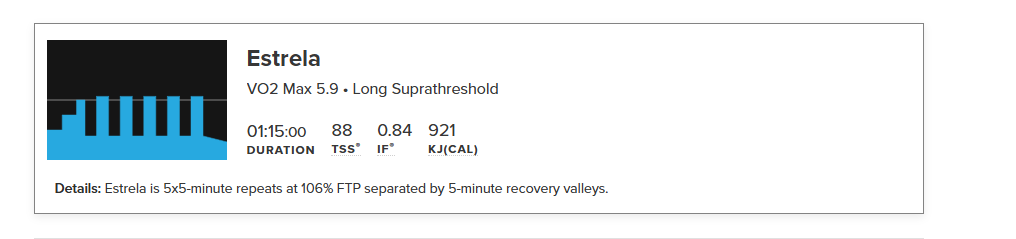
ok I cleared all my filters, I accidentally still had 1 hour checked, put in 5x5 and came up with this:

I also had intervals checked before but this comes up under long suprathreshold.

2 Likes

Ahh! Thanks. Yeah, I tried searching on 5x5 but like @mrtopher1980 I had checked VO2 and “Intervals” and it didn’t come up.

1 Like

There’s nothing stopping TR or any online training plan from addressing limiters and weaknesses. TR learns your progression levels. They have training plans/settings geared towards specific targets. And even TT specialists need to raise VO2max to raise their FTP. And even at the start of the training season VO2max work is what to work on if their fractional utilization is already high.

IMO, TR should get a good assessment of an athlete’s full performance ability (tempo, threshold, VO2max) at the start of training. Also ask questions about the athlete’s goals, perceived strengths and weaknesses and what works best for them. Only then should it build the training plan. And it should explain the rationale behind it. IMO that would be a better product and more clear for the users, which would increase compliance and satisfaction compared to the current extreme opaqueness. Include some regular forced check-ins with the user on how things are going.

None of this requires AI, just a well-chosen set of questions and answers to choose from plus a good algorithm and logic tree. It’s not that complicated to implement. The tricky thing is picking the right questions and answers to use and the decisions to make based on those, but that’s what human coaches do anyways. It’s not like they do different questions for every client. They are following a pattern.

If I weren’t really busy already with work and life I’d go ahead and team up with a coach, make that product and commercialize it. I’m fed up with the poor existing products.

7 Likes

I meant something different: my bad sprint is a weakness, but in a TT it isn’t a limiter. In a road race a bad sprint could be either, and you (= the human) needs to decide what you want to do. Afterwards you can instruct TR to create a training plan accordingly (or modify one accordingly).

No need, TR has your training history and can/does compile a profile from that.

I reckon misdiagnoses would be a significant issue. I once went to a PT with knee issues. He had me walk up and down, titled his head and said: clearly, the problem is with your right shoulder.

That’s a bad idea for the vast majority of people. Even when you are a coach you likely wouldn’t follow a script, but adapt the take-in session to the athlete. Perhaps someone misdiagnoses themselves.

What I would agree with, though, is that TR explains what the goals of its training plans are and how that will be beneficial for the discipline you chose.

Yes, but TR provides zero guidance for that in the product. Newbies don’t know what their options are or how to pick. They can go listen to hundreds of hours of podcast or somehow know to look for an article on the topic that covers it, but the product doesn’t mention this. It should be part of Plan Builder IMO.

Not if they are a user that didn’t have power before. Or they have not done maximal efforts at long and short durations in the past 6 weeks. A PD curve (and PLs) are only as good as the data feeding them. At best TR will give a ramp test but they really should do something like 4D Power profile.

No matter what, the training is in the athlete’s hands: they either follow it or they don’t. The product can try to explain what it’s doing to encourage compliance as well as highlight progress towards that goal to maintain motivation. TR falls short on both.

Also, does TR even have an experienced coach of athletes on staff anymore? They have successful athletes, but a successful athlete does not make one a successful coach. They have Jonathan who is a USAC certified coach IIRC, but I’m not sure that he’s directly coached anyone, let alone a roster of athletes.

It’s surprising how little they integrate coaching questions into the product. They assume the athlete is either so novice that any training they give is going to help or that they know so much they can self coach and know when to break away from the plan. IMO that’s a bad strategy

3 Likes

I really like your idea that TR should expose more on why it does something as well as additional metrics that are relevant to that particular athlete. The tricky thing is that beyond FTP, there are very few performance metrics (outside of race performance). I’ve participated in discussions on this precise point in the past, e. g. in the feature suggestion/wishlist thread. My hope is that TR will implement this at some point down the road. Right now they seem laser focused on implementing and improving their algorithms, and they seem to neglect their apps.

TR does highlight progress via Progression Levels, and the way it is displayed feels a bit like gamification of training. It is also a tradeoff of their approach: ML models are a black box and you fundamentally cannot extract the whys and hows from it.

Do newbies really need such complicated choices? If you don’t have any background in structured training, any training plan will significantly improve performance and the question of weaknesses, limiters and such shouldn’t be posed at this early stage. TR’s approach is their good (human) support by knowledgable people and their education efforts.

Plan Builder and TR are used by vastly different athletes, which poses a problem. If it needs to work for professional athletes and people with zero training experience, you need to design a product very carefully and not just add stuff. I hate wizards/decision trees with a passion, they always feel as if they are hindering me rather than helping me.

Sounds to me like a solution in search of a problem. For starters, you’d have endless discussions about how to test these abilities (just think of how many circular arguments we have had about FTP tests). For untrained individuals a test might give the wrong impression as they haven’t developed their abilities at all and any training plan will lead to rapid improvements. Moreover, once they have some training under their belt and some data, you can extract this information anyway.

Such an evaluation cannot be implemented via a decision tree. Remember the example I gave, where I had an issue in my right knee and the actual issue was an imbalance in my shoulders.

Good question, I don’t know. If memory serves, @Jonathan has coached athletes at a high school.

I’m not surprised, it seems a deliberate design decision. Coaches interact with athletes one-to-one, and their personalities need to mesh. One athlete just wants to be told what they should do. Another loves numbers and needs to know what is going on and why the coach makes certain decisions. Some like tough love, others are sensitive. Coaches provide the human element in the equation. Coaches understand context that’d be hard to implement (e. g. to distinguish someone who is fast vs. someone who is fast, wants to win a particular event and is willing to give it their all). They understand that they can’t push someone to train 5 hours outdoors when life circumstances (e. g. kids) don’t allow for that. Or when someone works day and night shifts, which complicates their training schedule.

My impression is that TR has been designed to complement that, i. e. it is not designed to take the role of a coach. That comes with the obvious drawbacks, some of which you listed. However, it also comes with the advantage that it focusses on being a scaffold for someone who self-coaches, i. e. these decisions are made by the athlete themselves. TR tries to educate athletes with its podcast. They have deliberately chosen this demographic and are trying to build a product for them.

When it comes to replacing coaches by AI, though, AI/ML just isn’t there yet. CoachCat is trying that, but I haven’t tried it and can’t say how good it is. My experience with LLMs in general is that they still need human supervision, because it is surprisingly easy to get completely non-sensical or subtly wrong answers from them. And they are limited by their input, i. e. CoachCat is just implementing the coaching philosophy developed by CoachCat, the company, because it has been trained with the interactions between their athletes and their human coaches. It is an amalgamation all their coaches, which brings its own set of problems (outdated coaching strategies, mixing sushi, ice cream and steaks, etc.).

1 Like

Coachcat is trash. Complete junk, unless you just want ai telling you how great you are…its good at that

4 Likes