I’m a T1 Diabetic and have been using CGM for 12 years. I can confirm that staring at the CGM data all day long can definitely lead to a very myopic view on ‘nutrition’.
If you have a functioning endocrine system (lucky), the data that a CGM gives you is a very small glance of what’s going on with the balance between insulin and blood glucose. It’s like driving in a snowstorm and staring at the line on the road BESIDE your car: you don’t know what’s coming up! Firstly, as others have mentioned, a CGM is measuring (at best) what your glucose was 5 minutes ago and that value could be +/- 15% your actual glucose level. Secondly, your BG value is really only useful if you ALSO know your IOB: insulin on board. If you aren’t on an insulin pump (again, lucky bastards) you have no idea how much insulin your pancreas has dumped into you from that last gel. Or, for that matter, if you also have a bolus of glucagon in your blood from that hard climb you just finished. Or maybe you’re going for a KOM and the adrenaline created a massive BG flush. There’s ALOT going on in there! It isn’t all simply correlative to those empty moon pie wrappers in your bibs.
I’ve often been curious to see the CGM data from a non-diabetic, but I would advise anyone with functioning beta cells to take the info with a grain of salt. Or a bag of Haribo, perhaps.
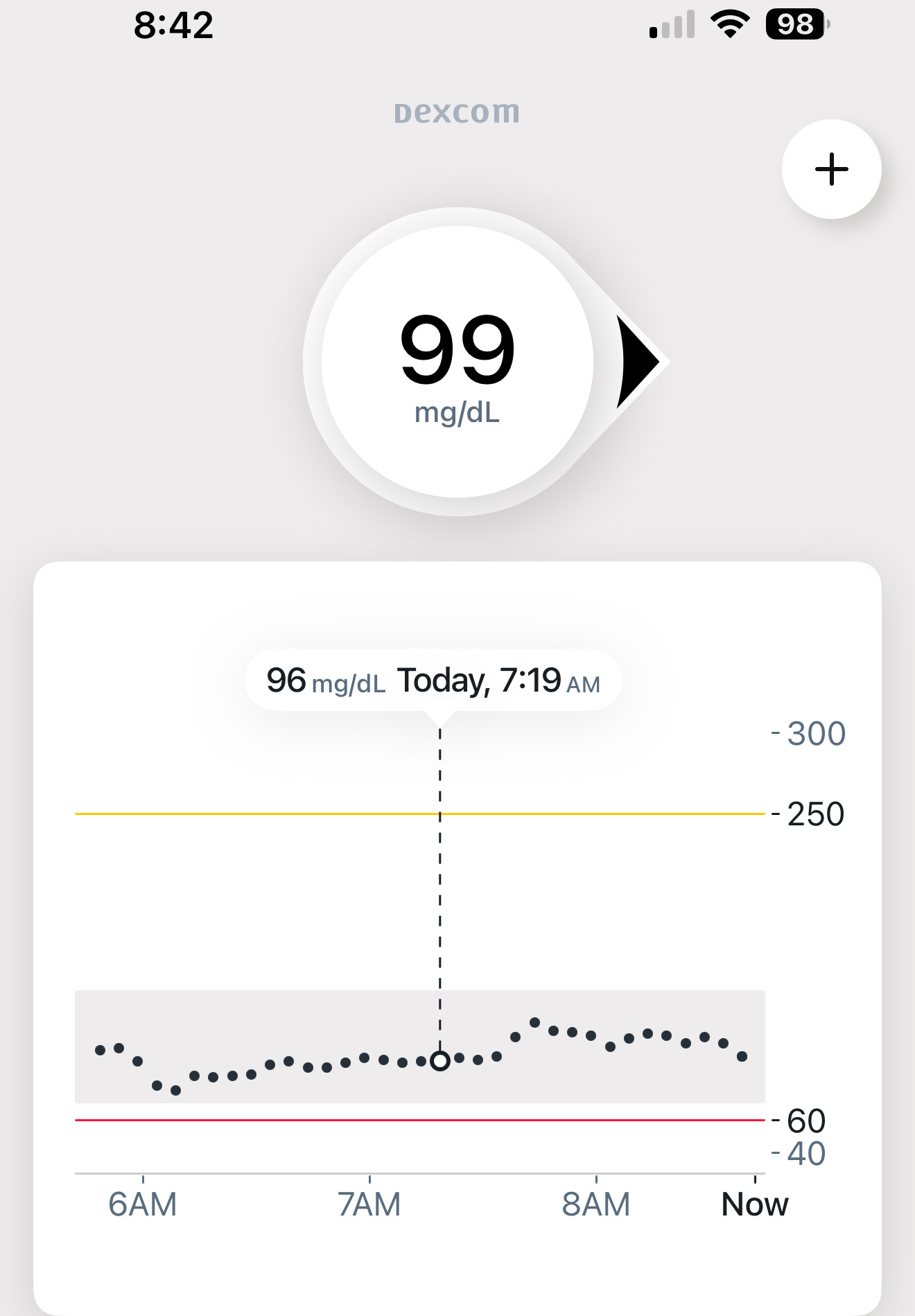
This morning was a 90 min Z2 ride at .64 IF. Started at 5:50 a.m. had around 5-6 bites of steel cut oatmeal before I started. Had 25g carbs of Swedish fish at 10, 30, 50, 70 mins. I jumped straight into meetings after and wasn’t able to have breakfast (steel cut oatmeal and protein powder) until around 9:15. Good to see the blood sugar didn’t crash post ride - it’s rare that I don’t have breakfast immediately after my sub 2 hr weekly Z2 rides, however.
400 calories consumed, 966 burned. 90 mins Z2 is the longest I’ll go being in this kind of calorie deficit. Much past 90 mins and I’m in the 100g carb/hr camp. Interval rides (of any length) I’m also closer to the 100g carb/hr range.
Same as yesterday’s ride, blood sugar dropped pretty quick right off the start and then balanced out very very well.
We stop for coffee on all our long rides. Usually for 30-40 min to enjoy the coffee and snacks. It’s just part of our enjoyment- regardless, we ease back into the ride after stopping. I may try eating some sugar 10 min before getting back on the bike.
So yesterday I had lunch at a normal time, a protein shake around 4, and dinner at 5:55 pm. For dinner I had approx 1 cup white rice with beef and an onion gravy. My blood sugar peaked about 30 mins post meal at 37 mg/dl higher than when I ate.
I did the exact same today but had dinner at 5:30. I ate the exact same meal but substituted brown rice for white rice. 30 minutes post meal my blood sugar had risen 10 mg/dl, it did peak about 10 minutes later, but still only 15 mg/dl higher than my dinner blood sugar.
As was mentioned elsewhere in the thread, fats and proteins seem to blunt the effects of carbs in general. I would bet it’d be a bit more pronounced if having those carbs alone. I was fasted from carbs for 4-5 hrs before each of those meals.
Although the white rice was higher, only rising 35 (100>135) is totally reasonable. In the past I’ve had simple carbs (white breads/instant oats) that have skyrocketed me from like 100>185+. To me, that’d be a concern over a long period if someone was eating like that over every meal.
There’s other factors mentioned in this thread that aren’t really measurable, like other factors that may have contributed to my body releasing insulin to counteract on a certain pulsating type of cycle that could have impacted this comparison as well.
Either way, I feel pretty good about any meal that doesn’t spike my blood sugar past 140/150. I eat “pretty healthy” but still have white bread and ice cream occasionally. Being mindful of how much they spike my blood sugar at least keeps me in check. Leaving next week for a 2 week Colorado trip and you can bet I’ll be eating the sh** out of like a half dozen s’mores on multiple nights.. hopefully the Dexcom has expired by then
Hunter Allen has a new book on the subject coming out shortly. I have ordered a copy. I’ve been on the fence for a couple of years about purchasing a glucose monitor for an endurance athlete that is not a diabetic. Most doctors seem to think they are a waste of time - but most doctors aren’t athletes:).
A lot of doctors, and people, think you don’t need to care about blood sugar until you’re a diabetic. Someone doesn’t just go from a fasting blood glucose of 90 one day, to 130 the next. It’s usually over years of poor dietary habits, being overweight, lack of exercises, and a little genetic predisposition sprinkled in. Peter Attia has mentioned it countless times. Doctors often dont want to get involved until you’ve passed that diabetic threshold.
It’d be like thinking there’s some magical thing that happens where a ride at 54% FTP means nothing as it’s recovery, vs 55% being Z2…
People can monitor their blood sugar occasionally and at least be mindful of what foods have certain effects and make some reasonable lifestyle changes to moderate some of the effects. It doesn’t mean you have to go keto, but maybe less sugary cereal in the morning or ice cream before bed.
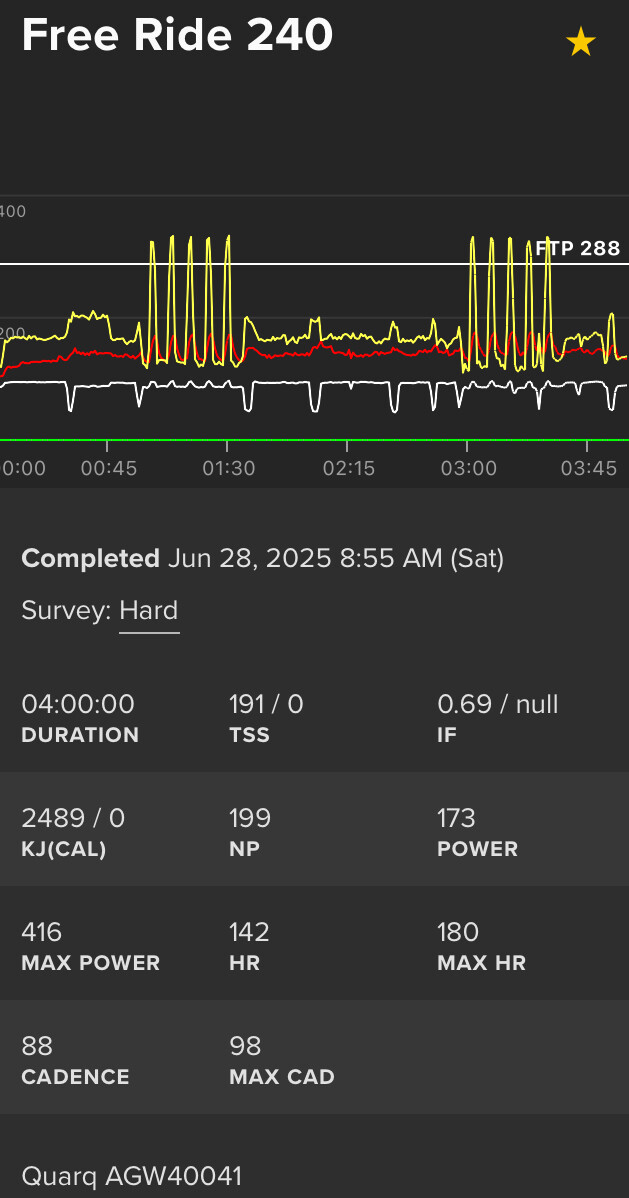
I did a 4 hr Z2 ride yesterday with 5x2 intervals at 1 hr and 3 hrs yesterday. During the ride, I ate 100g carbs/hr the full ride (approx 15 min fueling intervals), and stopped at 30 mins before the ride ended. I was pretty full after and didn’t eat for a couple hrs. My blood sugar sky rocketed for a long time and later crashed to the point I was experiencing a bit of hypoglycemic side effects. I’ll make a more detailed post with numbers later on.
At around 9 a.m. I started a 4 hour Z2 ride. I did 5x2 intervals @330 watts at both 1 hrs and 3 hrs in. For breakfast I had a large bowl of Frosted Flakes with a banana. I do oatmeal w/ a scoop of protein every day but my long ride days so I have something to reduce the fiber. The Frosted Flakes/banana skyrocketed my blood sugar to about 163 mg/dl, compared to the normal 125ish from my oatmeal.
During the ride, I consistently consumed 25g carbs (100 cal) every 15 minutes. I had 3 bottles with 266 calories of tailwind each, spread over the 3.5 hrs, plus having 25g carbs on 30 minute intervals. I stopped consuming all carbs at 3.5 hrs into the ride.
Over the course of the ride, my blood sugar stayed incredibly stead around 105-115. Steadier than it is at any other part of the day or night. Wild how steady it stays. After the ride it skyrocketed into the 150’s and stayed there for nearly 2 hrs aside from a short dip in the middle. Significantly longer than any spike during the rest of the day. I was completely full from the intra-ride calories so didn’t eat anything until 3:20 p.m. (2 hrs 20 mins post ride). At that point, I had 45g carbs with a protein shake, pretzels, and hummus. My blood sugar was 115 at the time of consumption.
Within 40 minutes, my blood sugar crashed down to 72 as confirmed by both the monitor and a blood test via finger prick. At this time I started to feel low blood sugar side effects (anxiety, bit of chills/hunger). The carbs must have kicked in soon after as it was up to 112 by the time I had dinner at 5:45 pm.
I’m not sure what I expected in all this. I had hoped stopping the carbs a little earlier would minimize the post ride blood sugar spike. I was also a bit surprised/disappointed that it stayed elevated for so long. I’m not sure how or if this could be combated nutritionally.
Anyways, There’s a million other conclusions that could be drawn from this, ranging from “not concerning at all” to something that should be avoided if possible.
I don’t fall in the camp of, “well you’re not a diabetic, so everything is normal/natural.” Not saying the sky is falling, but I also think that too much over a long term could eventually lead towards some negative consequences.
Can I ask you something? And please don’t perceive this as me being dismissive or argumentative? I honestly want to figure out what your goals are and what you want to learn from this exercise.
What are you hoping to get out of it?
How are you interpreting these numbers? My understanding is that context matters hugely, and numbers that indicate a problem while sedentary are actually what you would like to see when you are exercising?
Do you need a CGM or other forms of glucose monitoring that you should follow hunger cues by your body?
Great questions:
1- I ultimately want to see how my body interacts with different foods so I can make good food choices. From what I’ve read, reducing huge blood sugar spikes can minimize the chance of type 2 diabetes and other health issues. While occasionally I don’t think they’re a problem, being in habits of good food choices (like steel cut oatmeal vs Frosted Flakes) I think can pay dividends later on. Some people will eat crap their whole life and be fat and sedentary and never have problems. Some people will.
Also - a big part was seeing how exercise and all the intra-workout sugar affect my blood glucose. From what I see, it’s eerily perfectly smooth during the whole activity, but spikes pretty hard for a long time afterwards. I’m not sure if there’s anything I should do to change that, and if so, what that is.
From what I’ve read, a non diabetic should have a fasting blood glucose under 100 and spend 95% of the time between 70-140. That allows for the occasional spikes. Peter Attia, who I admire greatly (in most ways) further says that average blood glucose should be lower than 100 and you should avoid foods that spike over 140. In terms of interpretation, there’s a million factors, some great ones that have been mentioned by others in this thread. The longer someone wears something like this and more data they get, the better conclusions can be drawn. I should really wear one for a dozen long rides with different fueling and post workout nutrition samples to draw a good conclusion.
I think you may have missed a word in your question for me to fully understand. But in short, no non diabetic needs to do this, however I find it incredibly insightful. I think the majority of people would find this beneficial if they wanted to make better food choices and seeing how foods affect them. I eat better than probably 90% of people (99% before I had kids ) but still seeing how certain foods impact me does make me conscious to make some better choices. I should probably wear one for a week, ever 6 months, as a reminder. If people just make conscious choices not frequently indulging in high GCI carbs and are mindful of their choices, it wouldn’t be necessary - although IMO would still be interesting.
My understanding is that physical activity and not being obese greatly reduce the risk of type 2 diabetes. How do blood sugar cycles compare to that in importance? Better blood glucose values might simply be the product of lifestyle changes that have kept your weight in a normal range and you physically active.
My understanding is that Peter Attia is not a scientist. It doesn’t mean he’s wrong, but questions like “good” glucose levels should be subject of studies. The advent of CGMs should make this easier. Moreover, just going by what you wrote, blood glucose numbers need context to be useful.
Honestly, this is where efforts like yours might be interesting, though. Although if it were me, I’d refrain from being prescriptive (e. g. under these circumstances my blood glucose level should be in this range) and simply look for patterns.
What I meant to say was that it seems to me you could just follow/anticipate your hunger cues instead. It’s like HRV telling me I have had a bad night.
How do you keep track of the context? Do you keep a journal of sorts?
There is a lag, but they are still 90%+ accurate, and certainly consistent enough to see trends, spikes, etc. In my own testing, it was VERY easy to see which drinks/gels/meals were giving me a manageable rise in blood sugar before, during or after the workout, and which gave me a spike or crash. I was able to tailor my pre-ride loading and on the bike nutrition to suit my own metabolism.
A CGM isn’t a silver bullet, but if used properly it should provide some great insight into your body’s response to specific carbs and behaviors. The 10-15 minute lag between blood levels and interstitial values simply needs to be figured in when evaluating results.
@OreoCookie I’d agree that inactivity and obesity are more likely to cause type 2 diabetes. That being said, most obese people aren’t getting that way via a healthy balanced diet and low glycemic carbs. If so, I’d bet there’s a less chance they’d become diabetic.
You’re correct that Peter Attia is not a scientist, but a medical doctor. One of the most knowledgeable people on longevity and health span. Much of his knowledge and recommendations are based on scientific studies and experience with his large clientele base. Perfect example is that they used to prescribe clomps for Low T but over time found certain questionable changes to blood markers and discontinued.
I definitely agree that patterns will be most important. Through the Dexcom app I log every meal, what I ate, what time, how many carbs, etc. you also log specific activities and can add photos of anything. I should keep a separate log but haven’t yet. The app is pretty detailed.
@jkyle - my examples with instant oats were plain/unflavored. I added the same sugar free maple syrup that I use in my steel cuts. Some more tests between different oats would be worthwhile again the next round of testing. This was short and most of the time is now on vacation.
My example above regarding the fueling during the 4 hour ride I stopped consuming calories 30 mins before the ride ended. I had fueled enough by that point I didn’t feel any sort of bonk. I agree maybe trying 45 or doing a longer cool down could be beneficial. Definitely deserves more testing.
High glycemic foods are not inherently dangerous and when mixed with fat and protein turn into a lower glycemic meal. Our bodies are designed to deal with eating ice cream.
The only problem is constantly eating the wrong foods - sugar cereal every morning, drinking soda all day, fast food for lunch, frozen or take out dinner, ice cream after dinner, etc, etc. A crap diet usually goes with gaining pounds over the decades, and the possibility of getting diabetes or heart disease some day.
I don’t agree with Peter Attia’s ‘keep it under 140’ for every meal (if that is his actual stance). That implies that if you ate ice cream once a month, you did something negative to your health. I doubt a high glycemic treat once a month would move the needle on one’s health.
It’s all about the overall dose of the poison and a CGM doesn’t track that.
This is about what I thought (hoped) it would be. I always pair white rice with protein and fats, so the difference between white and brown isn’t too much, especially if I blunt it further with a walk after. I can also feel the difference between big spikes and little spikes just listening to my body. I’ve never felt white rice was raising my BG too much compared to say straight up simple carbs (non paired).


 ) but still seeing how certain foods impact me does make me conscious to make some better choices. I should probably wear one for a week, ever 6 months, as a reminder. If people just make conscious choices not frequently indulging in high GCI carbs and are mindful of their choices, it wouldn’t be necessary - although IMO would still be interesting.