This update has been surprising and at times, frustrating. I’ve spent a significant amount of time trying to understand the behavior of the new system.
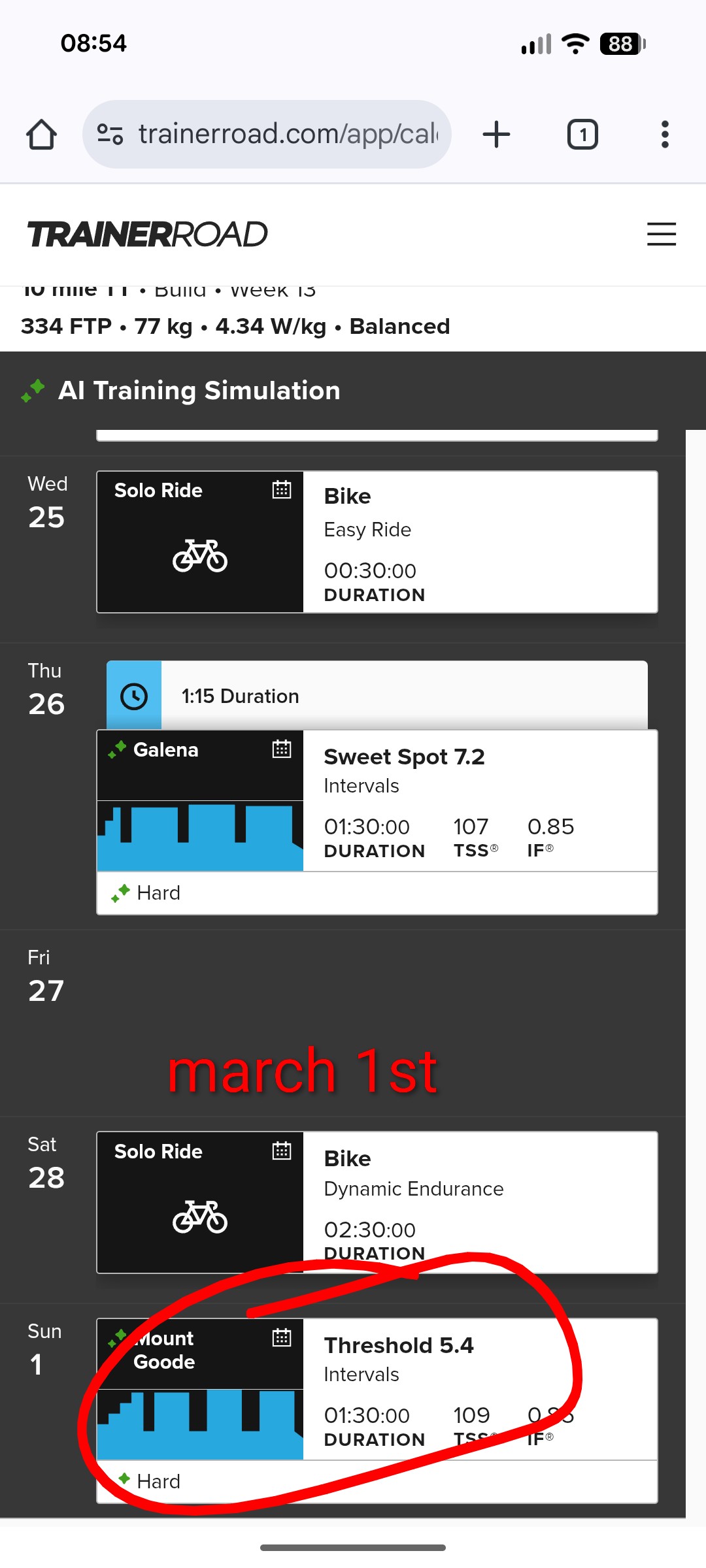
I’ve been testing the calendar since beta switching between my actual FTP and the inflated value to compare the resulting workout prescriptions. With my real FTP (in WKO5, incl. TTE. Previous AI FTP from TR was bang on), the workouts are well aligned. Appropriate O/U targets, baseline is 3×10+ at FTP, or 2×20+ at SST. With the higher FTP, however, I’m assigned level 1-2 FTP workouts such as 5×5 at (physiologically) 110%+ FTP, which places the effort in max aerobic territory and doesn’t match the intended training stimulus.
The system appears to struggle in a few specific areas:
• Endurance rides above LT1 (workaround: manually setting conservative endurance rides)
• O/U workouts being at FTP/over (workaround: avoiding TR for these and using Intervals.icu values and the workout builder)
• Low-level FTP workouts (levels 1–2) being prescribed at physiologically suprathreshold intensities (e.g. 5×5 min) (workaround: manual FTP adjustment to avoid these cases)
That said, my predicted FTP is now trending back toward my WKO5 values, which makes me cautiously optimistic that this was a calibration issue specific to our use case, i.e: trained cyclists with high workout levels in the old system.
I’ll continue using TR for now, in the hope that the system stabilizes. Despite the criticism above I still think it’s a strong tool that mainly needs some fine-tuning.
If I were to suggest a change, it would be to calibrate AI FTP using a level-1 baseline such as 3×10 at FTP, rather than the current level-3 effort. This would likely reduce FTP inflation for many TR users (even if I understand it wouldn’t be popular with everyone), while aligning more closely with physiological markers and remaining consistent with TR’s system.
Feedback / feature request: it would be very valuable to have a slider allowing users to bias the system between intensity and TTE. I understand the core demographic includes newer cyclists, but for athletes past the rapid noob phase, a TTE-biased approach would resolve many of the issues described above.

 ?
?