Fitness score is pretty much the request you made above, combining FTP and PLs into one TR specific ‘fitness score.’ At least that’s how I understand it. I would like to see this too.
Right now, I would settle for TR finishing / adding additional functionality to already released features:
- Finish out the Apple Health / Fitness / Apple Watch Integration so that completed TR workouts - with power - are pushed to Apple Health / Fitness
- Enable Historical AI FTP Detection every 28 days - allow users to generate AI FTP detections (on a 28 day cycle) for their complete training history prior to AI FTP Detections release / prior to the users first run of AI FTP Detection. So as not to overload TR infrastructure, this could be done via a request, and then TR would schedule it so the load could be spread over days / weeks
3 Likes
Oh right, was that the one where Nate was saying he’d considered just assigning a number, which is a combination or wattage and duration, kind of like lifting, where you might have an 80, and it’s a measure of how much work you can do?
Please yes! Do the 2nd bullet.
To clarify what mtbjones said, this can be accessed using the web browser. Really I think it’s more comprehensive than what strava gives you. Go to the Trainerroad website -» Calendar -» select a workout (it pops up in the drawer on the right) -» select “View Details” & you get all the juicy data there. You can select an interval or any other selection & it can show you time in zones for whatever’s highlighted, & you can even define your own zones (but I haven’t). Here’s a section from mine yesterday, when after intervals I added some… Z2½ I guess you’d call it, on some commuter cycle paths & the foreshore with my phone in a top tube bag:

If it’s recorded as an outside ride it can show you a speed profile, but that’s turned off by default. It comes up as a teal line when you select it from the top of the chart where other data types are.
Super valuable for outdoor rides, or trainer rides where you’re not using erg mode, self-gauging compliance, that sort of thing.
3 Likes
I’d really like a couple of green stars at the top left of my workout. No real reason, just think it’d look good.
12 Likes
I would like a W/kg chart, rather than just FTP.
2 Likes
I’d also like it if TR could say something kind to me, a bit like Athlete Intelligence does on Strava
3 Likes
Mywhoosh integration
3 Likes
Recovery profiling using HRV, RHR sleep etc. use the data to feed the AI recommendations
3 Likes
ROUVY integration
3 Likes
Please no. If AI adapted my workouts based on HRV I would never get any hard workouts prescribed.
2 Likes
It’s only a suggestion your subjective assessment wins out on what to accept. Where it’s useful is if there is a negative trend.
When trainer road summarizes a workout I would love to see a summary of the power zones with target durations. It would be a big help in trying to match my local MTB terrain to doing the workout outdoors.
1 Like
TrainerRoad has options in the calendar to add a Zwift race or replace a planned workout with one, but it’s a manual process to add it, enter any details about the race, and move it around if you reschedule it.
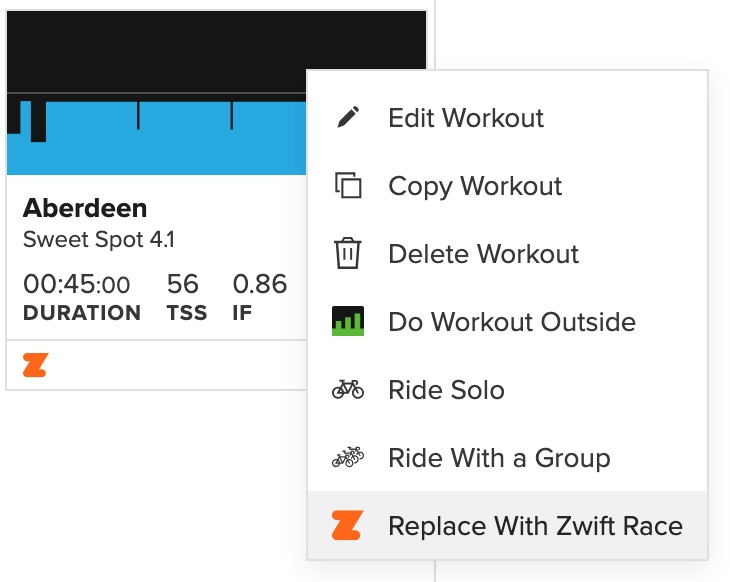
I would love if signing up for an event in the Zwift Companion app automatically added the event with all its details to the TrainerRoad calendar, so it can be my source of truth for my training and racing (especially since Zwift doesn’t offer an iCalendar feed for events). It could also trigger adaptations automatically, such as offering to remove existing workouts from the calendar, or put them back if I remove myself from the Zwift event.
This would obviously need collaboration with the Zwift team, but since there seems to be a much closer partnership between both teams thanks to the Zwift integration, I’m hoping y’all can find a way to make it happen.
2 Likes
Thanks, Eddie, totally forgot about this thread. Sorry!
1 Like
If consistency over time is the best predictor of sustained performance improvement (I believe they’ve referenced this several times on the pod), I’d love to see some sort of consistency rating. A macro-level “here’s you as an athlete” (years long time horizon) + scoring training phases (adherence to the plan).
8 Likes
I had a long private conversation with Nate on this exact same idea - I sent Nate a private unsolicited “suggestion” message, which is what started this conversation. I’m going to paraphrase just what I suggested to Nate, and NOT anything from Nate as this is from a private conversation. Note the below is somewhat disjointed as I’m not including Nate’s questions / comments to me, just what I suggested to Nate.
My Suggestion:
TrainerRoad should implement a customer dashboard that summarizes how I’m doing, how I’ve done. E.g., Ave. # of hours / wk of scheduled rides, Ave. # of hrs / wk of total training, compliance to training plan, compliance to structured rides, change in FTP, performance to event goals, etc.
Thought process:
Currently the TR website makes two very large “promises” to users:
- Get Faster with Adaptive Training
- What Do you Want to Achieve
But how do I as a user understand if TR is working for me? How well is it / isn’t it working for me? And what did I do differently this season vs. last season(s) that changed how well TR is / isn’t working for me (e.g., I was on a LV plan last season, and I decided to do a MV plan this season. Was that a good / bad decision? Am I doing tons of non-structured rides - e.g., not from a plan or TrainNow or custom TR workout - this season compared to last season(s). How is this impacting my overall progress?)
I think having a dashboard - would obviously evolve over time - that cleanly presented how I’m progressing this season, and what I’m doing well (e.g., high plan / workout compliance) or not so well (e.g., lots of long group rides that lead to low workout compliance), would really be beneficial to users and to TR. For TR, this would be the next evolution of Adaptive Training: helping the user understand what they are doing that is either in alignment with their goals or working against their goals.
A compliance score could encourage over training, but if you factored in the Red Light / GreenLight into the compliance score, that would counter-balance pure workout compliance driving over training.
Workout compliance is only one part of what I’m envisioning. I’m thinking something more comprehensive that would help me understand what is it about all the riding I’ve done this year that yielded zero change in fitness vs last year I upped my FTP by 20 watts for example. Is it workout compliance? Overall plan compliance? Overall plan compliance plus higher (or lower) overall volume? The real gold star would be how are unstructured rides / group rides impacting my training?
I’m thinking of a dashboard that would help me figure out what is the right balance for me of total training time, structured vs unstructured riding, and what is the benefit or penalty from group rides.
Using me as an example: group rides are my social time, so I’m not going to give them up. But what is the cost or benefit I get from these? And am I better off pairing my long 3 to 5 hour group ride with a LV plan vs being on a MV plan and substituting my group ride for. A structured workout. Or does my history say I only make gains if my weekly volume is consistently over 10 hours / week?
How I compare to other people is interesting. But I’m interested in what learnings my training history says I should do to improve me
On compliance leading to possible over training: once RLGL is rolled out, maybe a compliance metric that “docks” compliance points if you train on Red days, and maybe if you train on Yellow days.
So more like a compliance to work and recovery combined metric
I agree this isn’t perfect, but I’m thinking about this as a look back feature as opposed to something you’d check daily. That is: as I’m thinking about my 2024 season, how many events to target, what training volume to target, mix of structured TR workouts / plan to unstructured, etc. what can I learn from past? Do I do make the most gains following a low volume plan, and then adding in extra workouts? Or does that lead to lower overall gains than a MV plan, because on the low volume I add in too many extra rides that mean that I under-perform on my key workouts? Do I do better on 3:1 (like the new plans) or 4:1 or 5:1 work to recovery ratio. Etc.
if before training I filled out the “how do I feel” (e.g., fatigued, motivated, not motivated to train, etc.) you could capture more info on whether or not Workout Compliance is being prioritized over Recovery Compliance (you should trademark that  ).
).
My general thought is: What actionable info can you provide to your TR athletes to help them think through what they should do holistically to keep improving season over season. Adaptive Training is “great” day to day, but it doesn’t address the season over season, or even in a season (or week) how do I trade-off just doing structured riding vs. group ride with friends? Or even what is that trade-off? Maybe leading up to my big event I trade-off group rides with friends for more structured training to maximize my performance for my big event. But after my big even I prioritize riding with my buddies, even though I know I won’t improve as much.
12 Likes
I think this is what a lot of us are after, if said differently. A clear space for TR to excel would be in giving insight around what’s worked and what hasn’t. Lot of apps prescribe, but they don’t really give you the why. I wouldn’t let the perfect be the enemy of the good either.
If I asked, ‘what about my training in 2022 made me successful on days X and Y’, I don’t need an ironclad answer - there probably isn’t one - but a menu of possibilities would be really helpful.
3 Likes