keep power the same, progress duration
its better to slightly undershoot than overshoot. again, when it doubt just go longer.
maintenance mode or hold volume/weight, but certainly not progressing. good way to add too much fatigue to legs.
This.
Progressing power leads to doing suprathreshold efforts especially as you fatigue, and that’s why you blow up after two weeks. Progress TiZ, and do so less aggressively than you do in Sweet Spot.
Keep power the same and progress duration.
Better still is probably to turn ERG mode OFF, and ride based on how you feel. FTP varies day to day so theres no need to lock in on a set power number every ride. When you’ve done a few sessions and know what it feels like to nail these, you can ride them by feel and you might see +/- 5w day to day but that doesn’t matter. As long as you keep it pretty close you’ll be doing the required work.
Quoting myself here, because my thinking on this has changed a little bit.
I’m much more inclined to base where I start off of TTE of the specific rider. I don’t hesitate to give a 3x10 to a rider new to structure with a short TTE. I might not get to 3x15 with them for a month or more in a straight threshold progression, again depending on a number of things. I’d rather ease someone in to this kind of work. More experience, higher training age… rip the band-aid off.
So much that this season with a higher mFTP (which I’m actually ignoring right now anyway, using a lower value/feel), I started myself at 4x10, then a 3x15 which was pretty brutal today coming off a hard week and as I’m still working on increased volume. I largely managed it - the first two were totally clean; the last one was not. My TTE is needs a lot of work right now having come off of COVID in January and not done much sustained work other than maintenance since then… it’s showing… and so now I’ll go back to 2x20, and then look to progress TiZ back up from that “baseline”.
TL;DR: it depends.
So, has anyone here… maybe @WindWarrior ? played around with short threshold intervals during base? Say, running a progression of 4x4 → 4x5 → 5x5 → 5x6 → 4x8 (“Seiler” or hill intervals) run by RPE, all on 1-2 min recovery, and done it for several months?
I ask because now with all this time spent deep in backed-up learning, specifically on “polarized” training (which isn’t new), I’ve been going back through old Fast Talk Labs stuff listening to Trevor Connor and noting that his preferred base progression is high volume with a threshold progression like this roughly twice per week, less tempo and sweet spot, and some neuromuscular work (which I’m a fan of year-round).
Now, he’s a noted proponent of year-round polarized training, and I’m not there yet… but curious if anyone has experience with this kind of threshold training themselves? It’s a bit squishy in terms of polarized in that you’re probably riding at, maybe slightly above, MLSS/LT2, so the whole thing gets hazy in that regard.
That said, as I’ve personally increased volume up to 10-12 hours per week over the last six weeks or so, and aiming more to the 12-15 hrs/week in base for this coming season, it’s something I’m willing to try since trying to do a SST/Tempo progression with long durations will probably incur more fatigue than I want at that volume.
Anywho, open to thoughts!
yes, but not that type of paper progression. Looking back to January its an interesting mix of work to pull up threshold. January started with ladders, to short threshold (7-min), to over/unders (1-min above threshold, 7-min tempo), to ‘sweet spot’ (=92-95% with my coach), to longer threshold (8-min), to pyramids, to stair climbs, to longer over/unders, to step-down progression, and on Monday I did 5x6-min at threshold with 2-min rbi. Beyond that its a homework assignment if you want to look at my intervals on Strava (easier to see on mobile app). Apologies I don’t use the interval workout names when naming my rides in Strava. But Monday, Wednesday, and Friday are usually the days I’m doing intervals.
What you wrote about Trevor is both vaguely familiar and not. To my eyes I’m not doing Polarized or polarized. What I am doing is trying to average 8+ hours/week, and always some intensity, always some ‘extracurricular’ end of ride neuromuscular work, all year round. The intensity is an interesting mix of work like I wrote above, and its harder to ‘see’ the progressions until I write it out on paper.
Thanks, I remembered you talking about doing shorter interval sessions somewhat more frequently with an increase in Z2 volume, so wasn’t sure about it. I wouldn’t call what you’ve done polarized either, FWIW.
I’m in the way-back machine with Fast Talk right now, going back to the original Seiler podcast and listening to it, hearing Kristen Armstrong talk about her training… pre-COVID episodes, stuff like that.
My gut has always told me “polarized” is great when you’ve got the time… in fact, most people putting in that 12-15+ hrs probably HAVE to polarize their training to make any kind of progress without crushing themselves… but when you’re in that 6-10hr neighborhood, the moderate doses of intensity (SST/Tempo) have more of a place. My team had a pro talk at our camp this year, and he seemed out of touch with “reality” for most people… he just said “Go ride long and slow for as many hours as you can…” Looking around the room there are guys that ride like 6 hours a week spread on four or five days, and that’s just not going to help them long-term.
My biggest issue is consistency, I’ve mostly solved that with my coach (except for allergy issues). Then recovery partly due to having entered my sixth decade. So fewer intervals for me will be different than fewer intervals for you. The intervals my coach has me doing are good stimulus and recoverable at 8-10 hours, and even at 12 hours for the last week of a 3 week cycle. Even something like Monday’s 5x6min is surprisingly good stimulus, although I partly attribute that to the steady endurance work that usually ends up around 70-75%. Tried a little polarized block In the fall 2019, and endurance work was lower around 55-65% and I think that is too low for me, from a performance point-of-view, on 8-12 hour weeks. But first thing about endurance is duration, so if I’m not feeling it then no worries I’ll dial it down to 65-70%.
worth a quick listen to the more recent podcast when he revisits these 5x5 intervals with the coach that originally started him on them - he’s evolving the approach and talks about removing the HR cap he mentions a lot, and potentially even adopting a hard start approach to maximise HR TiZ.
Funnily enough I have been thinking about similar stuff as I finish work next week and aim to increase my weekly hours to 15+. Also wondering if only 1 =>threshold session per week might be enough with such high volume and some ‘mixed’ social rides with a bit of mixed intensity. Last year I just logged big hours up to 20 hrs/wk in summer, and didnt do specific interval work - result was a 20w drop in FTP 
Adding to this, there’s also the debate around supra threshold workouts with shorter durations similar to those you were proposing.
Listening to Evoq bike podcasts they seem quite big fans of going above ftp whilst at empirical cycling the opposite is true.
TR’s specialty plans include longer supra threshold workouts.
However my question is, don’t they actually lead to similar vo2 adaptions pushing HR higher and drifting into vo2 zone?
I still have to make up my mind on these workouts to be honest.
Hopefully this is the right episode, I haven’t listened to it for a bit.
Dan Lorang discussed using high intensity efforts during base/early season. (VO2 rather than Thresh, but interesting)
(ETA: that’s a Greg Bennett show podcast with Dan Lorang. I thought I was sharing a link but it’s loaded as a player  )
)
Yes, Brendan said a while ago that he (paraphrasing) “wasted so much time riding below threshold”, and now he does a lot more of the stuff above it.
I’ve done a little bit of that with some over-unders running around 5 min at 110% followed by three or four over/unders at 110/85. It felt like one hell of a workout - hard but manageable. I’ve yet to pull the trigger on committing to it.
Thanks for the link. I’ve been jumping around the podcast library, so I’ll give that one a listen. I wrote a note in my journal about his HR cap with a big, fat ? next to it. Because Seiler and some of the athletes were talking specifically about doing these by RPE, so capping a HR doesn’t make sense to me if you’re trying to meet the intent of a polarized threshold interval approach.
Agreed. As I look at ramping volume with a lot more time in zone 2 this coming base season, the idea of doing 3x30SST all the time or building a progression as in our other thread doesn’t appeal… in fact, I just don’t think it would be sustainable to progress that much SST time alongside multiple 4-5hr rides per week. So the thought of the shorter threshold intervals inside 60-90min rides early, then pushing them to the end of longer rides later in base, seemed like it might be viable.
Then instead of strict 3x30 intervals for SST, any SST time I accrue will likely be on the climbs during those longer rides once I’ve adapted to the increase in hours in the saddle.
I asked him an indirect question about that on the forum - I came to realise his prescription of 5x5s is not what Seiler etc looked at in the study. Seiler talks about max repeatable by RPE but Trevor is strictly suggesting threshold.
I thought the 5x5 with the HR cap and 1m rest would be far too easy to be of benefit, so tried it one day. Turned out to be a good session when I hadnt been doing a lot of threshold work - I get the feeling it would be a useful part of a high volume base period. He does admit himself that its not a quick win with these and takes time to see results.
Right or wrong, one WKO proxy I like to use when evaluating threshold work is time above 85% estimated vo2max. Here is a snapshot from the time in my season where PDC is accurate:
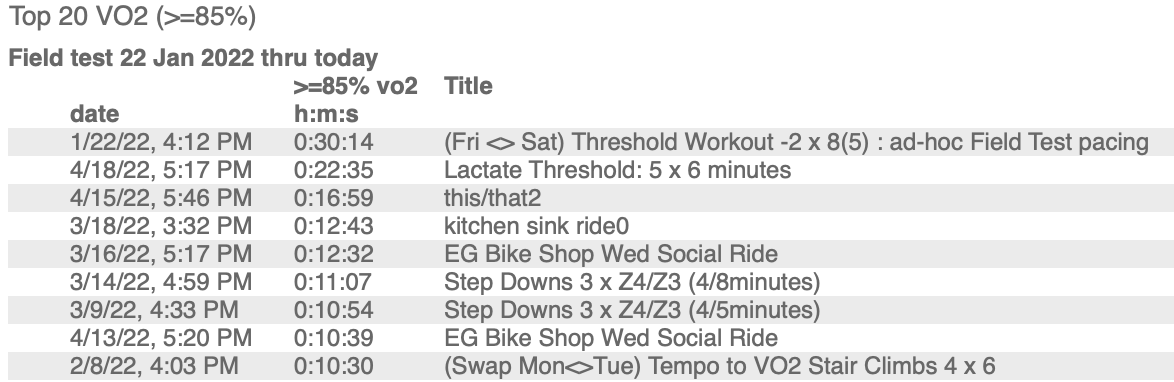
VO2max relative of 45, and ~4.2L/min absolute. That level of work, for my vo2, led to a high level of consistent riding.
First on the list is 32-min ad-hoc pacing effort, felt so good at the end of 8-minutes I didn’t want to stop!
Second one is self explanatory, 30-min at FTP vs 22-min 85%-eVO2max. It was 3 days ago and I was coming off two weeks of low volume (bad reaction to antibiotic) and I was playing it conservative. Also had 2 mid-interval traffic stops that cut into eVO2% time. Here is WKO telling me I should have pushed just a little bit harder:
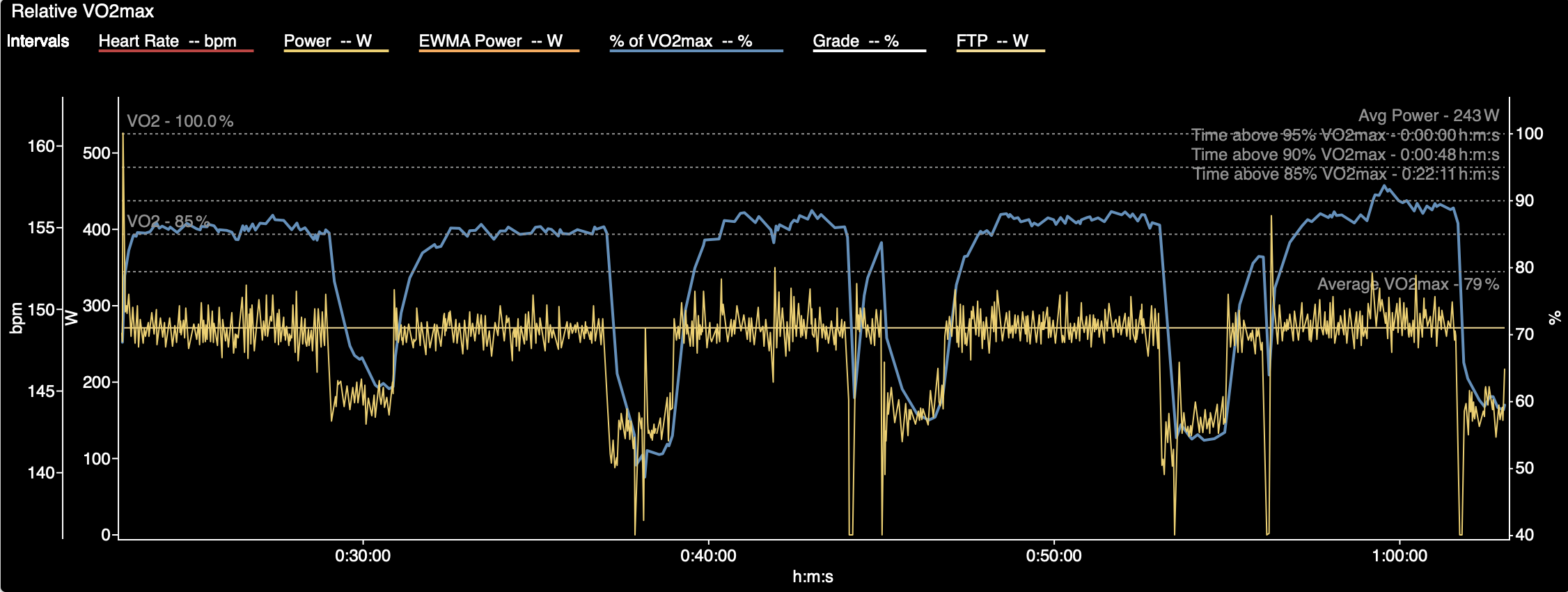
What’s interesting here is 10-20 minutes is a fairly good minimum effective dose, for me, before moving into a build.
Now lets compare that to an actual build phase (January-March 2017), when I had the same vo2max relative/absolute (absolute vo2max 2% higher at 4.3L/min):

Wow, didn’t realize I had that much on the double century and the two TftT club centuries.
More interesting are these:
- 39:13 “Trainer - 4x8-5 Steady State intervals” which is 32-minutes at threshold with 5-min RBI. That was in the gym with Stages stationary bike. 39 vs 32 minutes - must have done some extra credit intensity.
- 29:18 “5x6/3 - 275/175” time and watts in the name, makes that one easy to figure out! Also in the gym. 29 85%-eVO2max vs 30 minutes interval work. Check.
- 27:02 “Zwift - 3x10⁻⁵ climbing repeats” in the gym so 27 minutes of 85%-eVO2max vs 30 minutes threshold intervals. Check.
What’s interesting is that during that 2017 build I piled on the intensity averaging around 82 minutes/week:

and hit 4.2L/min aerobic ceiling, but that much intensity led to inconsistent training.
This year during early base:

hit 4.1L/min aerobic ceiling averaging around 32 minutes/week, its probably a little high because PDC wasn’t properly fed.
One big difference 2022 vs 2017 is that this season I did a LOT of 70-75% steady endurance work, for the same total hours. This time around I’m usually fresh and ready to ride, versus 2017 when I was falling asleep at 8pm. First principles of consistency and volume.
Hope that helps, like I said right or wrong that is one of the ways I evaluate training as a “I’m not a coach but am interested in self-coaching” analytical dude.
This is in line with what TC and Seiler recommend re: TiZ around threshold… 30 minutes being the “sweet spot” for advanced athletes, so us normies might be more in that 20-25 min range if we go by this.
So say I start base at 10hrs, build to 12 before introducing any threshold work… 40 min of threshold intervals (2 sets of 4x5s on two days) across 720min of training gets you at about 95/5 balance of TiZ (1/3). The suggestions I’ve read are polarzation ends up at 90/10 (sessions are 80/20) in your working blocks, so this does seem a reasonable “polarized” approach early in base period.
Yes, two distinct interval sets from the “Seiler 4x8” study vs. these threshold intervals. As I mentioned earlier in this thread, the Seiler 4x8 don’t seem to me to be threshold work, but more MAP-focused (even though they may indeed end up in the Coggan “Threshold” zone in terms of power).
Thanks for mentioning this. I had listened to this episode but not with the context around the 5x5s. Much more informative the second time around and the hard start at 110% makes a lot of sense to me. Like I said before, I have dabbled with long 110% hard starts (which amount to just being 110% intervals before a short set of O/Us) and thought it was a great workout.
Circling back here, I think the simple answer to whether long suprathreshold intervals push VO2 adaptations is “no”, and honestly I’m not sure that’s what they’re targeting. I think those intervals are more about mental toughness and lactate tolerance than anything. They’re incredibly fatiguing, as well.
A couple of really high end athletes (Kristen Armstrong, Brendan Housler) do encourage suprathreshold intervals. KA talked a long time ago about things like 5x5s at 110%, even though some disagreed. Again, it’s about what you’re training for… in her case, she’d do 20-25 minutes of suprathreshold work and then was able to extend that to 45+ min for Olympic TTs. Do you need to do that if you’re a weekend crit racer? I’d say not, but maybe if you’re looking for some stimulus to break a plateau, bang on.
I think what those people are talking about has to do with riding threshold sets by RPE, and being willing to go a bit harder because the intervals are shorter (rather than 2x20s and such). So it’s a distinction between the Empirical Cycling mindset of extend TiZ predominantly and these types of workouts.
Both agree that overall volume is king.
Per you PM commenting about an open question on a % eVO2max to use in mid-to-late base, I think it might be a question of physiology and wanted to share my “I’m not a coach” thoughts:
So 2 threshold workouts a week is a paper target of 60 minutes/week. Now regarding how I look at it and why it might not be the best way for others to view it.
My fractional utilization - threshold as % VO2max - floats around 88-90% early season (base) and drifts down to 84% in season. Early season it is pretty hard for my fractional utilization to go any higher LOL. And threshold HR is about 91% HRmax. Both of these physiology metrics, coupled with some studies, seem to point to the possibility that threshold might be a good VO2 stimulus for my physiology, better than say raising threshold via increases in metabolic fitness (which I might be getting from 8 hours/week of endurance + ‘stuff’). Makes sense, at least to my uneducated eyes. Threshold is already bumping up against the aerobic ceiling.
Now if I had a more normal lower fractional utilization, say in the 78-84% range, it would likely take more intensity than threshold and over/under work to get into weekly 30-90 minutes of high aerobic work. Without having looked at someone in that range, I’d expect more movement in lactate threshold as % vo2max, and if correct, tracking fractional utilization might be better in order to answer “is this training effective?”
With my outlier fractional utilization in mind, here is how it played out for me this season:
| Block | Focus (my perspective, not what coach might say) | Ending Frac Util | Ending Absolute VO2max | Ending eFTP |
|---|---|---|---|---|
| 2 months early base | aerobic base, post C19 getting volume/consistency back on track | 87% | 3.8 L/min | 260W |
| 2 months mid base | raise threshold | 86% | 4.1 L/min | 270W |
| 2 months late base | strength/anaerobic endurance, survive allergy season w/o losses | 85% | 4.2 L/min | 270W |
For my physiology, that raise threshold block can be viewed as needing a target of ~1 hour/week of >85% eVO2max. That’s my assertion, YMMV, and anyone with a normal fractional utilization might find that to be unhelpful.
Again if I had a naturally high top-end, say a 76% fractional utilization, I’d probably be training and tracking differently. And have a different view of the role of threshold work.
My random uneducated thoughts, FWIW. Clearly I’m just the monkey on the bike, without any formal sport science background. Simply trying to make sense of a season self-coaching vs coached, as I’ve ended up with roughly the same fitness.
Going back to your original question on year-round polarized training, I’m sold on the concept of volume/consistency comprised of mostly endurance + ‘stuff’ and in my mind that fuels slow/long-term increases metabolic fitness. At least for someone with my physiology and training age (6) and chronological age, no need for progressing classic vo2 intervals from 3x3 to 4x4 to 5x5 to …, as it would kill consistency and its likely too much stimulus for my humble vo2max (and kill consistency of resistance training to combat age declines in muscle). Answering the question of ‘what stuff?’ seems like it screams for individualization and that involves both physiology and why you are training.
Obviously not a coach because you didn’t say “it depends” in that whole thing! 
Are those numbers you presented all off WKO modeling or did you get lactate tested after each period? Just curious. But otherwise largely agree with your thoughts.
As I watched my girls play this afternoon I thought about base planning at higher volume and figure I am going to do a lot of “unstructured structure” once I have the foundation hours down. That is, in a four hour session, find the big hills and tempo/SST my way up them rather than doing any more 2hr trainer sessions at those intensities. Then have some long easy and one or two true threshold interval sessions or so. It will be largely three zone pyramidal… then as I build and want to go HARD, that’s when the 80/20 comes in. All IMO. I suspect this is what a lot of athletes who say they’re polarized all year are actually doing…
“I think it might be a question of physiology” is simply a longer way of saying “It depends” LOL.
WKO on fractional and absolute VO2max. The eFTP is a mix of Garmin, WKO, and WindWarrior Natural Intelligence™ (LOL) estimates from power-to-HR.
Yeah, I agree, a great approach to early base training is to ride your bike a lot with “unstructured structure” as it helps minimize mental stress (save that for later) while still building a foundation for later training.
Thanks for sharing - I did listen. Tough to know whether that’s a fantastic plan for, say, a road racer vs. a TTer or IM/long endurance athlete. While the periodization is “reversed” relative to “normal athletes”, it’s really not for IM because it’s still General Training → Race Specific Training for him by going VO2max → Strength Endurance → Economy/“Speed” (specifically he talks about short to long for Ironman).
Good note on his breaks, though… two weeks off and two weeks “fit for fun” before getting them back into their routine. Going VO2max right out of a transition/completely off phase is bananas.
He’s smart talking about the run not being periodized in the same way.
I think I’m failing another threshold block. I don’t know what happened.
I was flying in the end of my VO2 block. Took 2 weeks of recovery and started my threshold block.
I tested 327w as ftp after base from 20min test and did 347w 20min at the end of VO2 block and it felt pretty easy not all out by any means.
However during this block I’m barely able to hold on to 320w during the intervals. Just did 4th workout of the block and had to abort after 20min + 10min intervals my legs just feel dead. Heart rate was in normal.
I’m sleeping fine about 9 hours a night and eating a lot of carbs, even overall volume is pretty light to me sub 13 hours. I’m feeling fine but just don’t have power.
I feel like I lost all the gains from the VO2 block and I’m in pre base season shape.
Here’s my intervals.icu I’m not sure is it public.
Any guesses what happened?
Have I caught some bug? I did get 3rd covid vaccine 4 days before this block.