 It’s easy to be good when someone else tells you how to train and I can just trust the progress.
What would be a reasonably amount of intervals to do, with 2min rest?
Athletica.ai has me doing a minimum of 7 
Current situation:
Hold 1x60min 275w (two weeks ago), didnt really want to continue. One week ago did 1x90min 253w and didnt feel tired at all.
What i have been doing last 8 weeks; If I felt good, i did threshold and if i felt little tired or just didnt want to push it, i did sweetspot. Tried to get little progression every week.
So what do i do now? More time at threshold? Maybe vo2 block now?
Assuming 1 × 60 at 275w was near enough FTP, I’d probably take a chill week, maybe with some high cadence work, and then get VO2ing. 
Hey @kurt.braeckel,
It’s worth noting that we provide workouts of different intensities and “levels” in each training zone, not just VO2 Max. Many athletes won’t be able to complete workouts such as Spencer +2 without working up to it first. This is why we have over 4,500 workouts in our library. It takes time to build up to longer, harder intervals in any/all zones. All of the talk about time in zone between this thread and the sweet spot one can easily be applied to VO2 Max.
Let me just clarify that we don’t start athletes with lower-level workouts with the hope that training will be simply more enjoyable and in turn sell more subscriptions, but rather our goal is to set our athletes up for success with productive and sustainable workouts and adapt their future workout to meet their capabilities. As you mentioned earlier, intervals that are simply too hard for an athlete “will lead to inconsistency, burnout, and plateaus or just lack of progress.” Our goal has been clear from the very beginning – we’re here to make you faster, and we care about our athletes!
Training in the VO2 Max power zone isn’t all about riding at your VO2 Max. How do your athletes consistently monitor this? The same goes for LT1 and LT2 which arguably waver slightly from one day to the next. This is why training zones exist. You don’t need to ride right at LT1 to build endurance, LT2 to increase your FTP, or VO2 Max to increase your VO2 Max.
I’m curious to hear how “raising VO2 Max” and “VO2 Max improvement” are different.  You mentioned that “there are multiple ways to train peripheral adaptations to VO2 Max” but in the same sentence say, “No… I specifically said “intervals targeting VO2max improvements””
Since VO2 Max can be improved by time spent riding in many different training zones, I don’t feel that it’s necessary or even beneficial for most athletes to find their true PVO2 Max to train at. As we’ve mentioned before oxygen uptake =/= performance.
As far as I know, VO2 Max won’t align with a specific power target on its own but needs a specific duration at a power target to be elicited. Therefore any power target (ideally above FTP) will result in working at VO2 Max at a specific duration. At that point, it’s simply whether you want to train at max intensity or max duration to reach VO2 Max…
As for @hubcyclist’s comment about working at a % of FTP, this is the best way to ensure a steady and sustainable progression across different workouts. We’ve found that sticking to the power targets for the duration of the workout brings better results than setting a PR on your first interval and then fading by 15% by the end of the workout.
2 Likes
there’s nothing to “work up to” with vo2 max, you go max, and spencer +2 is hard because it both locks people in to a % of ftp and set rest between intervals, when reputable coaches who I personally know tell clients to take long rests between efforts.
I’m not sure I follow what “you go max” means. Could you explain?
Also, if you don’t need to work up to high-level VO2 Max workouts, does that mean that you could knock out all of the VO2 workouts in our library? 
Similar to workouts in other zones, the duration of rest between intervals is a factor. I think it’s clear that the longer you wait between intervals, the easier they will feel, but that doesn’t necessarily bring a better training stimulus…
Intervals that require you to go as hard as you can without considering power would definitely fall into the anaerobic category.
1 Like
YES! I think many people can get by with 3 to 5 min intervals for total time of 20-25mins.
Not trying to be funny, these are all intervals I’ve done that require going as hard as I can without considering power:
- 90 min
- 60 min
- 40 min
- 30 min
- 20 min
- 10 min
- 7 min
- 5 min
- 4 min
- 3 min
- 2 min
- 1 min
- 30 sec
- 15 sec
The longer ones are usually done as an interval of 1, but sometimes (fast group rides) there are 2 or 3 longer intervals. And no need to get into a discussion of fading vs iso-power. It should be obvious, max efforts require consideration of timing (upcoming workouts and staying consistent). Thats the short version.
Don’t take this the wrong way… TR appears to make decisions based on defaulting to Erg, and not having the TR app coach people on using other modes. That creates an assumption, and constraint, that you don’t have when doing workouts in other training systems.
We recommend using Resistance mode for sprint intervals between 5 and 20 seconds. Otherwise, we think it’s best to hit the power target consistently with ERG.
Self-pacing an “all-out” 90-minute effort is not something I’d ever choose to do. 
I’d love to see how consistent your output was if you weren’t considering power.
Don’t forget that TR workouts aren’t only followed on ERG trainers inside!!
2 Likes
Is this 88 minutes

TrainerRoad Approved? Variability Index of 1.00 if you round up from the VI on that chart. My power standard deviation on a Kickr v3 using TR Erg mode is 12-15W. That was NOT in flatland.
Legs were shaking at the end of it. Had done 30m and 60m pacing efforts before it. And I’m good at riding by feel. 
Edit: a few more
~20 min effort

VI of 1.00 and IF 1.06% that was a spontaneous effort done by feel, on rolling terrain, during a “10-min at perceived 20+ TT effort” interval that turned into “I was feeling it and just went for it.” Again had done pacing efforts in the weeks before hand and knew what it felt like. Had to turn around around, and slow for a light, and if you look at power between those interruptions, the variability of power was actually lower than some of my TR erg efforts on a Kickr v3 
~50 min effort
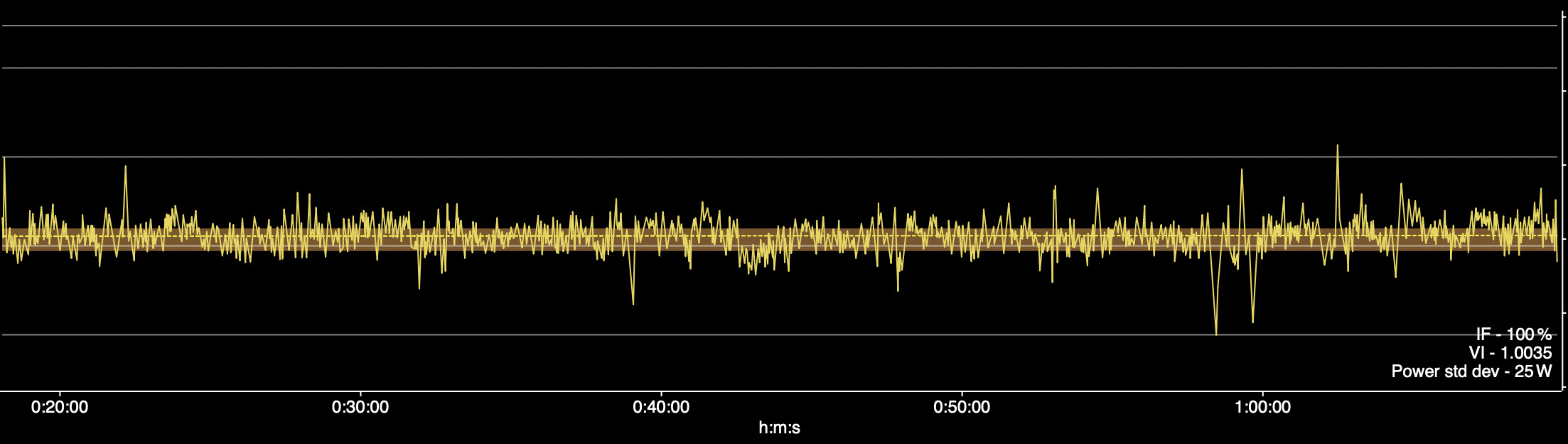
VI 1.00 and IF 100%. This was on a pancake flat course.
The brown band in all those charts if 90-105% FTP.
I answered this in that same post, Eddie.
For the record, I have gone out of my way over the years to be supportive of what TrainerRoad does, and have said this multiple times: TrainerRoad is the best value training platform for what it is.
When you remove all context from the quotes as you have, that’s not arguing from a point of intellectual curiosity. Otherwise, I don’t care to engage in a game of forum “gotcha” with the TrainerRoad staff.
Agreed, I also appreciate TrainerRoad for what it is.
Kurt, you know I’m doing a group coaching base training this winter. They put a lot of effort into teaching pacing and weaning people off erg to learn how to ride by feel. They even provided great coaching for pacing Zwift AdZ climb (or outside) and the 20-min FTP tests and recent 10 mile TT challenge. Very different mindset versus what I remember on TR.
Ride by feel, by all means it’s a critical skill whether you’re doing it on a trainer or not!
Yes, I am in the camp that needs specific target power/cadence numbers to push through deep discomfort, it is like mental crutch. Plus progression to work up to. Looking for traumatic “drowning feeling” never can’t provide that 
For comparison 2 different 5x5 workouts:
- with target power: IF 1.19, 1.17, 1.16, 1.11, 1.15 (good workout)
- self-pacing each interval separately: 1.22, 1.16, 3rd interval 3min 1.12 (not good workout)
Of course, I can learn pace properly but then it means again targeting specific numbers and progression.
Honestly that isn’t enough info to determine good vs not good workout.
Time spent in Z5 HR:
- 6m16s
- 1m27s
EDIT: but my main point was different: I am able to ignore discomfort as I hang to the goal by teeth but I will start dreading workouts when I know goal is to drown each time, even if actual feeling is actually same.
Do bear in mind that some of us have no choice but to use erg due to equipment issues. Wish it were otherwise. I feel I get reasonable benefit for TR VO2 workouts that way, but do wish I could try them in the other mode.
Weird, because I can’t do it in erg mode.
Back on topic: finished 2x33 before stage race. Completed stage race (8th, 4th, 2nd = 7th in GC… not the best, not the worst.) Next stage race in 8 weeks. Do I rest then get back to solidfy my 1x60+ at FTP or just go on to something more race specific? (Targeting the crit in the next stage race, so short power needs work.)
Sounds like you’ve got a pretty bang on idea of what your FTP is. You could add 5-10 W if you felt so inclined. But I’d focus on training for your races, not a 60 minute all out effort for the sake of it.