I made the mistake of introducing some friends to TR plus my winter zwift TTT team.
They’re all over 4.5 w/kg now and closing fast on my numbers. Going to have to step it up!!! (Although entering triathlon training focus now when I normally slide back a bit on power output).
Moral of the story, don’t invite anyone to join TR unless you can handle them getting a lot faster!
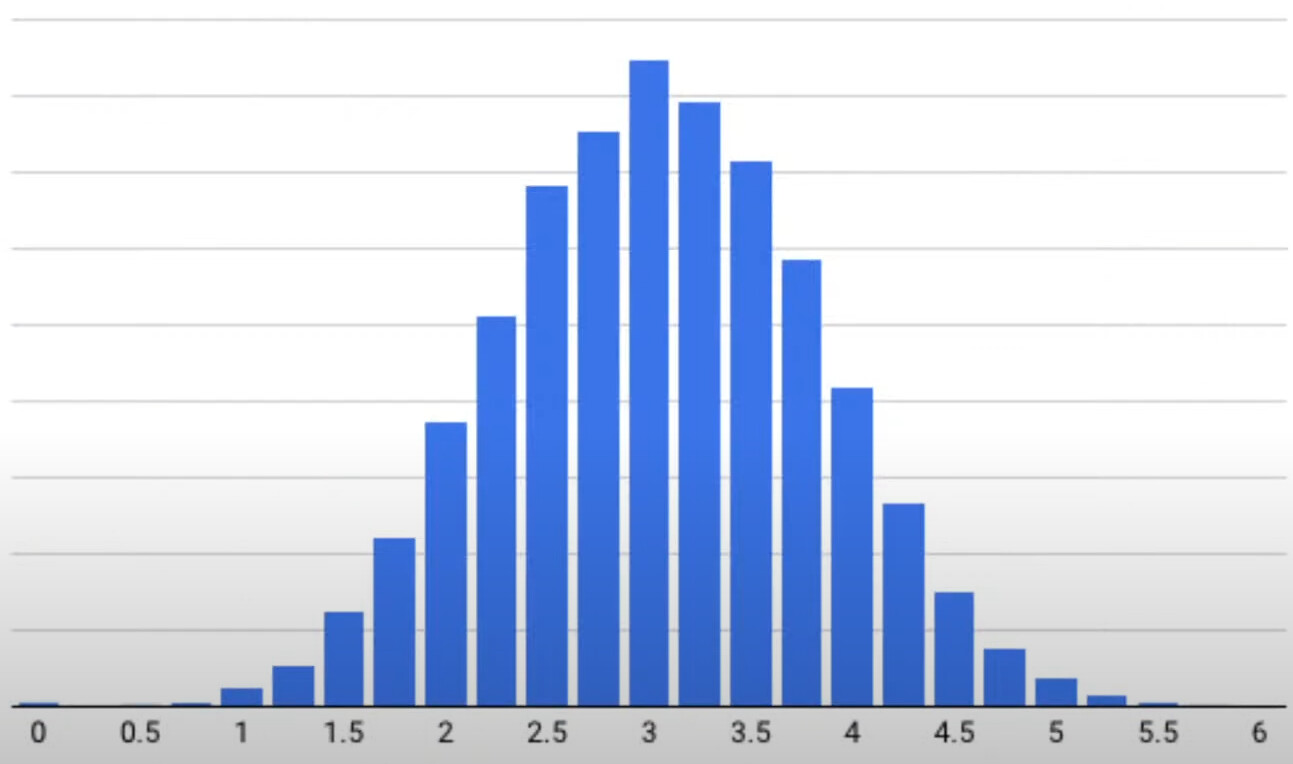
Chart Data: Watts per kilogram (bottom values, 0.25 w/kg buckets) for All TR Athletes (all ages & genders)
Additional comments from Nate:
- Middle of the curve is about 3.25 w/kg for Men
- Middle of the curve is about 2.50 or 2.75 w/kg for Women
- The data just for Women is generally about 0.5 w/kg lower than the values for Men (corrected from review to override Nate’s comments that were lacking handy data).
- With respect to aging, the curve drops 0.25 w/kg on average for every 5 years of age after 30.
Great idea and to that end, for easier access in the future, I went ahead and edited the OP at the very top, to include links to the 3 main posts by Nate, that have the data in various forms.
I don’t know why not. All the great people throughout history used others to motivate them. Wanting to beat your peers can be a very positive driving force. I see Bob do [a thing] so I will work hard to also do [that thing].
I get that you shouldn’t let it destroy your motivation or crush your soul (if we had them) but I suspect he was using hyperbole for comedic effect. There will be people you cannot compete with so that shouldn’t keep you down. But you should pick achievable goals which probably are benchmarks set by other riders and let that inner drive to exceed his/her performance to motivate you.
In my fit days, all we had was speeds, times, and occasionally head to head club rides or races. I can see that these days you can rely on W/Kg or even just W over time. Yet it’s only by looking at others that you know what is a good W to chase. I would like to get over 3.25, not because that’s a magic number but because others have shown me it’s a respectable target and my own performance tells me it’s possibly achievable.
So at 63 with a 3.49 W/kg ratio I would have had something in the region of > 5W/kg back in my late twenties? Hmm… I know I was fit but I wasn’t that fit!
I’ve never cycled competitively and back then I was a climber rather than a cyclist so it’s a bit apples and oranges.
It might use survey info in some cases, but it is not a requirement for AIFTPD.
Once you fulfill the minimum of 10-12 actual TR workouts, TR will use any and all workouts uploaded. These can include a ton of stuff from now and into the past, many of which will not have any survey response.
Yes. Id be interested to see the curve of AI FTP detection ftps, to see how it compares to the distribution of ramp/20min/8min tests and manual updates.
Presumably @NateP means that TR could verify and quantify how AI FTP compares to FTP tests (8-minute, 20-minute and ramp tests). If e. g. the ramp test on average overestimated the FTP of the athletes, then the mean of the ramp test numbers would be shifted to the right compared with the AI FTP numbers, for example.
So comparing the distribution of riders using FTP AI vs. riders doing tests? (ignoring that some may have both AI and regular test results).
Would be interesting, but wouldn’t really say much about why (if there is any) differences might exist. It could be that the riders in the two groups are different or because the tests yields different results?
The only was to differentiate between groups vs. test differences would be to test groups of individuals with different tests within a short period of time.
As far as I understand they validated against athletes successfully completing workouts, they weren’t trying to match the numbers of other FTP tests. So there could be differences in the statistics.
This post of mine periodically receives a like (most recently just yesterday).
I am now about a month out from a planned knee surgery and have a latest tested FTP (and personal PR) of 392. Obviously I want to be able to tell people I had a 400 watt FTP - but I’m 40+ and am not confident I’ll ever get back to this level post-surgery. How close do I have to get in the next three weeks to be able to make this claim?
My past sarcastic self is mocking me from 4.5 years ago


 .
.