Z2 is a % of your FTP, regardless of how small or large it is. At that low %, fat will automatically play a major part in providing fuel for the effort.
Look at the TR Z2 workout Bandeira – a 4500 kJ burner. If you start the ride fully carb-loaded, you should have more than enough to complete the workout without eating at all.
But, only one way to see – try it for yourself! Good luck!
Thats not what I meant. We were talking about riding purely aerobically for days, maybe 14 days… you will need to eat. In fact, if you can keep this up for a long time, your pre-existing reserves should be irrelevant, because you just eat what you then burn.
And regarding the z2 - yes exactly, at high ftp, z2 in absolute W is higher, but the amount of food you can eat and utilise is probably 'similar’across people, at least more so than ftp. I’d guess that if you are a small, but strong rider, you can probably outride your ability to eat fairly quickly, even in z2.
This is either just wrong, or dramatically over simplified.
Water, heat and CO2 are absolutely byproducts of aerobic metabolism. That’s how metabolism works.
The reason Z2 does not require as much recovery as higher intensity is due to other factors - maybe disproportionate use of slow twitch fibers, low glycogen use/lactate production, less stress on the heart, etc… but it’s not because of an absence of the above byproducts.
By the way - I don’t know who Tom Bell is - if he is someone who knows better and is trying to simplify an explanation, or someone who espouses bro science.
That’s what’s being stated, just not in the most grammatically functional manner.
As far as fuelling goes, yes, perhaps if you’re a 145lb 4% BF 400w FTP pro, you’ll probably need to eat carbs on the long rides. However, I’m not too concerned with being part of the 0.001% of cyclists. The average TR user, on the other hand, with a ~230w FTP @ ~165lbs (and probably ~10+% BF), should have tons of on-board fuel for long slow rides…at least 3 days straight.
You will need to eat for any/all Sweet Spot Progression.
I’d be staring right at Wednesday and swapping it with Thursday if you know on Tuesday evening that you’re pushing your luck with a 3-in-a-row. Problem is knowing on Tuesday. Another idea is putting a light switch on Wednesday. Go/no-go with an easy option like Pettit, leaving everything else in place. Mix your options depending on what week. As you’re spiraling up through a block, three-in-a-row seems more doable psychologically., IMHO.
Much of this heat is dissipated via the evaporation of sweat and other heat loss mechanisms.
Metabolic heat generated at Z2 wouldn’t be a lot. I guess if you’re doing a long ride in a closed environment w/o cooling or in very high external heat (not produced by metabolism), it could lead to fatigue.
We all know heat is a maj issue w/ SS progressions. Get a fan or two.
Actually, lets stop guessing. Say you ride at 150W for an hour, thats 150W×3600s = 540kJ. Assuming that because of the body’s efficiency, 1 kcal = 1kJ, thats 540kcal you need to eat. The currently discussed upper limit seem to be somewhere around 100g carbs / hour. 1g carbs has about 4kcal, so thats 400kcal/hour that you can eat. Leaving you with a deficit of 140kcal, just from 1h of riding in z2.
But you aren’t burning 100% carbs. You don’t need to replace the fats. At Z2, you would be around 50% from fat at least. So you could actually overeat what you are burning.
Two riders having a similar w/kg, it’s actually the heavier rider that will have a harder time replacing calories because they are riding at a higher raw power and burning more calories.
How does this look for a basic sweet spot progression? I kept Wednesdays as easier sweet spot workouts, making the other days where I progress in length. Many of these workouts are an 88-94% range, so I figured as the weeks progress I would bump the intensity up a percent or two. I made week 4 sort of a recovery week to nail the Saturday 75 minutes straight, but not sure if I really need to do that.
I only have 60-75 minutes on weekdays and 90 on Saturday for right now. Sometimes I free ride or do a short Zwift race on Sundays, or sometimes I just take the day off; so I didn’t schedule anything there in case I don’t end up doing it.
What’s everyone’s thoughts? Thanks!
ETA: I didn’t realize the image cut at the bottom (trying to fit it all in). That’s tallac +1 and phoenix +2 for Tues and Sat.
It is a little bit strange, because you have quite hard Cumberland +1 in the beginning after eclipse. Eclipse is pretty easy workout and Cumberland is quite demanding if you did not have done this type of efforts. As you are constrained with time I would add some higher intensity like Galena or something closer to threshold with shorter workouts - you can go longer (but time constraints) or more intensive.
I do not understand why you need something like tallac-2? The normal Tallac would be better. These brakes are completely not needed with short 15 min SS.
It is a rough sketch but it is a little bit more progressive in terms of time and intensity (your constrains are quite big if you have +15 time during the week the availability of workouts is a lot bigger).
The other thing is that you can skip brakes in some of these workours or create custom versions in workout creator if you are doing them exclusively in ERG mode.
Looking at your first week I’m seeing the following: Geiger +1 (4x12, 36 min) / Carson (6x5-7, 36 min) / Kaweah -2 (3x10, 30 min) / Eclipse (3x20, 60 min)
What stands out are that you’re starting the week off with 4x12 (36 min of Sweet Spot Time in Zone), then following that up with Carson. This isn’t wrong, per se, but you could drop the intensity, but extend the work intervals by doing something like Spruce Knob (2x20 @ 85%). To me this would be a better workout to follow up with. It will also get you accustomed to riding at longer durations and prep you for Eclipse later in the week. I’m also questioning why you would do Kaweah -2. You’ve done 4x12 already in the week, 3x10 is going to be really easy. You could further challenge your self with some Over/Unders. I think those are great workouts that fit in nicely with a Sweet Spot block. I love them.
I personally like to build my Sweet Spot workouts around 15, 20, 25, and 30 minute intervals. If I haven’t done Sweet Spot for a while I’ll start with 4x10 or 3x15 and push out from there. A sample block might look like this:
Feel free to adjust the interval lengths to match your current level. Hope this helps. Experimentation is your friend. Eat a lot. Rest.
*I’m not a coach so none of the above should be taken as a hard recommendation based on anything scientific. Just my personal experience training myself.
I’ve debated doing the workout creator but I hear it’s not too user friendly and sounds like a drag
Not really sure why I added tallac-2, maybe I was afraid of boredom!
Do you think it’s necessary to add in some easier sweet spot to break up the overall progression? Or do true recovery rides or just keep trucking through it straight?
I’ve done some Phoenix-es and Pioneers in the past. I like those workouts once I get into the swing of things. I’m hoping to use this sort of sweet spot base to slowly just creep closer to my ftp in comfort or even increase my ftp!
Thanks for your help. I’m definitely going to do some rearranging based on your suggestions!
I wish I had more time on my hands to do longer workouts that look so beautiful in the progression! I refuse to wake up earlier than 5am but I think I can adjust your recommendations to squeeze into 75 minutes during the weekday. And I may be able to get up to 2 hours on the weekend, I just have to set the alarm…
So if you have done them than almost all the workouts are too easy Honestly if you can do Phoenix the 3x15 would be a waste of your time and energy. @anthonylane has given the progression that is closer to the progression I would do - you will gain a lot more form his suggestion. Honestly 3x15 or 6x10 etc are the workouts for threshold not for SS. If you are more experienced and with your time constrains doing 2x30, 1x45, 1x60, 2x40 etc would give you a lot more. I am in the camp, that thinks SST and Threshold efforts in TR plans and most of the workouts are too easy
If you will spend 5 minutes to understand it quirks it is extremely easy tool. I would like to see new tool from TR (and web based) but it works and I use it all the time with no problems.


 my bride wouldn’t even bat an eye, roll them maybe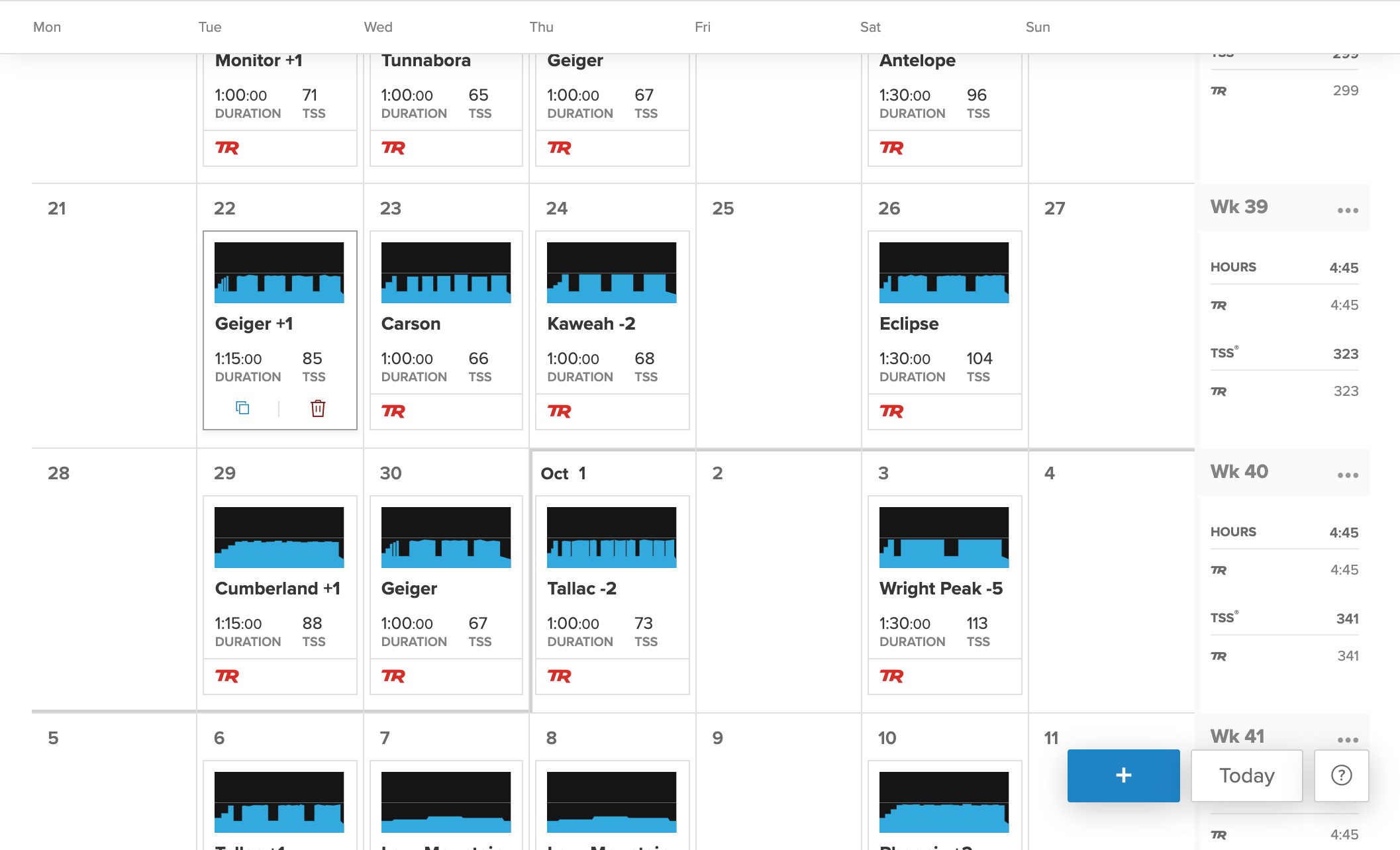


 but I think I can adjust your recommendations to squeeze into 75 minutes during the weekday. And I may be able to get up to 2 hours on the weekend, I just have to set the alarm…
 Honestly if you can do Phoenix the 3x15 would be a waste of your time and energy.