In the past I thought you did a lot of long sweet spot, correct? If yes what zone would you assign those in the 3 zone model?
From what I’ve read, POL Z1 is below 80% FTP and Z3 is VO2Max (so generally 105-130% FTP depending on how long or short the intervals are, respectively). That puts tempo and sweet spot in Z2.
6 days workout seems though! Will need some considerable amount of rest just like the HV plan, I guess.
I’ve read your detailed workout on the Seiler thread and just want to ask how about your RPE or your leg sensation on those days? What did you do when the fatigue’s catch up in the middle of the week, let’s say maybe in 18th
Here’s my first cut at a “medium maturity” rider plan using the VO2 progressions from Short Power Build Mid Volume. Not sure if the reduced amplitude billats workouts are the right progression to use in a polarized plan focusing on short power. Constructive criticism welcomed!
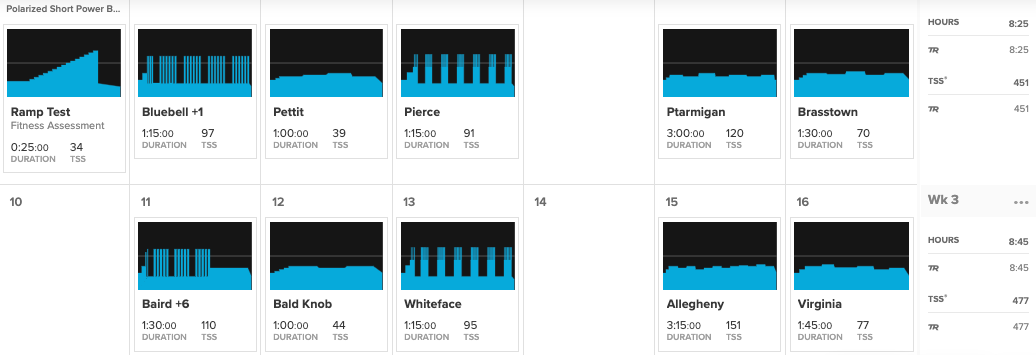
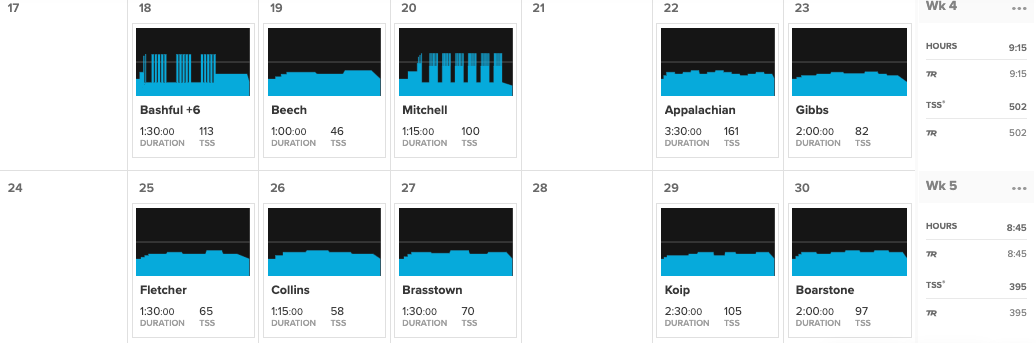
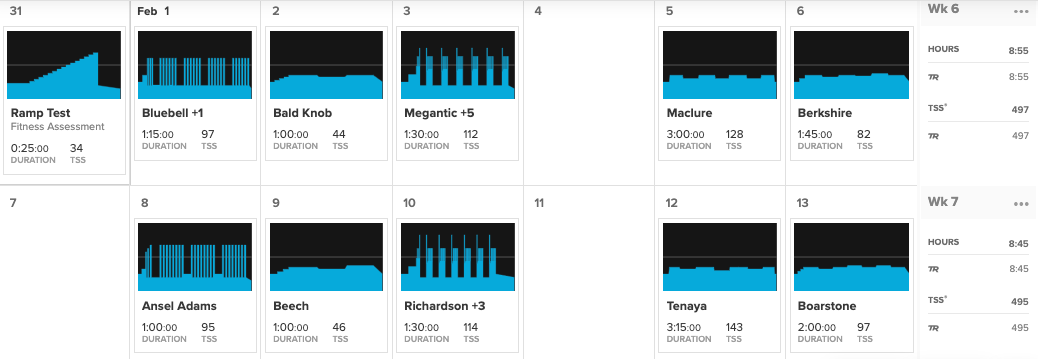
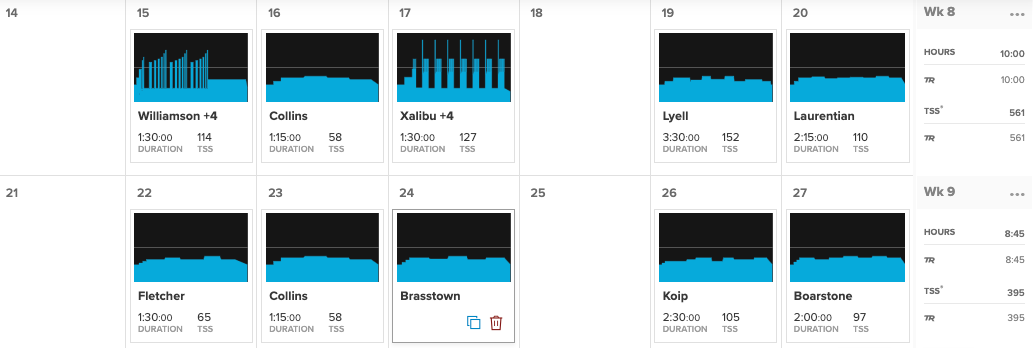
Loving the traffic light colours on your calendar. I’m doing the same using Google calendar and its so easy to just glance at it to check you’re on track.
I don’t set a particular day for my intensity, just wait for a good opportunity like a friend being able to join in or a race training session.
It’s the simplicity of the polarized model that I love. Someone on here mentioned putting the ride into a red, yellow or green bucket. Went out for a hill session with a mate yesterday. Had intended to ride at threshold but instead we smashed them at VO2max. ‘This ride is firmly going in the red bucket’ I exclaimed!
Thanks for sharing. Out of curiosity, I noticed there were some Z2 workouts sprinkled in. I thought the point of polarized training was to avoid spending time in Z2 and either stay in Z1 (most of the time) or in Z3 (infrequently). Can you clarify the purpose of these sessions?
While you are at it: when you say Zone 2 (out of 3), were these workouts in Zone 4 (out of 7), i. e. sweet spot-to-threshold or tempo, Zone 3 (out of 7)? The description makes it seem you are talking about sweet spot and over/unders.
Was Tim Cusick the coach you worked with? That is the second time I have seen his name mentioned…and I’ve been contemplating working with a coach for a season to get a bit better grasp of what works for me and how to set up training long term.
I think the big shift is ‘everyone is the same below FTP’ no longer being viewed as a true assumption.
Somebody is going to post that graph with the big variability on the left, and no variability on the right. The one they use to introduce iLevels.
Sigh.
It’s good stuff but I’ve been on a quest to figure out this “below threshold variability” for a while. That graph doesn’t tell the whole story.
It was a reasonable assumption 10 years ago. Now we have more information about how lactate is managed in the body so assumptions can change.
So what is “the story”?
If the R^2 between FTP and say 4 hour power is 0.90, how much variability between individuals can there be in their “durability”?
Please don’t give me anecdata, especially results that confuse differences in X at a given Y with differences in slope.
What more information is that?
There have been no breakthroughs in the understanding of lactate metabolism that influence performance at long durations.
Mr Old: How do you pace long efforts?. For example, you want to ride 5-7 hours, it’s not a race and you want to make sure that you are ready to do hard training again with only 1 day or rest in between…Thx
good list, but i think you forgot safety… bike maintenance included…
because if you crash due to equipment failure, that could put you back to square 1 or worse…
By feel.
Exactly.
You should pace your rides accordingly:
- at the end of an endurance ride you should feel like you could go out and ride it again
- at the end of an sst or threshold ride you should feel like you could do it again later that day
- at the end of an VO2max ride you should feel like you need a good nights sleep
Thanks for the feedback! This is my first attempt at developing a polarized training plan. My starting basis was TR’s Sustained Power Build (SusPB) Mid Volume and a separate plan based on Short Power Build (SPB) Mid Volume. In retrospect, both plans essentially keep the VO2 progression from TR and replace the threshold and sweet spot workouts with POL Z1 rides - one that is around 3+ hours and the other 1:30-2:00.
You replied to the SPB-based plan, whereas the SusPB-based plan is further up (here). It has some of the longer VO2 efforts that you cite.
Do you feel faster and / or stronger following the polarized plan? How long have you been using it? Has your FTP and / or TTE increased? Trying to judge the efficacy of what looks to be an easier plan (i.e. 1-2 intense days per week + 1 long endurance ride versus 3-4 intense days per week for roughly the same number of hours on the bike).
The graph that’s being referred to is the maximal power as a percentage of FTP vs log-time yeah?
But training endurance isn’t about maximal efforts, is it? You said yourself you pace your endurance rides by feel. You’re not looking to progress by beating your previous best power for that duration each time you go out then.
What if it’s a question of recovery? What pace can I hold today that’ll let me do the same almost ad infinitum? And whilst there might be some day to day variability of that, what if by consistently staying below that tipping point/zone, you can progressively shift that point upwards, thus allowing you to achieve greater training loads, and thus stimulus, without burning out?
In other words, what if everyone’s 5-hour power (just as an example), is almost identical relative to FTP, but what percentage of that max power someone can do day-after-day can vary between individuals and improve with training?