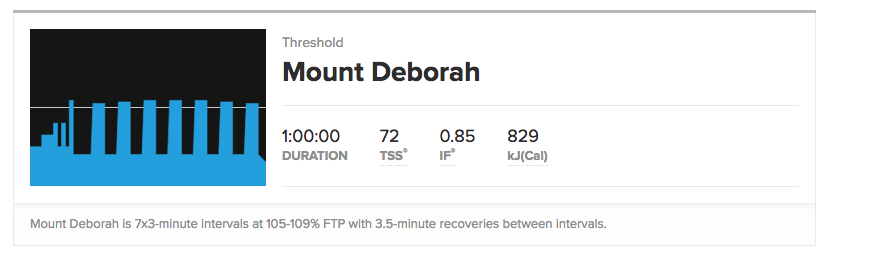
You mention Sleeping Beauty, which reminds me I think it was Seiler who in one of those podcast (51?) says they’ve seen no advantage to 30/30’s, but he didn’t seem to say that they don’t work just as well as a traditional interval. Just an aside, but I like 30/30’s as I just seem better suited to them…
@GT7 Not sure if Seiler has commented on them, but Rønnestad & Hansen did some work comparing 30/15s to longer sustained vO2 max workouts (I think 4x5s) and the 30/15s elicited an improved response. These are in TR with the “Brasted” family of workouts.
Yes There is generally more than one way to travel to any destination. Some might be quicker and involve a little more stress. Others might be slower but are less stressful. (motorways vs country roads)
I don’t think so. That is because the Polarized model defines and uses “High Intensity” workouts that are effectively in the 100% and above Threshold value. The SSB plan is mostly below Threshold with only a few that even get to the “High Intensity” definition per the 3-Zone model.
Another question - and sorry if this has been asked before - does the polarized method hold benefits across all rider types, or some more than others? For example, I don’t do a lot of racing, but I do train for long hillclimb TTs (think Mt Washington in New Hampshire - all uphill for 90 minutes - 2 hrs at an avg. grade of 12%). In order to train for something like this, I feel a lot of Sweet spot is necessary - physically, but more importantly, to develop the mental fitness to keep pedaling under stress.
I can’t say that I really know. Studies and comments from Dr. Seiler and others take a range of athletes in various disciplines (cycling, rowing, running, skating, etc.) and mention variations in event length from under an hour to over several hours.
I think they even mentioned some track (cycling and skating) athletes in some cases. Those can vary from super short to quite long, and I don’t remember how specific they were.
My take is that it seems wide reaching when you look at “endurance” as a broad category from around and hour and longer. I’m not sure how it would work for short stuff, like BMX type racing that is typically 1 minute or less. But I think you can apply Polarized to just about any cycling that runs 30 mins or longer.
Dr. Seiler states some info showing how much aerobic contribution there is in many short and sprint type efforts. So I think growing the aerobic engine is worthwhile to most riders.
Been looking at the chart for a bit and am confused by this:
If i am a 7.5 hr per week rider and Z3 should be 1.5 hours, then it says 15-20% Session Time, specifically how many minutes should be spent @ say 250 Watts? Surely not 90 min @ 250. I looked at your notes by the Asterick and just can’t seem to make sense of them.
I think it was best explained in the podcast but there’s a couple of ways of looking at it.
The bucket method, you do a workout and it either goes in the Zone 1 bucket or the Zone 3 bucket. 80/20. Getting over a hill quickly doesn’t throw a Zone 1 workout into the High Intensity bucket, nor does warming up and cooling down spoil your high intensity work.
Or if you’re doing something like time in zone then the percentages become closer to 90/10 or 95/5.
Woah, this is a long thread! I skimmed it but here are my thoughts.
You can get fit in many different ways. I think one podcast seemed to say you can’t get fast on sweet spot. That’s crazy sauce. I went from 275 to 345 on almost only sweet spot.
We’ve got a TON of data that shows that you can get faster with the periodized/Coggan approach…like a lot a lot.
Seiler is not prescribing a training system, he’s describing what he’s seen in pro athletes (as far as I can tell). In a 90/10 time in zone split at 20 hours per week with intensity at 120% of FTP (for the intense stuff) you’d be doing 40x3 mins at 120%. Put that over three workouts and you’ve got about 13x3 @ 120% three times a week. If that was ALL you were doing that would be crazy. You can see how you could only do easy stuff for the rest of the time.
Take this with a grain of salt because the analysis is not done: Our data shows that the main difference between 2-3 watt/kg riders and 4-5 watt/kg riders are that the 4-5 watt/kg riders do more 2-hour rides, and those rides are mostly between .80-.85 IF (aka sweet spot work). They don’t do longer rides on average compared to 2-3 watt/kg riders.
Anecdotally, I don’t know anyone who’s stuck with a polarized approach. Justin Rossi tried it for a season, got slower, and switched back to periodized. We know of a pro who just left polarized and is having a breakthrough season. He’s actually adding more tempo GASP work! Other pro’s we’ve seen don’t follow the periodized approach.
More anecdotal “evidence”; I’ve never ridden or seen Strava files of pros were they totally go easy for 90 percent of their stuff. They are always picking it up on the climbs (even if you take into account their superior fitness).
I can defend points 1 and 2.
I hope I’m understanding point 3 correctly.
I hope to defend point 4 in the future.
I can’t defend points 5 and 6 since they are anecdotal.
In summary, I’m sure polarized training works (as most approaches do as long as there is added volume), but maybe a little too much is being made out of the recent polarized craze because a couple podcasts are pushing it?
I agree that the info from Dr. Seiler and others is questionable to the point that “what the pro’s do” may well not work for “average Joe’s”. That to me is not evidence enough on its own, because we are most likely not able to match the conditions or schedule that they have for themselves.
The insistence from the POL camp that their approach can work on as little as 6 hours per week (Despite little data in that range) is what drives the questions from myself and many others. It seems illogical when you look at the TSS in overall comparison to a SST / Threshold approach. Great if you have 10, 12 to 20 hours… but we all wonder about how well it really scales down to half that time.
I am doing my small POL test because I have time before my usual TR SSB launch in late November, so I figured this would be an interesting way to kill some time and maybe learn some stuff for myself along the way.
Even if my test is worthwhile, I am still in the 9+ hour range per week and I will wonder about a lower load being effective or not.
I know I am super excited to see the final report when you guys have it ready to present.
They are perfect really, and I am happy you shared them. I can easily up adjust the Intensity for a few percent if needed, so they are really great options.
I already slotted them in for this week because I like them better than the options I previously had on the calendar. I will report on the workout tomorrow.
Hi Nate, for your 3rd point, the polarized approach is about the number of sessions. So if we say you’re doing 10 workouts per week, 1-2 will be high intensity workouts.
It does make sense if you train frequently. But for me who can only ride my bike 3x per week, I’d rather do two high intensity work and one sweet spot/tempo. I totally agree that there are plenty of ways to skin the training cat.
I keep reading here that Seiler shows that “pros train polarized”.
What pros are meant by that? Cyclists? In all of the papers from Seiler and the subsequent review by Stöggl and Sperlich (2015) [-> this is the one Seiler mentioned in the first VN podcast] there are exactly two TID studies on eltie cyclists:
Lucia (2000) —> Spanish elite U23 (road)
German track cyclists
1 —> trained a lot in Zone 2, no way polarized
2 → trained polarized
The bulk of included studies are on XC skiing and rowing.
This is why Seiler himself said (in the first VN podcast), polarized may not be the best approach for road cyclists because it is not race specific.
I’ve said this before here but one of the reasons why so many people are drawn to this polarized approach is because they believe “pros are following it”. Which is funny because even Mr. Polarized himself says they do not.
I also second the Strava-observation. So many pros out there sharing all their data. I like to browse their Strava data while doing low intensity workouts, time flies by with this. And one thing is obvious, I’ve yet to find one pro who trains polarized.
the TR plans are not better. And Polarised Training is not better. They are different. And for most riders the both work quite well. If you are are serious racer, eat every day exactly the perfect amount of calories in the perfect ratio, you sleep 10h a night, do core workouts, you’re bodyfat is lower than all good cyclists in your local club, you’re flexible as hell and you bike is light as f***.
Than you are the right person to think about where to improve in every little thing.
It don’t means that every other cyclist couldn’t improve by going polarised and so on. But you have to look at the big picture. It’s an interesting topic, there is room for improvements.
But we all have to ask our selfs if we are so well prepared that this is just the icing on the cake and not the dough.
Don’t get me wrong: there are legit questions. But ask yourself if you are the type of rider that needs these answers.
@Double-A You are not the person I want to address it to. But as I read your post I thought we should point out on which small field we are playing in this top e.g.
Sometimes a fresh cyclist starts reading and get confused because he thinks that this is the important stuff. But keep in mind: what type of rider are you, where is your cycling career are you right now and foremost: cake - icing.