Thanks! It was, I run the Wahoo TICKR and even with a fresh batter it still acts up from time to time. Just yesterday I went on a ride w/o it and noticed my Garmin displayed 195 bpm. It was just sitting in my box of cycling kit.
1 Like
Hmm, that’s an interesting point. I’ll have to mull that over.
PLs are by power zone, and I tend to think there is a vast over emphasis on PLs in the forums these days 
1 Like
Ha ha, but the benefit of that has been to drag people kicking and screaming away from FTP 
I’m planning to do the same !
This year I started trying Polarized training and it felt way better.
Next season, besides doing a messenger job on the bike, I plan to just have 2 intensity workouts a week with 1 long z2 ride.
I can’t wait to see the results!
2 Likes
I personally don’t really care about PLs as a vanity metric, but I think workout levels are helpful at comparing two workouts in the same zone. PLs help you pick out a workout that suitable for you on that day for whatever system you decide to workout. It doesn’t mean you have to do a block of training in a system. You can switch systems every workout if you want. some might disagree, but I still think it’s helpful to pick a system in a given workout and not muddy a workout with two many different concepts.
1 Like
Ha ha and you may have missed the real point… PLs and AT should drag people kicking and screaming to stop saying HTFU, and that everyone should NOT be slamming 6 vo2max intervals at 120% during a 12 week base. More on that below the FTP infomercial…
The head coach of is on record, repeatedly that FTP is useful and valuable, and I’ll extract a few quotes:
“Without actually testing your Lactate Threshold and VO2max in a lab, your FTP is an approximation. But, the applicability and usefulness of this number has been proven by generations of coaches and endurance athletes.”
and
“it’s important that this number estimates your actual sustainable-power threshold as closely as possible.”
Hope that clears things up for you.
For 5+ years TR missed the memo from Coggan to move away from classic zones to individual zones above threshold.
Fast forward to 2021 and happy days, TR responded by creating a “workout difficulty index” (PLs) and a work-in-progress semi-automated system (AT) to help users deal with:
- ramp tests that in some cases can give inaccurate FTP estimates
- the fact that number of intervals, power-above-threshold, and time-in-zone should be individualized based on athlete’s fitness for that type of workout
Overhauling the plans earlier this year, plus the stuff above, is very positive.
2 Likes
I’m sorry, I thought we were on the same page - have I offended you? It wasn’t my intention.
1 Like
All good, had some tough meetings today and in an argumentative mood.
1 Like
Been there haha
Whether I like it or not, long slow distance is magic.
1 Like
Did a bunch of climbing centuries and at my W/kg that meant longer climbs at low (60-70rpm) cadence. We used to say “in it to finish it” while training for the DeathRide. Never understood the magic of tempo at low cadence until years later!
2 Likes
My local 125km/75mi. loop has a 300m/1000ft climb over 5km/3mi. near the midpoint. When I was riding the loop once a week, I only had to do a bit of VO2Max interval training to be race ready. It didn’t seem to matter how fast I completed the loop, I had to survive the climb AND make it home. So effective!
PS the Death Ride is still on my bucket list.
1 Like
Sounds good Anthony.
One thing is for certain, if you repeat the same thing, you’re very likely to get a very similar result.
Personally, I don’t think polarized training works very well indoors. This is for very obvious reasons. Volume. Depending on your training history, your Z2 days may simply be too short in duration to drive significant adaptations. This is one of the reasons why indoor training programs have all merged to a somewhat similar model. More intensity, more variation. Workout compliance being a significant driver of choices. Not physiology.
Based on myself, I get little out of a 60-90min Z2 session. Essentially, in a very simplified manner, I’m actually somewhat detraining that day. Obviously, it’s vastly more nuanced than that, but 10,000ft…
Progressive overload is the founding pillar of any program.
Without significant free time, building progressive overload into a training program heavy on endurance is difficult.
This is not me saying do more intensity, sweet spot etc. It’s me saying, any way you can increase your recovery time, sleep and available training time will give you the largest long term gains.
A majority of amateur athletes seem to think adding training hours is a single metric.
As Alan Couzens very concisely put it…
The greatest misconception that amateurs have about “the pro’s” is that it all comes down to pro’s training 100% more. While it’s true they train more, it’s more like…
*** 33% more training**
*** 33% more sleep**
*** 33% more “down-time”**If you want to narrow that gap, scale accordingly
As much as I value this forum, I believe there’s an incredible resource in going to the very best coaches and physiologists, directly. Most are on Twitter now and will often answer questions.
Alan Couzen’s is an absolute must follow for any endurance athlete. Professional or amateur.
https://twitter.com/Alan_Couzens
Finally, I’ll post this image. It’s endurance training summarized in a single image. Once you understand it, you’re set.
Long term consistency.

7 Likes
Depending on how much your fitness is based on SST…suddenly dropping it for strict Z2 is a recipe for disaster, unless you are riding close to 20 hrs/wk of Z2 (basically doubling the hours). A better plan would probably be to do Z2+Z3 (80 - 85% FTP) and let go of the higher stuff toward VT2. I would still be doing at least 1x/wk Vo2…8 min or over/unders. I learned a hard lesson at the end of 2020 when I dropped all intensity for 9 weeks for strict Z2. It took 16 weeks of 10 minute intervals to correct the situation. I mean the top end just completely crashed. This year I’ll do Z2 + Z3 and Z5 (1x per week) through the winter. It’s just too hard to give up gains and try to recover what has been lost.
2 Likes
100% agree, and for what it’s worth my polarized training doesn’t start until I’m able to ride outdoors consistently. My “indoor season” runs from December to April, and will be mostly pyramidal with a lot of Z2 & Tempo workouts and the once per week high-power sprint workout. This is while I’m lifting heavy between December and March. After I have a good 12 weeks of strength training under me I would typically start throwing in some Sweet Spot work come April in prep for more threshold work.
The reality is, I’m not actually getting more fit (or building CTL) between Dec-March, but more just hanging on to any residuals I have, and doing other things that will help the bottom line and my overall longevity: strength training and some explosive sprint work on the trainer. The good news is that I have all year to get fit and fast in order to be peaked for CX season that starts in September.
From what I’ve found is that when I’m in indoor season my progressive overload starts to plateau after around 4 weeks given that I’m generally accumulating no more than 450TSS and/or 6 hours of indoor riding. I might be able to change that if I start forcing myself to do 3-4 hour trainer rides, something I’ve yet to do. However, when spring hits this changes as I’m able to push volume.
I’ve spent some time on his website, and have found it very enlightening. The thing is, and this isn’t a knock on TR, but IMO the seeming complexity of plans and huge variety of workouts within gave me the illusion that building excellent fitness is a complicated thing, but folks like Couzen’s make it really simple. And lastly, the deemphasis on long endurance rides really held me back for 3 seasons or so. This is, IMO, the single biggest issue I have with TR.
Not saying that Sweet Spot is not valuable, I just don’t think throwing out some arbitrary TiZ number (like I did in 2021) paid off. I thought I was programming race-specific work. Gravel racing = lots of Sweet Spot, but the reality is that just isn’t true. Here’s my zone breakdown from my one and only gravel race of the season. Looking back I wish I spent more time working on FTP development and VO2max.
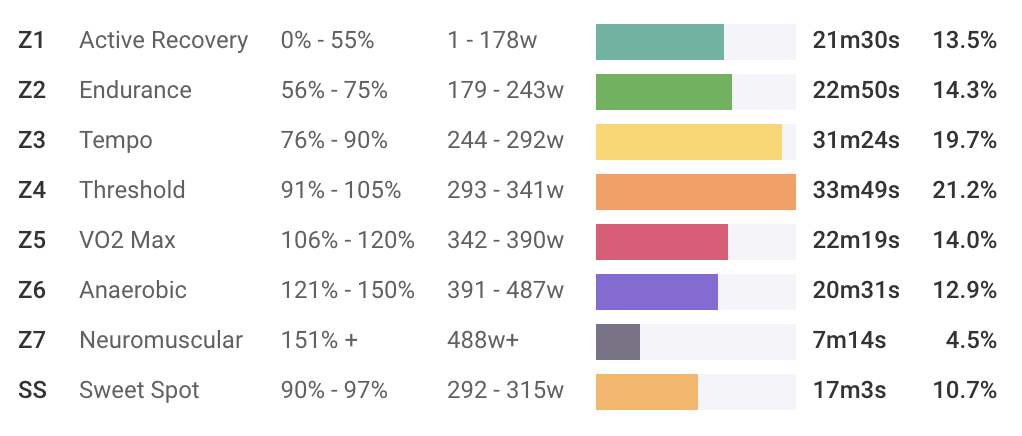
So with that, I’m excited to take what I’ve learned in 2021 and try some different things in 2022.
3 Likes
What do you find beneficial about low cadence?
On a limited time budget I have found low-cadence work to effectively push FTP up higher, and supports muscular endurance needed to do long climbs. I used low-cadence work to train mostly on flat ground at sea level to prepare for an event where I did 8 hours of climbing mostly above 6000’ elevation.
Some coaches describe the adaptations as making Type IIa muscle fibers more aerobic, lowering rate of lactate production, and increasing fatigue resistance of the leg muscles. My coach wrote an article on Muscle Tension Intervals with some references.
3 Likes
This is along the same line I want to approach the next year, would like to see what you come up with for workouts. Will you devise them ahead of time or just go with it daily?
YMMV but this is how I’ve trained, and it works for me (I have pretty lousy 5sec and just ok 1min power – 4min on up is my joint, so more aerobic, lower VLA works well for me, and I can handle a lot of it).
M – rest
Tues – zone 5 intervals
Wed – high tempo (80-85% FTP)
Thurs – low tempo (76-80% FTP)
Fri – 1 hr zone 1 super easy
Sat – zone 5 intervals
Sun – 2hrs hard as you can (ends up being 90-92% FTP)
no rides over 2hrs. seriously.
During the winter I’ve done less time in zone 5 on those days (say only 16-20min) and done them at lower % (say just 106-110%). It’s just keeping the system open, not trying to flog the crud out of myself.
Remember, Coggan says Sweet Spot is a concept, not a zone. The most TSS that you can recover from, in the least time. In that regard, SST is anything from high zone 2 to 90% FTP.
In that context, I think of those tempo days as “sweet spot.”
4 Likes