I guess her focus was to win the gold medal at the Olympic race, and she suceeded (sorry, had to  )
)
Sorry I don’t understand this. Is the paper saying that there is no point in consuming carbs on a ride as it has no effect on sparing your glycogen stores?
No, they are not saying there is no point in consuming carbs on a ride. They’ve just summarised the available data on what affects glycogen usage during a ride. Depending on the context of a ride/training session there a many other reasons to consume carbs on a ride.
2 Likes
This guy seems to oppose what ISM is saying

(the second of the three presentations)
Someone asks him (paraphrasing) whether training just at that intensity is the best way to improve fatmax and he says he suspects (but hasn’t seen concrete evidence) that mixed intensities are likely to be best.
Question is at 58:20
I dunno. Take a look at ISM training for McNulty in November:
Roughly speaking I see a fair bit of work at 240W, 280W, and 320W.
And December:
Roughly speaking I see a fair bit of work in the mid to upper 200s, say 250-280W.
And mid January he did a 20 minute (actually 19 min) test at 465W:
and saving you a click here are the 19 minutes:

A few days later he did 3x60-min at 360W:
and saving you a click:
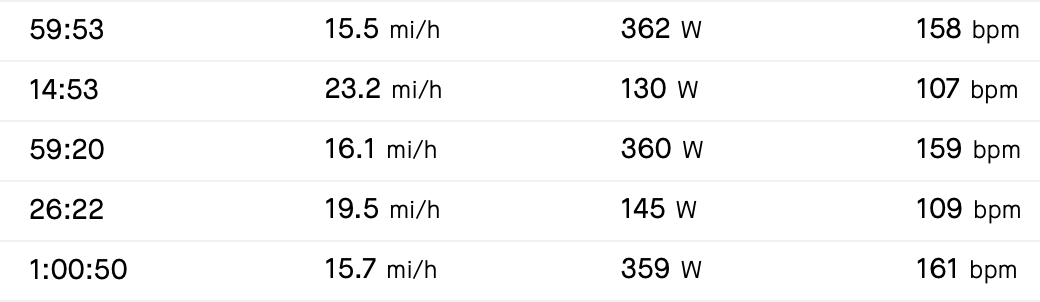
I’m guessing that was 85% tempo pace at an ftp of 420W.
3 Likes
Not sure ISM says one should only train at fatmax. And that the sole purpose of zone 2 training is to develop fatmax. I think it’s more about the overall package, cost-benefit is pretty good for zone 2 with some other stuff sprinkled in. The other stuff becomes more important when race season approaches.
“An endurance athlete should never stop training in zone 2. The ideal training plan should include 3-4 days a week of zone 2 training in the first 2-3 months of pre-season training, followed by 2-3 days a week as the season gets closer and 2 days of maintenance once the season is in full blown”
3 Likes
I don’t have time to find it now but he says triathletes should only train zone 2 because they have no requirement for sprinting.
He will have pro cyclists train in other zones because they do need these energy systems during races.
”In conclusion, in my opinion all energy systems need to be adressed (trained), with the exception of pure sprint training for athletes competing in events that have no such demands (for instance middle and long distance triathlons).”
2 Likes
Mmmmmm 

4 Likes
I agree.
This is a tougher concept to fit on Twitter or for ISM to fully articulate in podcasts. Not even sure he feels the need to do so. Maximize work, minimize fatigue. If he said those words it would be an oversimplification and become misconstrued, like intensity distribution has.
So we’re left with “magic zone” thinking.
3 Likes
Paradoxically, I’ve had great performances (for my standards) with all these approaches. The only pattern I can see is that I perform well when a.) I get the overall balance of load and recovery right and b.) I’m happy or motivated.
6 Likes
Which is why I think more of us can benefit from tuning into how we feel rather than just looking at numbers.
There is the fatigue you get from a hard session or series of hard sessions. That fatigue, say heavy legs, that passes with a few easier or rest days. Then there’s a residual fatigue that inhabits your whole psyche and can linger, the sort that if you let it build, leads to non functional over reaching, lack of motivation to train or even get on your bike, and eventually over training.
Sometimes it is hard to remember how long you’ve had a feeling of the latter type of fatigue. I now make notes about how my sessions went and how I’m feeling. I’ve found it invaluable aid spotting negative trends and knowing when to back off or take a few days or weeks recovery. Have a plan but know when to leave it, due to the way you are feeling.
2 Likes
Unfortunately, I work with some athletes who really struggle to ID this deep, chronic fatigue. Telling them to rest does no good, as they feel ‘alright’. So deep in the hole, they don’t even know it…
1 Like
I’m interested in more discussion of this too…
I’ve been reading “Midlife Cyclist” by Phil Cavell and between that and the ISM recommendations and my own experimentation over the last six months, I’ve gravitated to doing mostly Z2 endurance rides and letting the V02 and Threshold work happen naturally whenever I get the chance to go hard in the hills for the 4-20min efforts we have where I ride. I’ve been logging 10-15 hrs/wk with that strategy, taking one day off every 7-10 days and doing mostly 1.5-2.5hr trainer rides and whatever I have time/weather for outdoors. I do wish there were a TR plan that matched this type of training but I also get that it’s not what time-crunched folks are looking for and it doesn’t take a lot of ingenuity to come up with…
5 Likes
The above generalization (that you reference @Clean39T) leaves out a critical part: namely, there is still a Zone 1. Also, 4-5x / week seems like too much and it also suggests that one would only ride this intensity “for general endurance riding”. (because what do you do the other two days, one will most likely be rest). All Zone 2 all the time is not the case.
Although not high intensity, it is not general endurance riding. It has been difficult to explain without using subjective terms like “happy hard”, “tempo”, or my favorite “high Zone 2” (because let’s make something less confusing by forcing it into a totally different system <——. Sarcasm). There is a helpful part of Attia’s interview where they provide some coaching cues about breathing.
If you throw in a once per week VO2max session, I think you have moved too far from a fair generalization. He would be more inclined to suggest some efforts at the end of a ride rather than a dedicated session. Or something similar to what you are doing, but perhaps minimize a lot of up and down with intensity during a ride.
This is all within the context of “riding for health”.
As a racer (particularly shorter events, crits, cross, XC), I would have dedicated HIIT sessions in my plan, just not as much as what is commonly prescribed these days.
3 Likes
I think this is a wise and interesting way to do it. I still plan a dedicated session once a week but the idea to let it happen naturally (smashing a hill, get on a wheel here and there, a sprint…) is a nice trick. Thanks for the tip! Listening and re-listening a lot Seiler lately. For reference, I’m 46 so full in masters mode. Last 2 years I started to feel less recovery between hard interval session and borderlne burnout.
Also good points!
Yes he does 4-5 endurance rides with harder efforts at the end, combining the two systems. Good you pointed out; in a ride for health context.
I did this last summer and autumn and was logging up to 20hr weeks outside. I didn’t do much, if any deliberate threshold or vo2 work on these rides though, and as a result saw about -25w on my FTP despite the big hours and volume. Obviously BIG endurance and durability gains though.
I’m about to start a repeat now as I just retired early, but plan 1 dedicated interval day every week - probably a ride out to some 3 min hills for dedicated vo2 hill reps, or some form of threshold. Otherwise I’ll do 1 indoor TR session involving work >FTP.
I hope 1 day will be enough intensity to at least maintain FTP and perhaps enable it to grow from more z2 and low z3 ISM type of stuff.

Yeah but it’s like climbers sprinting - it looks like a sprint but it’s not
5 Likes