Yep thats my thought too specialy doing some ultra mtb races up to 10h or so.
I miss the time I used on my 26er the Maxis Larsen TT from 24h races up to stages races never had a puncture or tear that the liquid didnt solve without me needing to stop. But thse days with realy tubless tires are gone tubless ready tires are more light to compensate in weight the bigger size on the 29er and more now with the tendency going from 2.0 to 2.4 or more.
Im using the scorpions but not the light version. My 2.2 wheights more that what you had on those 2.4 but so far with over 1500km havent had a problem. Before I had the maxxis ardent race 2.4 and almost had to drop an ultra mtb race half way but after some time the liquid finally took care of it but that eas the end of it. I know luck also has a huge part on having less or more flats but if the flat protection is better you have better odds on having luck
Just considering other options because of the weight of the scorpions 2.2 im using because id like to go back to 2.4 but not getting extra weight.
Kenda are around 690, Maxxis around 680 and the Hutchinson around 615.
The Kenda Rush Pro 2.4 in TR version are about as light as the Hutchinson but are only suitable for lightweight riders, that’s why I prefer the SCT with my 83kg weight.
Is 64kg at the moment (racing wheigh usually goes down to 61/62) light enough for the TR version? What is different besides weight comparing to the SCT version?
TR casing, at least on the booster pro 2.6, is really thin. Like super thin. Sct feels more like a “regular tire”. Having said that…TR here in Florida on our “pine needles over sand”, TR is fine even at 85kg.
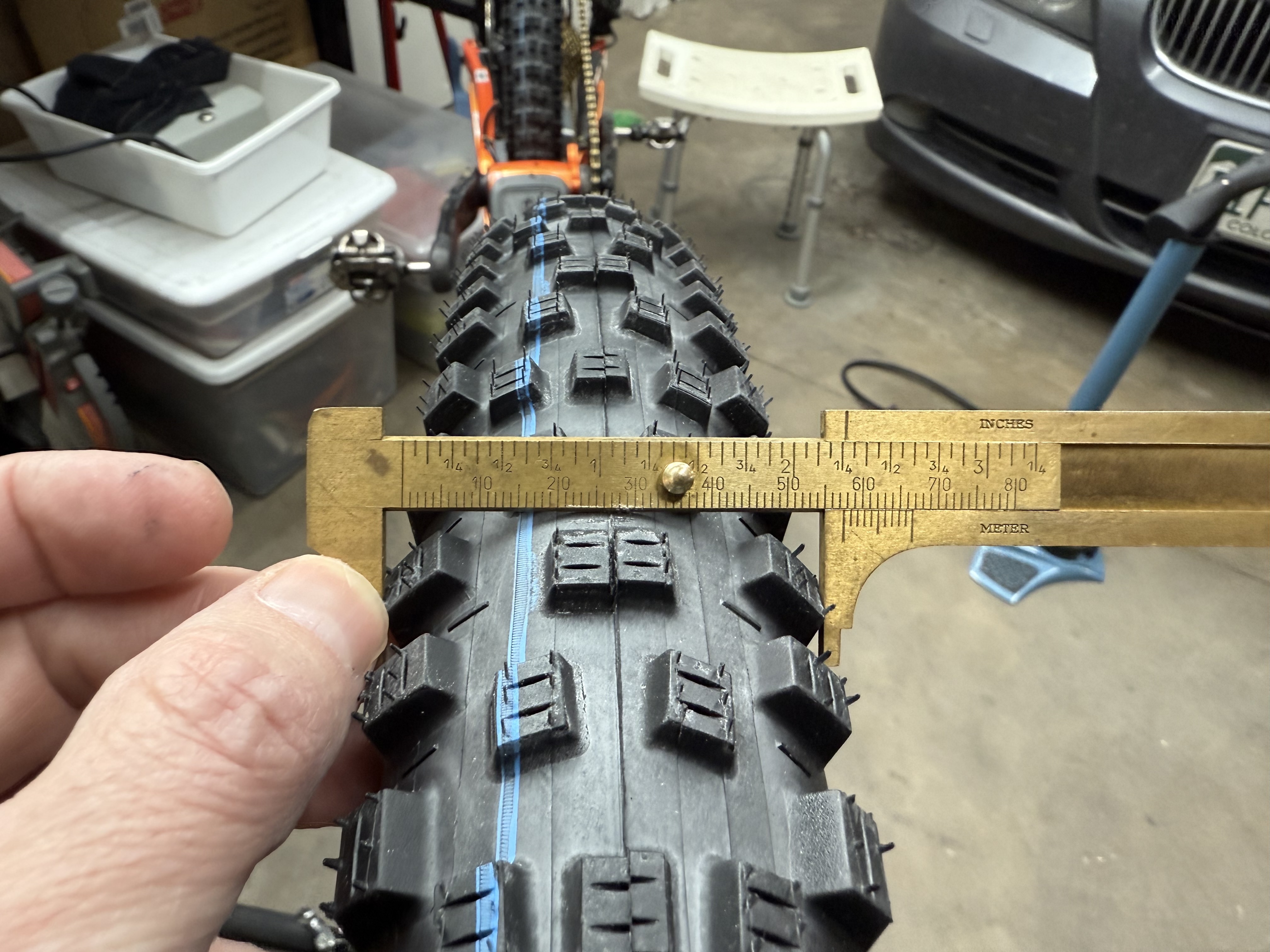
So typical of Schwalbe. I’ve never seen any of their tyres reach advertised widths. My so called 2.4 Rick are still 2.3"/58 mm on 30mm rims, even after many miles of hard use
I’m admittedly not overly familiar with the design and industrialization processes of bike tires, but this sounds like such a weird problem to have from Schwalbe. One could understand this happening maybe back in 2017 when the tires could end up in rims from 20 to 35mm wide, but this is not the case today.
If I wanted a 2.25 tire I’d get one marked as such, so I’m not buying anything from them still they sort this
Agree - a miss of 0.15” can’t be blamed on rims, or manufacturing tolerances. That’s a design issue.
Speculating here - maybe much of their tooling / production capacity is designed for 2.25” tires from past years, and they are “getting with the times” in producing wider tires - but not really producing wider tires, just changing their labeling to say they’re 2.4”?
Check out the vulcanizing step at about the 7 min mark. I’d bet those vulcanizing molds have a maximum tire width capacity. And they are reusing molds designed for earlier generation narrower tires.
How wide are the casings in those 2.6s ?
Asking because what most of us for a XC application are looking for is casing width, but tire manufacturers normally claim the widest part of the tire and that sometimes is on the thread
Yep. It’s just puzzling that they make their 2.4” tires deliberately / knowingly to be 2.25”.
Possible they have only a small production capacity for tires as big as 2.6, and the bulk of their capacity is from years ago when MTB tires were in the low 2s.
I’m still searching for a fast, true (or damn close) 2.6, and durable (enough) tire. The tire that seems to have come the closest that I’ve used is the bontrager 2.6 XR2. They aren’t very well liked, but when I used them, they felt fast (I know…), had good grip, but just weren’t durable enough for the rough rocky conditions I ride.
The other tire I have been using is the maxxis forecaster 2.6 (old version). This ticks most of the boxes, but it’s too slow. What’s in between these tires that is actually a 2.6?
 but so far with over 1500km havent had a problem. Before I had the maxxis ardent race 2.4 and almost had to drop an ultra mtb race half way but after some time the liquid finally took care of it but that eas the end of it. I know luck also has a huge part on having less or more flats but if the flat protection is better you have better odds on having luck