Having gone down the rabbit hole on the various videos, etc. ISM highlighted somewhere that his Z2 is within 70-80% of your observed max heart rate (not theoretical heart rate). That might be a narrower, more helpful range than % of FTP.
Also per ISM, I find the talk test to be really helpful (assuming it’s accurate, which I’m taking on faith for the time being).
So trying this all out last weekend, I periodically recited the pledge of allegiance aloud while on the trainer. Felt like 75-80% of max heart rate was about as far as I could go on the upper limit. My family thought I was crazy.
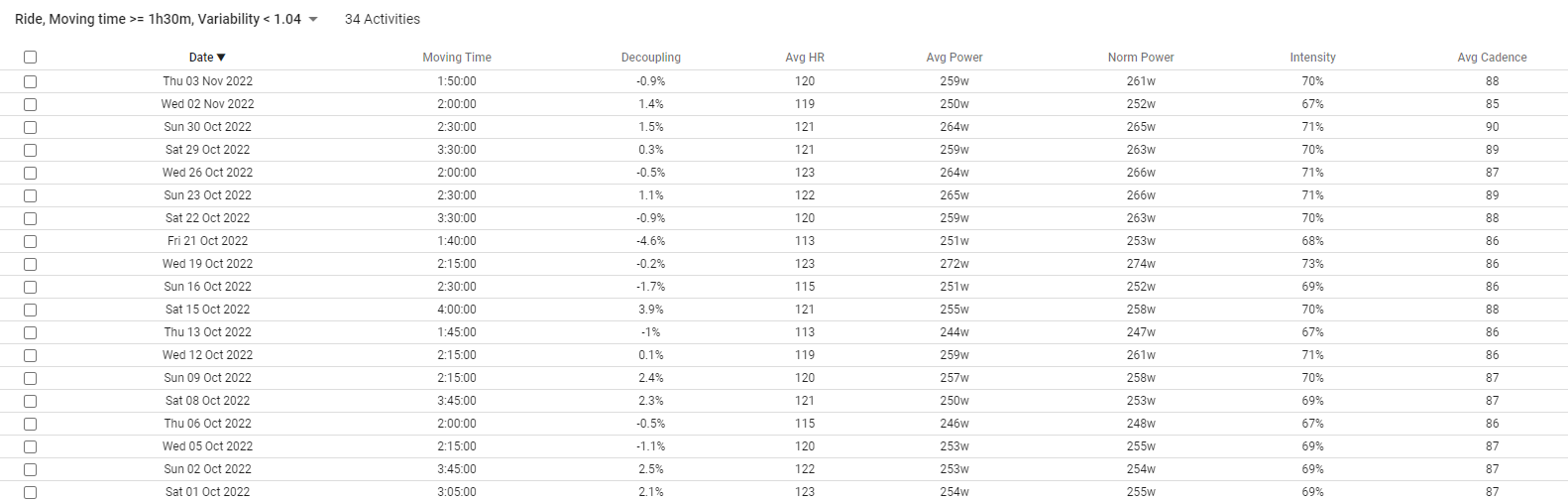
No - I’m saying you aren’t seeing a high level of consistency in your numbers at the durations you are riding, so I was encouraging you to ride longer to help stabilize the numbers and hopefully get you a more reliable trend line
I honestly stopped looking at decoupling with such a fine eye a while back - but below is a similar view of the rides I’ve done indoors with a low VI over the last month - I’ve included shorter durations so you can see the variations I see on those, as well as the longer ones
I have a standard route I do for a couple of hours mid-week with a standard endurance effort near 130bpm.
My decoupling on the ride varies a lot week to week, beyond improvement from better fitness. For me it is due to my low HR in the first 30-40 mins some days. Sometimes it remains stubbornly low and makes the decoupling high when it springs into life. So similar to @WindWarrior , I need longer than the actual warm up for decoupling comparisons.
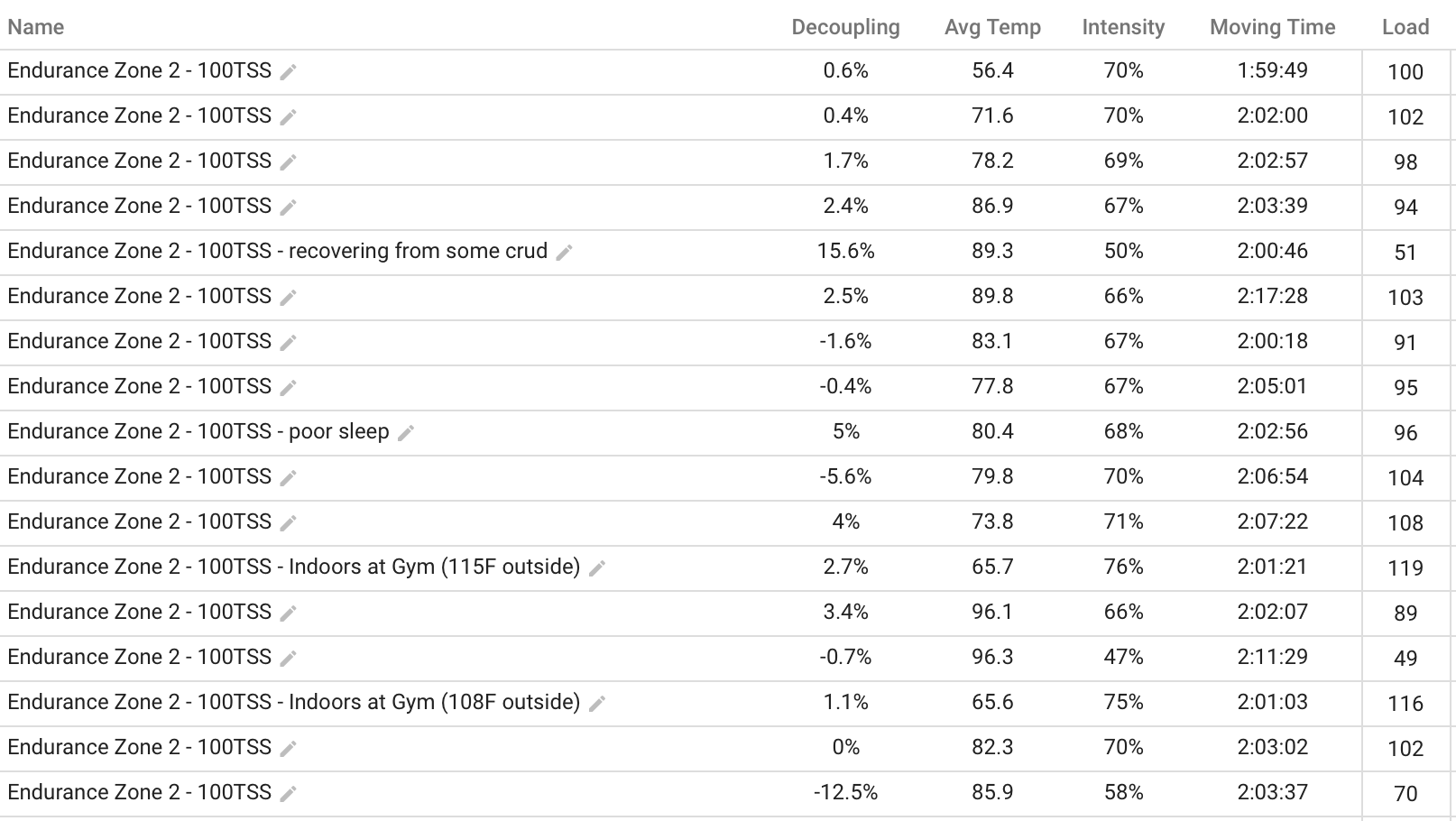
Last three months of my “Endurance Zone 2 - 100TSS” rides, using Intervals-icu defaults(?) of 20-min warmup and 10-min cooldown which isn’t the best for my rides but good enough for this discussion:
all outdoors on flat terrain, except for 2 in the gym during heat waves. One route takes 18 minutes before getting out of the city, another route is 10 minutes, and another is about 15 minutes.
Some pretty large swings in average temperatures. I’m fully heat adapted by mid-late July, and the one on the bottom is beginning of August.
Anything below 3-4% is NO decoupling to my eyes. So when I look at my chart above there are only two outliers - 15.6% while recovering from crud, and 5% after poor sleep. The rest I’ll wave my hands and claim no decoupling, nothing to see. Hope that helps.
Despite its origins, there is interesting information about your ‘engine’ from looking at any long-ish steady state interval (single interval) from endurance to sub-threshold. By definition working below threshold you are in steady state physiology, of course after you start the interval there is some ramping of breathing and heart rate, and then it should stabilize.
“Whole ride” decoupling is flat out wrong in my opinion. There is a reason Intervals-icu added the warmup and cooldown setting.
But yes, if you use incorrectly use Intervals-icu (or any other tool), then I agree.
I’m not sure I understand your second point. In my experience spending majority of each week doing endurance rides appears to have played a large role in building a stronger aerobic engine. And one benefit I see is a stable engine - decoupling under 5% - on long tempo (90 min) and long 30+ min just slightly below (or at) threshold. There is a TrainingPeaks blog from a coach talking about using decoupling to review intervals, again individual intervals, not the entire ride.
There is a lot of variability between athletes above endurance, the point is to figure out how your engine responds and if its less stable then there is benefit to doing something about it.
Got it, thanks. It really only makes sense on long-ish, steady, sub-FTP portions of the ride. After that we get into athlete differences due to physiology and metabolic fitness, assuming proper nutrition and hydration.
Yes, having a tool like Intervals-icu automatically calculate it - with or without warmup/cooldowns - its easy to miss the big picture and take decoupling out of context.
Yeah I just glance at it after a ride, and only for the steady-state portions. What I learned since looking at it for 6 years - my decoupling is only interesting after I take a break. And then for only a handful or two of weeks, depending on length of the break.
I was now also curious: Basically the same indoor training every day (only sometimes a little longer), and I don’t really see a trend in the decoupling.
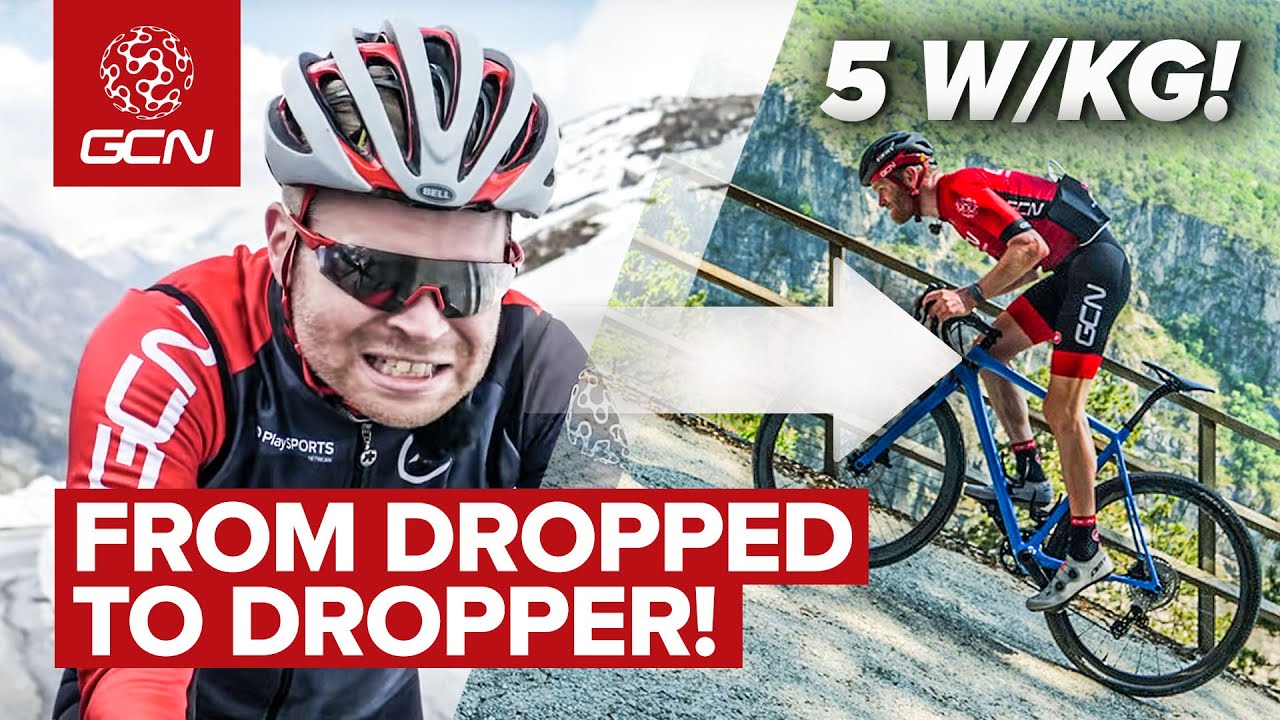
Interesting video from Ollie. I felt like he understated genetics, and made me feel bad about my inability to so closely control my diet. I enjoyed the video though and it added more curiosity.
Question (that I’ve seen before but couldn’t find the answer) how do those of you that MTB and follow the “Z2” approach manage your riding?
Yeah, I enjoyed this video, though the one thing that I did take away from it, is that somebody who is interested in science, seems to love tech (and aero), he didn’t get to carried away in fine detail and (it seemed to me) more interested in general health like diet and sleep, and that gave him most of his performance gains
I did think he was understating his training, or genetics, or both. To say I got to 5w/kg by not really focusing on riding is a bit vague as you say.
14hr per week seems more reasonable. It still indicates he’s reasonably gifted but is a more reasonable sort of number.
I think you’ve struck something I felt odd about it. I imagine he does pay more attention to training than he let on. The video was a real “you can do it too” thing. He didn’t talk about how he establishes his “Z2”, or what specific zones he hits if he does do intensity.
I think the answer to this is an e-bike (if climbing is a big part of your rides). Hear me out.
I put my Assiomas on my e-bike since my e-bike kit doesn’t give much other than battery volts. I still know how much I pedal with the Assiomas.
I just did 3.5 hours at 0.65 IF and travelled 65 miles with 4,000 feet of elevation gain at about 18mph average. Yeah, I was on the road, but you could do the same on the trails. The effort, not the speed, of course.
It’s just way more enjoyable to cruise up hills at Z2 instead of crawl, like I usually do.
I tried that, but then I realized that, for me, I could structure my trail rides like intervals - multi-minute climbs, followed by trail skills descending.
So now I do all my Z2 work on the trainer during the week, and then Saturdays are my high intensity polarized day - intervals on to climb, trail skills work during the descents.
Genetics is the #1 determining factor in athletic success. Training is #2 but you can train harder and smarter than everyone else, but if you haven’t won the genetic lottery you’ll never reach the top.
All too often those at the top get away with things that aren’t ideal for everyone or have some whacky training that people try to emulate. Talent masks mistakes.
I remember a guy in college who’d party all Friday night, skate board to the meet and still run the equivalent of a 4 flat mile. No matter how hard I trained, how much I slept and did things right I couldn’t beat him. I hate to say it… but not everyone can do it. We can train to be OUR best and should be happy with that.