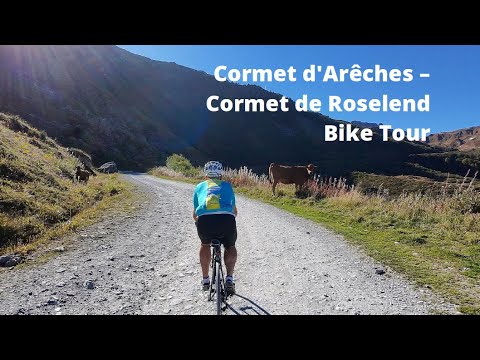
Last June I spent close to 3 weeks riding Mont Ventoux and several Alpine mountain passes and climbs. This post is to encourage others thinking about similar trips and to provide some useful information. I wasn’t trying to set Strava records. Instead, I just rode comfortably and enjoyed the incredible scenery, food, and hospitality found throughout this region. I flew to Nice, rented a car, and stayed in Airbnbs.
Locations, dates, and climbs:
Bedoin: 6/3 - Mont Ventoux
Briancon: 6/5 - Col de l’Izoard, Mur de Briancon (I regret not adding the Col du Granon)
Le Bourg d’Oisans:
6/7 - Les Balcons d’Auris
6/8 - Col de la Croix de Fer, Col du Glandon
6/9 - Alpe d’Huez, Col de Sarenne, Les Deux Alpes
6/10 - Oulles, Reynard, Col d’Ornon
Le Bourg St. Maurice:
6/12 - Cormet de Roselend, Le Col du Petit St. Bernard
6/13 - Col d’Iseran
Chamonix: 6/16 - Col des Montets, Col de la Gueulaz, Col de la Forclaz
La Clusaz:
6/19 - Col de la Colombiere (both sides), Col des Aravis
6/20 - Col de Merdassiers, Col de la Croix Fry (both sides)
Riding:
Targeted watts on climbs: 210, (3 watts/kg)
At this pace, my heart rate ranged between 145-160 BPM. (RHR is 45 and MHR is 190)
This was the first time riding to a specific wattage and I was pleased by how well it worked when combined with consuming 90 to 100 grams of carbohydrates per hour – see below. I rode solo but met many other riders at the climb summits, some of which have restaurants and/or snack shops. In general, drivers and motorcyclists in these areas are far more considerate of cyclists than what I experience in the US.
Fueling:
90-100gm of carbohydrates per hour using a mixture of maltodextrin (58.4%), fructose (38.9%), pectin (1.5%), and sodium alginate (1.2%) (all purchased on Amazon).
I used an article on this Forum to determine the 90 to 100 carbs-per-hour required to maintain 210 watts. I experimented with it on a few rides before my trip and had no digestion issues.
Each day I started with two 800ml bottles containing this mixture plus a Zip-Loc snack-size bag containing powder for mixing a third 800ml bottle, using a shaker ball to get the powder to mix well.
I carried gels in my back pockets but only ate 2 of them on the entire trip. (Warning: the Decathlon citron flavored gels are very acidic and taste terrible.)
Navigation: Wahoo Bolt Roam V2
Because the navigation display is too small for my aging eyes to read, I simply set the display to show watts, heart rate, and speed. Fortunately, the roads are well marked with signs indicating the towns, route #s, mountain passes, etc. Before starting a ride, I’d simply look at a map and make a mental note of the route I planned to ride. Although most cities have a tourism office, the one in Le Bourg d’Oisans is exceptionally good. Their website has over 20 rides of varying difficulty which can be downloaded in GPX format. They also have paper maps of the rides and hikes throughout the region and the staff are very helpful.
Lodging: Airbnb in all locations. All were comfortable and convenient. I bought an insulated bag (un sac isotherme) at Carrefour to carry perishable food items between locations. Lock box entry is preferred for arrival time flexibility.
Rental car: Renault Austral (Hertz)
Nice compact SUV with good acceleration and low-profile tires providing solid handling on mountain roads. The Serfas bike case fit lying flat in the back with the 2/3-split-rear-seat folded down. (The case is too tall to stand up in the cargo area.) One usable rear seat was a requirement as my wife and daughter joined me for a car trip after my 3 weeks of cycling. Note: Geneva Airport has both French and Swiss sides. If you pick up a rental car in France and fly out of the Swiss side of Geneva Airport, then be sure to return the car to the French side to avoid a second-country drop-off charge which can be several hundred dollars. (After returning your rental car in the French side, you can then walk through the airport to the Swiss side, just be sure to have a flight itinerary or boarding pass to show the Swiss security personnel.)
Bicycle: 2011 Cannondale Super Six Hi-Mod
Components: Shimano Ultegra 6800
Wheels: Mavic Ksyrium ES (yes, from 2006 with rim brakes – quelle horreur!)
Tires: Vittoria Corsa Graphene 2.0 25mm
Gearing: 50/34, 11-32 cassette
Bicycle travel case: Serfas Bike Armor Transport Case
Serfas website lists their current SBN case weight at 31lbs; however, my older case weighs closer to 28lbs. Most airlines will accept a bike packed in a case (or box) weighing less than 50lbs as a checked bag. The case has two wheels on one end and a nylon strap handle which allow it to be dragged with one hand. Fortunately, “SmarteCarte” luggage trolleys were available at both the Nice Airport arrivals baggage carousel and the Schiphol Airport (Amsterdam) rental car return area; the Serfas case and my carry-on bag both fit on the Smartecarts, making walking easy.
Clothing:
Throughout the 3 weeks, the weather was unusually warm. I wore bib shorts (Castelli Free Aero Race, ALE PRR) and short-sleeved jerseys (Giordana FR-C) and carried a very lightweight wind jacket (Castelli Squadra Stretch) which I put on at the top of a few climbs (Ventoux, Izoard, Croix de Fer, and Iseran) for the descents. I had packed a long sleeve jersey, but, after checking the weather forecasts, never carried it on a ride.
Under seat bag: Silca Grinta Roll Top Bag
Fantastic bag. The opening rolls down to handle varying size loads. BOA closures make it easy to open and close. It’s narrow enough to prevent rubbing on inside of thighs while riding.
Cost: ($1 = €0.87)
Airfare: $1,900 (open-jaw routing - Columbus, Ohio to Nice; Amsterdam to Columbus - made it more expensive, would otherwise have cost around $1,500)
Rental car: $60 per day through Hertz. I could have paid less for a smaller vehicle; however, I needed the space in the back for a passenger and the Serfas bike case.
Gas: $200; Tolls: $95; Parking $45
Food: average of $42/day
Lodging (Airbnb): average of $128/night