Am I right in assuming that if you HADN’T had a lactate test and had therefore taken your FTP as an approximation of Sellers LT2, then using the top of TR’s Zone 2 as LT1 you would in fact have been doing your SellerZ1 too high? Also therefore, TR’s SweetSpot would have been in low SellerZ3 (92% of 262= 241W).
I had someone draw blood for me. I think all of the moving around affects your HR too much. I used my earlobe because I found it much easier, and less painful. Also, you don’t really have to move using the earlobe.
And you are right, 2 and 4 mmol doesn’t work for me. It’s just an estimate. Reading the graph is better. We talk more about the best way to interpret a test in our podcast.
You are exactly right. I’ve essentially concluded the same thing. For this to work, you really need two numbers. HR at LT1 and HRMax for cycling. Knowing FTP is helpful to define a starting place for Z3 intervals, but not necessary.
I run my workouts like this.
Z1 Workouts
I have custom TR workouts that range anywhere from 60-120 minutes. The entire workout is 50% of FTP. I warm up for 10-15 minutes and then use the intensity arrows to raise the power until my HR sits just below LT1. If my HR drifts up past LT1 20 minutes into the ride, I decrease the intensity to make sure I stay below LT1.
Z3 Workouts
I started doing these by simply setting an intensity (ie 105% of FTP for 8min) and riding but I’ve learned with some trial and error that this is not the best approach. Letting your HR get too far above 95% of HRMax is a sure way to burn out mid-workout—I’ve done it! I’m going to start using a percentage of FTP as a starting place for the interval, but if my HR gets outside of the 87-92% of HRMax range, I’ll use the intensity arrows to adjust my wattage and bring my HR back to the desired range.
I had never had a lactate test prior to the one on the 26th. I really didn’t use the polarized approach prior to my lactate test. It was all right around the time I started riding again.
Also, I wasn’t doing any Z3 work because I was just returning from a long layoff and many injuries.
My initial thought was using Maffetone’s HR formula would be a good estimate of LT1 but it proved to be way too high for me.
For me using HRmax% never really lines up. Unless I’ve actually never hit max HR (193bpm was high enough for me) it just doesn’t work as well as FTHR using the Friel method. I’ve never been tested in a lab and probably never will. 92% of HRmax puts me at a HR I can hold for at least 30 minutes or more. That wouldn’t make for a good 4x8 session. That’s why I prefer using watts on the bike. With that said HR is great for keeping you in Zone 1
Again, I think this will vary for each person, and if your test numbers aren’t accurate, then using HR isn’t a good way to go. No different than using a bad FTP test as a way to set intervals.
I agree. Unfortunately that’s all I have to work with. I’m always learning and always willing to try knew things to see what works best.
You’ve nailed exactly what I landed on with my polarized approach. Dial the Z1 power up and possibly back down to keep the HR where it needs to be. Use the Z3 workouts estimates of 105% as a starting point.
two hard workouts per week. The rest easy. it’s very enjoyable.
BTW, those are a Flo disc and front wheel in my avatar 
Just read this in the comments of Joe Friel’s blog (2010):
I have athletes use HR in base 1 and power after that. In the early base period there is often a big discrepancy between HR and power zones. – JF
Didn’t know where to put it but thought it suitable for this thread. 
On the topic “how do elites actually train”
That’s an interesting read, he also links to his prior 70.3 training which he says was more of a polarized approach. But he also talked about racing more often in the past so that would be a factor. I’ll have to read through the older posts as well.
This is really great work, thank you so much for it.
I’m quickly reading down the whole thread but have input my own numbers to see if what I have begun working at look ok on the polarised model. I’m somewhat confused about how my L1 power looked. From what I can see, the optimal power for zone 1 for me is 232W? I was thinking that optimal in this zone would be much lower, indeed I did 2 hours at 185W on Thursday and then another 2 hours at 163W on Friday (back to back sessions due to weekend break).
I’m now thinking that I need to up the wattage to higher up the range? Is that your understanding.
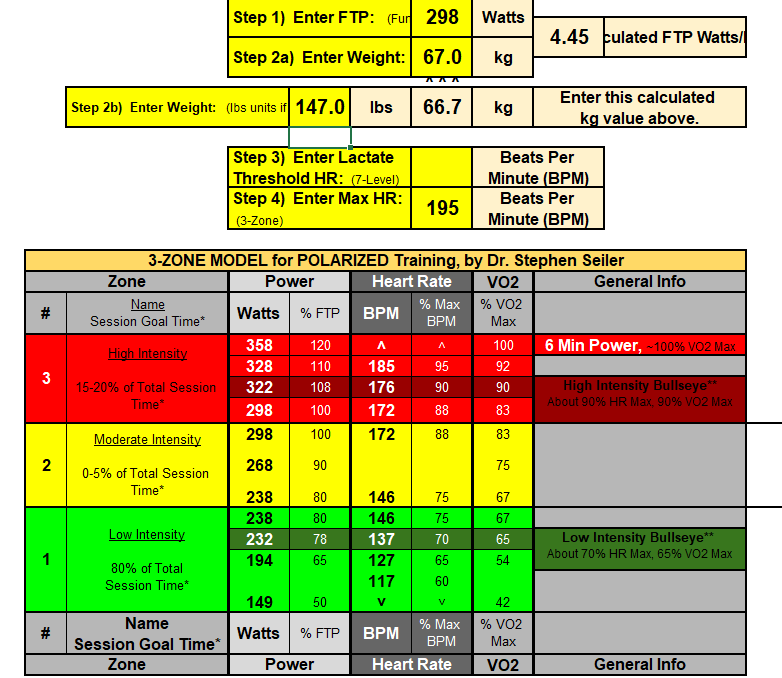
Be aware of the Bullseye. It is a point references by Seiler just one time. It’s not something most of us need to consider.
I almost left it out. But it was mentioned, so I included it for completeness.
For the Z1 stuff, stay middle to low in that range, IMHO for best application of the ideology.
That makes total sense from what I heard him and the other guys on velo news podcast say. Thanks again.
Certainly. Happy to help.
@Supermurph19 checkout my notes from Episode 54 podcast:
I’ve only just found this link to your spreadsheet today. Thanks for sharing @mcneese.chad, it’s really useful 

Good deal. I use it pretty regularly and find it really handy to compare the different models.
Happy you like it too 
I wonder about this. I believe it was Trevor Conner in one of the podcasts that suggested that most FTP testing probably yields a power number somewhat higher than a lab lactatcte threshold test would yield - with the result that threshold and even sweet spot intervals based on FTP testing might well fall in polarised zone 3 (based on on lab lactate testing).
Joel Friel remarks:
“The bottom line here is that even though polarized training has repeatedly been shown to produce the greatest improvements, how you train throughout the year must be seen in a far broader perspective. Smart training is not an either-or proposition.”
From:
@Nate_Pearson from “Our Training Plans are Improving” asks:
“Maybe I’m not doing it right. Can you link me to data that shows that cyclists who do 80/20 will perform better than a “Periodized Coggan” approach? If you could link me to data that shows that elite cyclists train this way that would also be helpful.”
@Nate_Pearson. Please refer to the study looked at by Joel Friel as linked above.
Do you have to have studies that show cyclists will perform better than a “Periodized Coggan” approach? Wouldn’t equivalency be enough? Or non superiority?
Do you have data that show that a “Periodized Coggan” approach performs better than a polarized or 80/20 model?
Are you only concerned with “elite” cyclists? What % of your subscribers do other sports? I live in the mountains of Colorado and ski quite often…I therefor am very much interested in what studies from other disciplines say about optimizing training…such as Dr. Seiler.
I find that a polarized approach is easier for me (as a Master’s age athlete) to do. I think that there are plenty of studies that substantiate the efficacy of a polarized or 80/20 approach.
@Nate_Pearson
Your statement: Can you link me to data that shows that cyclists who do 80/20 will perform better than a “Periodized Coggan” approach? If you could link me to data that shows that elite cyclists train this way that would also be helpful.
Is there data that shows that Traditional base performs better than a “Periodized Coggan” approach? There is not to my knowledge, but yet Traditional base is included as a plan option. Why are you raising the barrier of inclusion for a polarized (80/20) approach?
I’d like to end this post reiterating what Joel Friel stated earlier:
“Smart training is not an either-or proposition.”
Perhaps you will note that there are a number of people who have asked you specifically for a Polarized approach to training.
While I have to say that your platform is fantastic I certainly would appreciate you making it easier for myself and others who are interested in training in a Polarized manner.
Thank you for your attention to this.