Thanks for that. Very helpful.
1 Like


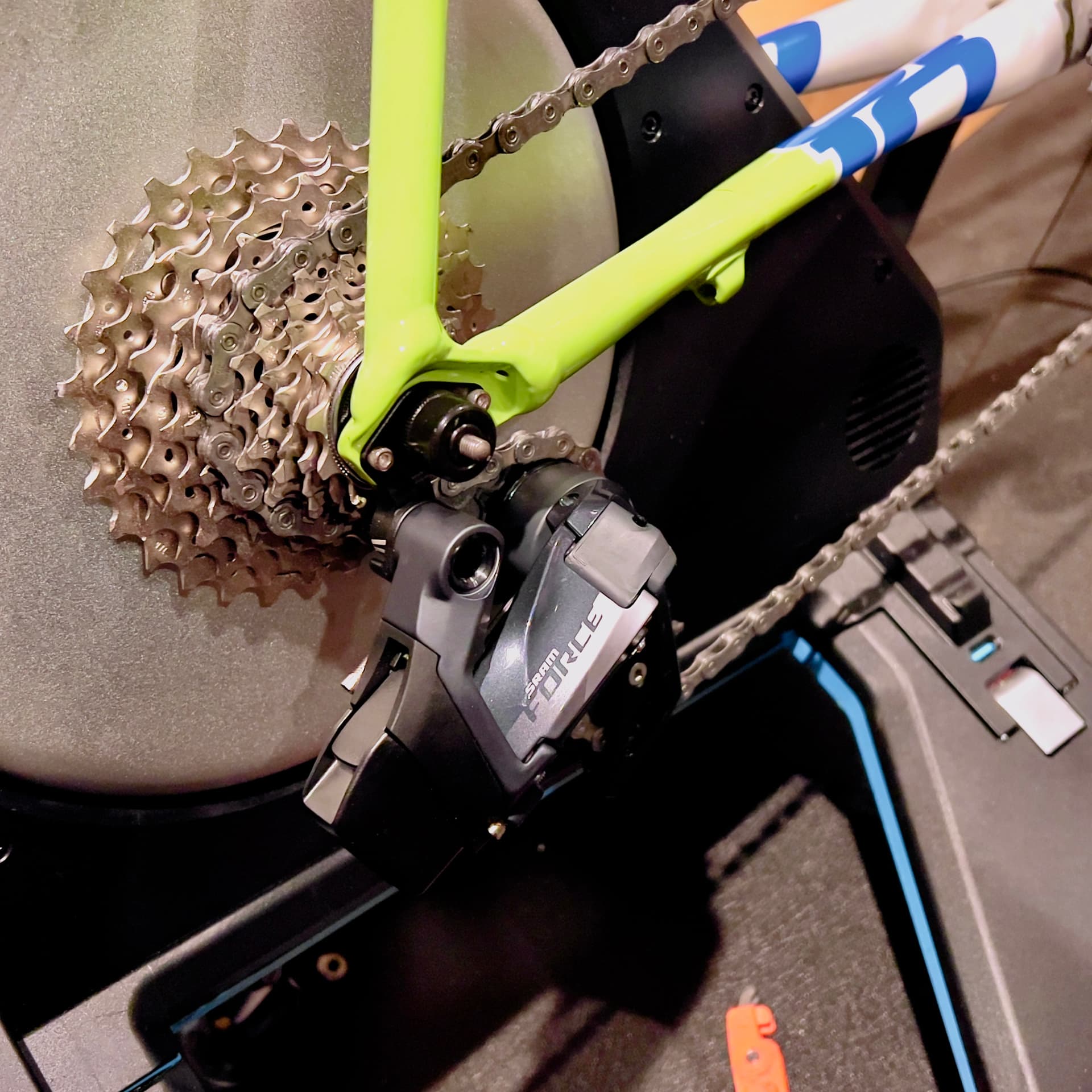
I have my caad10 on my Neo 2T.
Set up with R8000 Mechanical Ultegra front and rear mechs.
Unscrewed the rear mech, installed this SRAM Force RD (rated up to 36T).
Removed the Shimano 11 speed cassette on the trainer, installed this R8100 11-30T 12 speed cassette. New cassette is compatible with existing 11 speed freehub bodies.
Very preliminary, but it is promising. Adjusted b screw and limits, shifts through all 12 years no problem. Micro adjusted and it is not making any noticeable chain rub noises. Lower pulley is narrow wide, both it and the top pulley seem to fit into this 12 speed Shimano chain just fine.
1 Like
Tried the setup on my disc TCR as well. Results not good.
Not sure why it is different than on the caad on trainer. Will check with another set of wheels and also check hanger alignment to be sure.
On TCR, chain is skipping when shifted to 11T cog, it is getting caught on one of the teeth on the 12T cog next to it. Cannot micro adjust far enough to avoid the contact, makes me think that the total range of motion and individual cog spacing is smaller for SRAM flattop 12 speed vs. Shimano 12 speed. bummer.
Powermeter tested by Shane GPLama:

Pretty bad so far.
SRAM AXS/ Quarq still the gold standard here apparently.
2 Likes
Yeah, I was really surprised Shimano hadn’t managed to fix this. The design looks symmetric now, but still, the right-hand side power numbers seem to be problematic.
1 Like
I’m imagining that the strain gauges are still much too close to the spider and although the crank is now symmetrical, it still suffers from asymmetrical loading due to potential differential between the forces in the chainring bolts which will change throughout the rotation of the cranks.
Mike
Except it still isn’t symmetric. The configuration is the same as 9100, but the manufacturing changed. See the below picture from the Shimano website which clearly shows that the spier configuration hasn’t changed

d
It looks reflection-symmetric along the crank arm axis to me. Clearly, it is still asymmetric in the sense that the two arms closer to the crank arm are shorter than the ones pointing away from the pedal.
But in the end, the proof is in the data — the new cranks seem to be just as bad as the previous-gen cranks. I’m baffled that Shimano hasn’t fixed this. This is an unnecessary own goal.
Because Shimano is in love with their crankset look, and really don’t care if the power is off, as they don’t have to convince the vast majority of people to buy their crank arms for power accuracy.
Yet, Shimano is not the company of fancy stuff or being experimental, their products are actually rather boring… but the big plus is they work extremely well and are super reliable.
But inaccurate data isn’t really acceptable at the price point and the amount of time that this problem has been known now.
1 Like
I find it pretty shocking that (all due respect to Shane) someone in their garage can determine how poor the quality is so easily. Does that mean that Shimano doesn’t care to fix the issue? Can’t? Either way, very odd.
2 Likes
Yeah, that’s my image of Shimano, too. I cannot remember the last time it was Shimano who pushed the envelope in terms of features. But their stuff is reliable. I have had Shimano hubs since I was literally 12 — with the exception of my new road bike. I have never, ever done any maintenance and did not notice any degradation in performance.
But they seem dogged about their Hollowtech design despite cases where the bonding between the two halves fails. And they knowing about the inaccuracy of their power meter, they could have designed a crankset specifically for power meters. Among DuraAce customers, I bet the percentage of people running a power meter is actually very high.
The only explanation I have is the language barrier. (FWIW I live in Japan and a former team mate studied engineering and moved to Osaka to work for Shimano.) Even the owner of my LBS (a former world tour pro team mechanic who to this day is well-connected inside the Japanese cycling community) did not know about the accuracy problems.
To name a few……integrated shifting, dual-pivot calipers, clipless MTB pedals, perfected indexed shifting, Di2, et al.
2 Likes
Dupe. See below.
Well, Di2 was introduced 10 years ago, so if we wanna get pedantic….
But what innovations have other companies introduced in the last 10 years? eTap is SRAM’s version of Di2, road discs were pretty much an industry wide phenomenon and not one brand, etc. One could argue that nearly all of the changes in bikes in the last 10 years have been refinements of innovations Shimano introduced previously
I will also admit that I am nowhere near as up to speed on MYB tech as I am with road stuff, so there could be stuff there that I am missing, but I can’t think of any off the top of my head.
- It’s surprisingly old and still feels futuristic.
2 Likes
Off the top of my head:
- Shimano was the last to adopt 12 speed drive trains. In fact, they haven’t completed the transition to 12-speed yet, their highest-end electronic mountain bike groupsets are still on 11-speed. I have no idea why. Rotor and Campag already have 13-speed drive trains.
- SRAM pioneered 1x on the MTB side. It is fair to say that 1x has won in the MTB world and for drop bar bikes there are niches where 1x is strong. Shimano almost lost the MTB market because of that and was forced to do something unusual: forgo a staggered release of drive trains (XTR and XT one year, SLX the next, Deore thereafter).
- SRAM pioneered 1x drivetrains for drop bar bikes. (Yes, I know people have been doing that for ages, etc., but I am talking about native first-party solutions designed for 1x.) On gravel, I think the community is relatively evenly divided between 1x and 2x. I think most cyclocross bikes are 1x. My new road bike is 1x, too.
- Gearing for mortals. You have much more gearing options with SRAM or Campag on the road bike side. SRAM and Campag offer much wider gearing options, and for SRAM that holds 1x and 2x. Shimano decided to introduce a 54/40 crankset instead. Sure, if you want to ride pro gearing without pro legs, be my guest, it is your bike and your legs
- Deeper wheels made for wider tires. Here, among the pioneers are probably Enve, 3T and Zipp (= SRAM).
- First-party power meters. SRAM bought Quark eons ago and also PowerTap if memory serves. Their Quark power meters are among the industry benchmark power meters. Shimano bought Pioneer in early 2020, and their first-party power meters for drop bar bikes are not accurate. At the moment there is no Shimano-branded power meter for mountain bikes.
- A dropper post. You can have a SRAM electronic dropper post if you’d like. It even fits on some drop bar bikes. I like that.
- Wireless shifting and wireless everything.
Look, I come across as a SRAM fanboy. I’m not. If my next mountain bike has a Shimano drive train, I’d be totally happy with that — with the possible exception of a native power meter. I am just saying that they always seem to be the last to adopt something, and other factors like shift quality and shift speed aren’t that much of an issue anymore. Because drivetrains these days are so good that they all shift well, etc.
1 Like
I would argue that much of what you listed is not innovation, but refinement. Innovation is about a paradigm shift within the industry….adding an extra cog in the back is not innovation. Wireless is just a refinement of electronic shifting, etc.
I’ll agree to 1x drivetrains on the MTB side, but some of that is also because SRAM couldn’t make a FD that shifted for schitt, so necessity is the mother of invention and all that.
Shimano has always been first and foremost a drivetrain company….they dabble in some other areas, but it isn’t their focus, so I don’t expect them to bring innovation to wheels, power meters etc. And SRAM isn’t the one who brought innovations in some of those areas, they just bought the ones that did.
Ah, you’re right…2011 was Ultegra Di2.