
To be honest, while the “one gear” left may be a nice psychological trick, it shouldn’t stop you from using the right gear - if thats the lowest, do that. Going on gear lower than needed is also nice, it allows you to conserve energy and if you’re nearly there and feeling good, stand up and sprint to the top!
Its probably also safer to avoid shifting on steep climbs, if possible, because of the load on the drivetrain (ease off before shifting).
I once had a 2x wide gearing setup using SRAM road shifters, a JTek shiftmate feeding an XT long cage derailleur, wolf tooth road link and 11-46 cassette.
Was good for pretty much any incline and still a high top end for going down the other side.
As @ambermalika says, “I’ve never met a lower gear I didn’t like.”
Hadn’t heard that one, but love it.
Well, thanks to the advice on this thread – special shout out to @WindWarrior for showing me how to think through the numbers – I went down to see the good folks at Strictly Bicycles in Fort Lee, NJ and managed to markedly improve my gearing situation.
Ideally, I’d have liked to switch to SRAM’s 43-30 eTap AXS wide crankset, but that’s a 94 BCD part and won’t fit a power meter at the spider, so I’d have had to lose my Quarq, then buy the crankset and a new power meter of some kind. Much more expensive.
What Nelson’s crew figured out to be the most bang-for-the-buck approach was to swap me to the SRAM Force AXS XG-1290 12-speed cassette (10-36T) at the rear, and use the smallest set of 2x chainrings SRAM makes in a 107 BCD, which is a 46-33. Total cost about $370.
For my current parameters – a 6% grade, 150W (85% of FTP), 4.3 mph (6.9 kph) – the cadence changed from 51 rpm to 59 rpm. Seems like a substantial change and well worth the money.
Going forward, I can see how lower weight and higher power translates to more comfortable climbing. For example, adding 15W to my FTP gets me to 7.6 kph (4.7 mph) and 64 rpm. Recovering my “old” 212W FTP from Christmas 2020 and dropping 20 pounds – reasonable objectives for the next 6-8 months – gets me to 9 kph (5.6 mph) and 77 rpm.
And now the whole thing makes sense. 
Thanks to everyone. This thread has been an education! 
Thought I’d share my latest high-torque climbing experience, for inspiration purposes 
This is 700m of 9% average grade (64m vertical), but most of it’s over 10% (there’s a flat roundabout in the middle). Took me about 5 minutes, mostly threshold+, 34-32 gearing. It came at the end of three-hour ride/outside workout, so I was trying really hard to keep the watts low.
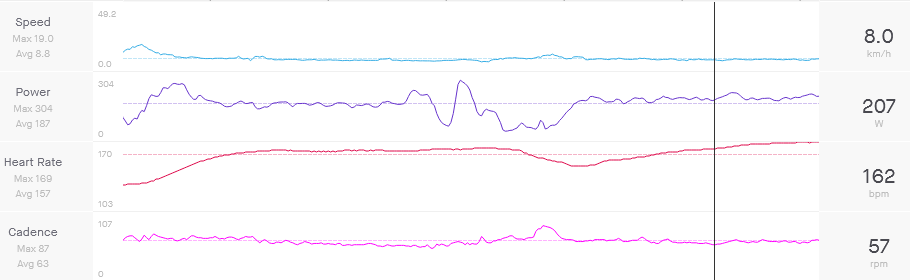
#TeamGrind
Another thanks to everyone for the input and advice. I attacked the first of the two hills I need to conquer today; and thanks entirely to the knowledge and gearing changes from this thread, I made it up the hill. Nonstop. On my first try. 
It took a solid 20 minutes and I was not a happy camper by the time I reached the top; but to my amazement, this 50-rpm thing is actually doable for me. I thought it would take lots more training before I’d be ready but once I got into my mantra of making perfect circles and keeping the motion smooth, I got the hang of it.
I do need more watts than what the pure numbers say, for whatever reason… but I’m within the margin of error and I got through it. Roughly 150-160W average, at 45-50 rpm and 5.8-6.0 kph (3.6-3.7 mph). Darn near fell over a couple of times. This is about 2.2km of 6% average grade, roughly 130 meters vertical ascent.
Hill #2 is just over triple the length of this one… but now I know how to beat it and it’s just a function of training

nice!
Well done dude! Fortunately I think it always feels a little more manageable the second time around when you know what to expect- and hopefully that builds a bit of confidence for the second one!
So, a quick follow-up question: I understand that going out and doing a ton of hills is not the best/quickest way to get fit enough for my A “race” (purely recreational for me). And the goal is to survive a hill 3x to 4x longer than this one at the same grade, so I have “enough” power though just barely. So in terms of TR workouts and my overall structured training, what’s my best focus right now?
A. Extensive: Long sweet-spot intervals to build endurance at the power levels I can currently put out. This is what I’m thinking would be best for this last bit of training before the big ride. Or,
B. Intensive: Threshold and VO2max work to raise the ceiling so I’m going up the hill at a lower percentage of FTP.
I only have time for one last short block of training, so this is truly an either-or case. After GFNY, I’ll do both of course. 
How much time do you have? If short, probably vo2max work as that can show pretty quick gains. But need to be careful not to overdo it - especially for us older athletes.
In addition to training, your strategy on race day will be very important - pacing, nutrition, hydration. I’d argue maybe more so than training - as when many people fail to finish big races, often they reference one of the above 3 things vs saying I wasn’t fit enough.
I have three weeks of training left. Generally, I’d say that is no time at all and I’d expect no gains; but since I’m still “retraining” and well below my previous FTP of 212W (before a year’s downtime), I’m seeing pretty quick improvement. The last six-week block gave me a 17W (11%) FTP boost. 
Agree that race day strategy is huge, but I think I’ve got a reasonable handle on that.
The goal on race day is simply to complete the course, 73km with 1140m of climbing. My plan is to ride as easy as possible (70%, 125W NP) except for the big hills which will need sweet-spot power (90%, 160W NP). Big Hill 1 (2.2km @ 7%) will take about 20 minutes, Big Hill 2 (right at the end, 7.2km @ 6%) would be 60-75 minutes if I could hold that.
I burn about 400-430 calories per hour and routinely take in about 300 calories of carbs (75g) per hour, mostly via Skratch Hydration Mix in my water and Skratch Energy Chews to supplement. I drink 20-24 ounces of water per hour, which was enough even in Miami. Nutrition and hydration are pretty well dialed in… that’s how I eat/drink on every long ride.
Your fitness is pretty much baked in at 3 weeks out. Sprint interval training has a pretty quick return, but it’s high risk and your job at 3 weeks out is to not lose fitness doing some risky last minute intervention.
My friend, this ENTIRE endeavor has been last-minute.
I signed up for GFNY’s “middle course” on impulse in late February, after the aforementioned year of downtime, to give myself a goal to train for. Never rode a real hill before then (just the Powell Bridge in Miami, 40m ascent @ 6%, and thought that was hell).
I’ve had all of 11 TR workouts and 3 outside rides since then. I have space for 5 more TR workouts and 2 outside rides before my pre-event taper. So those three weeks are roughly 1/3 of my total training time!
So as I said above: in general, I’d say three weeks is nothing and totally agree with you. But in this case, I’m making pretty quick improvement because I’m coming off the couch and I had at least a little fitness previously. It’s easier to rebuild than it is to build. And even if I gain nothing at all… I still need to choose how to best use those last training weeks.
My general belief is that I need to extend: increase my endurance by focusing my TR workouts (1 hr each) mostly at sweet spot and threshold, while my outside rides (~3 hours each) are generally aimed at “high endurance power” at about 75% of FTP.
I would think this approach gives me the greatest chance of finishing the event, even if slowly. More power, but without endurance, won’t get me to this finish line. Is there a better approach to this remaining training time? Am I missing anything?
Yeah, my approach would be to ride my bike more without wearing myself out. Then reduce time the last week.
I’m no expert so grain of salt and all, but this is actually the time I’d be wanting to get out and ride those hills.
As others have said you’re unlikely to make measurable fitness increases, so I’d be working on execution and getting mentally prepared for the most challenging parts. Hitting some climbs here and there should also help keep you “in touch” with harder efforts while not accumulating as much fatigue as you would targeting it more directly with structured sessions- the latter can hurt more than it helps this close to an event.
Good luck!
Yes, I am. Sorry, I hadn’t fully understood what you meant, but yes: GFNY’s “middle course” ends at the top of Bear Mountain, which is Perkins Tower. As for the “definitely doable at 1.2 W/kg” part… from your keyboard to God’s speakers, sir.