Thank you Chad. I was worried that some responses would be that it was unrealistic, but somehow the way you put it actually makes me feel kind of relieved in a way.
And to re-reference a worthwhile chart via TR info, check out the Men 40-50 chart for men in this post.
Top of bell curve for men
- 40-50 : 2.75 - 3.0 FTP/kg
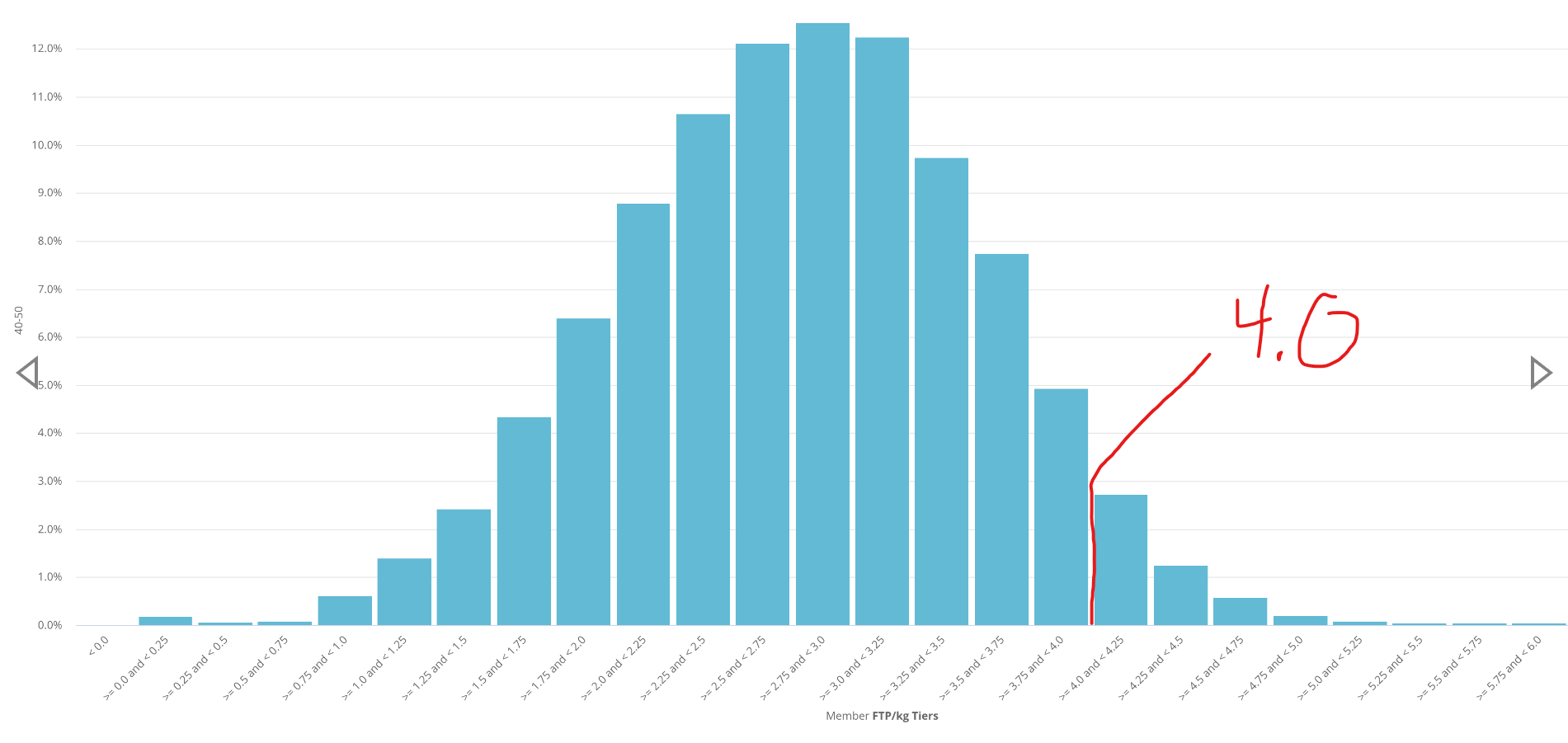
This is not absolute or conclusive (since it’s only TR rider data), but shows that those at or above 4.0w/kg in the 40-50 range are the outside end of the curve. Worthwhile perspective that is likely more relevant than the Coggan chart, at least for us older riders.
Just curious, but what does your diet and sleep look like. I am a much smaller guy, 64kg and I think that it is much easier for someone my size to make it to 4w/kg. But I am also older as well.
I will be 57 next month next month and I have always known that sleep was my limiter, but I had never really tested it until the last few months.
Because of time constraints, I have always gotten up at 4:00am and rode at about 5:00am, so getting much more than about 6 hrs of sleep a night was really difficult. But after about six months with almost no gains, I decided to do my very best for a couple of months to force myself to get more sleep.
I immediately started to see improvements. I have been hanging out at around or just below 4w/kg for a little while now, but I really feel like if I could figure out a way to average 8 hours plus of sleep per night for a year, even at my age, I think that I can get to 4.5 w/kg. But for me at least the sleep is absolutely mandatory.
This. ^
I personally increased ftp about 6-8% per year for 3 years then basically plateaued. Volume and relatively constant around 8-10hpw. My ftp was about 20% higher than my ‘just on the bike’ ftp coming from a fit background in other sports.
Your goal was just not realistic. TR seems to be working well for you with a large gain. You may consider revising your expectations or taking a different perspective as others have stated. Keep up the good work and go out and do some fun rides outside!
Spend more time at higher progression levels before updating FTP
I would also suggest looking at improvements in fitness other than your “FTP”.
If I assume that your FTP has always and only been set by the Ramp Test in all the above results, I would hazard a guess that there may be other improvements hidden in there. You may be an over-tester on the Ramp Test and actually now be riding at a more “accurate” number.
Or to put it another way, has your TTE at FTP changed/increased at all?
I don’t think there’s anything wrong with 4w/kg as a goal as Chad says above, but it’s easy to see the rapid response of some athletes and think that’s a fair expectation.
As above, I’ve never had an FTP increase beyond a few percentage points since I started with Power. 15% is pretty good, your real world increase may be more, or you may have had an increase in FTP and an improved ability to ride at FTP.
Ultimately you have to have faith in the system and plan you use. It doesn’t sound at all like you’ve maxed out/are wasting your time on TR. However if there’s something out there that motivates you more to follow the plan etc then that’s a major consideration.
Ftp is only part of the equation. I might have the same ftp over a year but my sustained power is better at a lower hr as an example.
I know mid-40s is a busy time in life, I’m right there with you. Kids, family, work…it all demands the majority of our time. And when time is limited that 6-7 hours a week is impressive. But… could it be that 7 hours a week just isn’t enough volume to get the gains you’d like to see?
As many have said you have had a solid improvement, is it that the work put in matches the gains?
And then there’s the age factor. At our age I kinda feel like we are holding on and trying to stop the slide rather than get the gains we would see in our youth.
I see two red flags here: you have a very concrete goal, 4 W/kg, which at 84 kg is a lot, and you are expecting to go up 1 W/kg within a very short period of time, a year or a year-and-a-half. You also seem to assume that training outdoors “would have been more productive.” IMHO you are setting yourself the wrong goals and expecting too much, too soon. This is very, very dangerous, getting better at endurance sports means playing a long game, thinks years. And it depends on your age.
Both of your goals, 4 W/kg and 336 W (= 4 W/kg at your current weight) are well above average, especially your absolute power goal, so you should not expect to automatically get there, especially not within a year. Some people are struggling for years and might never get there. (Not everyone is above average …) Age is another big factor, in your 40s you are not recovering and adapting as well as when you were in your 20s. For context, I started structured training in
Importantly, not all fitness is captured by your FTP. We frequently use FTP and W/kg, because these are fitness metrics that are easy to grasp and relatively easy to measure. Unfortunately, other metrics are harder to capture and track. So you might be missing ways in which you have gotten fitter, because you aren’t looking.
Moreover, independently of whether you use TR’s training plans, FasCat’s training plans or find yourself a coach, structured training is very different from unstructured riding. And you might need to reduce the number of unstructured rides to make sure it doesn’t interfere with your training. Structured training for endurance athletes is balancing recovery and fatigue with intensity and volume. What you describe here sounds as if you are doing too much:
That is another red flag: it means the workout is too hard for you to handle. The reasons for that could be manifold, e. g. intensity, too much training fatigue (i. e. too little recovery) and inadequate fueling come to mind. Instead, you should choose workouts that you can complete without modification.
Hey mate, I was in a similar boat chasing 4W/kg and spent a long time around 3.5w/kg. I finally reached 4w/kg and am currently at 4.18w/kg. I didn’t gain power(not a significant amount anyhow) I lost weight.
Theres one thing that seems a bit taboo to talk about here in the w/kg calculation and that is the weight. For reference sake I have a 4.18w/kg ftp with an FTP of 218.
At 84kg. Unless you’re a pretty big frame, you probably have room to shift your weight. If you lost 16kg and got down to 68kg, you would be 4w/kg.
I don’t know your body composition, but I’d recommend a dexa scan so you have some insight. I always thought I was relatively lean at 63kg but turns out my body fat % was actually 23%/14kg of fat(I’m short with a small frame) I knew I could get that down to 10% without any consequences.
Obviously you’ve got to be careful losing weight that you don’t lose muscle, run a modest calorie deficit, eat plenty of protein and lift weights regularly.
I had the same type of challenge where I was struggling to balance life with training and being able to lose weight (4kg in my case) whilst training effectively. Calorie defecit always hits me hard when I try to do SS or above intensity.
So I hired a nutritionist to sketch out how I can run a calorie deficit whilst training and not losing power or muscle. I thought I had a good grasp on nutrition and healthy eating, turned out I did and was 85% of the way there but the 15% that he tweaked was my blocker.
I’d recommend the experience
It might have been said already, but I didn’t see any references to your height. If you’re maxing out your power capabilities then the best way is shed kg’s, hello higher W/KG. If you continue to workout as the kg’s drop you’ll be able to assess if the power is the same or starting to drop as well. Finding the crux of weight/power is a worthy pursuit, and you’ll probably find that you’ll smash the times on whatever climbs or TTs you’ve been chasing.
Go to Ivy’s post click on user name

Click The Message button
Good luck

That’s going to sell out faster than Springsteen concert tickets in New Jersey.
I just ask a small royalty from the $5k tickets 
I suggested that a few months ago:
and I’m completely serious, was quickly contacted via direct message by the podcast host.
Ha Ha. You guys are awesome. For real though, I bet a lot of us would really benefit from something like that.
Would be super cool - It makes me think of how they have really good racers doing race analysis videos. Instead of racers/races, it would be coaches doing training analysis.
I agree a fuller expansion of the idea is very worthwhile. They have done at least a handful in shallow depth on the AACC podcast, via answering some questions. Nate & Jon (IIRC) have pulled open a few riders’ TR calendars to dissect them a bit and better understand and identify suggestions related to the initial question.
Taking this to a true and fuller review with the athlete in question and greater view of their life, training and all that surrounds it seems like a win to me. As we’ve said before, learning from mistakes can be very beneficial, for the person in question but to others listening as well.
I will add that people need to be pretty open if they step up to that type of review. As we see in similar topics here on the forum, the greater introspection can sometimes lead to discoveries that are not always easy to accept. Having people point out our misses may be tougher than someone patting our back, especially in a more public way.