Hey stanleyjack14
It’s hard to answer without knowing your goals. But some general thoughts.
Leg extensions have a bad rap. They apply a shearing force on the knee. With 7 knee surgeries under my belt, I steer clear of them, but haven’t dug too deep into the science of why they are commonly believed to be bad.
I see you have squats AND deadlifts on the same day. That’s taxing on the legs. And considering you are using your legs on the other days (cycling, running), I would recommend not to do this. If you do want to, make one of these exercises a different focus by reducing the load 50% or so and making it a more of a dynamic/explosive lift for a different stimulus. But considering you’re a triathlete, then I would reduce to 1 leg exercise per workout.
I see you’re working a higher rep range. Keep in mind this results in more “Sarcoplasmic Hypertrophy” which is more size with less strength gain. Great for body builders. If one reduces their reps and increases their weight, they will gain “Myofibrillar Hypertrophy” which is strength with less muscle size increase. So, with that said, I would look at reducing your reps and increasing your weight. You’ve been doing this for 3 months now, so I would assume you’re starting to feel comfortable with the exercises. I hope you have had someone to guide you through executing this program for the first few times.
The best program for anyone, is the program you’re not doing. That means, your body adapts and and this slows its adaptation. I try and change my weights routine around every 3 weeks. The easiest way is to have 2-3 routines (2 days is 1 routine in your case) and then shuffle them around regularly. It is also good if you come into a week and have an injury or extremely fatigued body parts, you can flip over to another routine that works better for your current situation.
One particular point (general ones were already addressed) - are you really doing less weight and less reps on the dead lift compared to squat? Usually it is the other way around. Check your depth on the squat.
I think in general, you are right in doing the higher reps at start with (assuming you are completely new to weight training). You could have gone a little higher even. One of my posts above lists the prep phase of weight lifting (off season, early base) as 8-12 reps. this increases time under tension so will lean towards hypertrophy over maximal strength. But as you are new to strength training and a light weight guy probably nothing to be too worried about.
As the previous two posts have said, you can now drop the number of reps, increase load and work on maximal strength.
In terms of isolated leg exercises, absolutely include them. I find it best myself to use them in the warm up/activation section of my session so for a start less likely to skip it, but also helps when you get to the heavy lifts. Options for you I regularly include;
Single leg hip bridge
Single leg step ups
Bulgarian squat
Lunge walks
Swiss ball hamstring curls
Single leg deadlifts
Single leg squats (can start easy by holding bands/TRX for example)
some of these you can naturally progress by adding weights of course.
Slight counterpoint to the above posts. You will not put on a bunch of muscle weight unless you are overeating. If your diet is in check, it is very difficult to put on large amounts of weight, no matter how many reps you are doing. Some people stress out way too much over this aspect and many people are in need of a little extra upper body muscle, at the very least, for injury prevention.
Hey guys. Couple of questions as I’m putting together a strength program with my PT. I’ve been doing 2 sessions a week over winter but only have time for 1 per week from now on, so I need it to be the most effective it can be.
If I only had time for squats OR deadlifts, should I do…
(a) all squats
(b) all deadlifts
(c) squats and deadlifts on alternating weeks
(d) 4 weeks of squats, 4 weeks deadlifts, rotating?
What’s the minimum number of days out from a race you would do a strength session? I do mine on a Friday morning so I’m a little worried about races on the weekend.
I don’t know the rest of your lifting routine but an option would be do (d) but keep the other lift (or a variation of it) as an accessory lift.
EX.
4 weeks of focusing on squats then doing sets of RDLs at the end.
4 weeks of focusing on deadlifts then doing sets of split squats or front squats at the end.
That way you never get to far away from either lift but you still get to focus on a lift and have several weeks to progress before rotating.
Depends on your body type. I put on muscle very easy even in an energy balanced or calorie deficit state and am adding in an afternoon endurance ride to my lifting days to avoid gaining mass.
Also, I’m not sure where this idea came from that you can’t do squats and deadlifts in the same session? What’s the rationale there?
I’ll throw out that unless your goal is to win Mt. Washington or a hilly Nats, putting on some muscle bulk at 40+/50+ – especially 50+** – is not a bad thing.
You lose muscle after 50 – it’s inevitable. So a 2-3 kilos of lean mass before you get too deep into middle age will make you less of a w/kg cyclist, but it may also help your general health and fitness as you get old(er).
“Also, I’m not sure where this idea came from that you can’t do squats and deadlifts in the same session? What’s the rationale there?”
The rationale is that you’re using your spinal erectors to hold yourself upright during both lifts and that over-working them by stacking whole-body exercises like back squats and straight bar deadlifts together is a recipe for injury through fatigue related form breakdown.
I understand your point but that is certainly dependent on the volume. Total volume you do in the two lifts and the volume you are used to.
I am not saying it is optimal programming but I do squats first and (sumo) deadlifts as a second exercise every session (3 times a week). I’ll sometimes switch to front squats but that’s about it. But I’ll hang a for a few minutes at the end of the session for spinal decompression and do cobra exercise almost every day.
I am open to suggestions how to improve my programming. However, since I already use Prilepin’s chart as a guide for the total number of reps, leaving out one of the exercises would lead to less overall volume. I don’t see how that could help.
@DaveQB Thanks for taking the time to provide that explaination, some great reading!
@Dostring I think there are two reasons for this. 1) Depth of squat is definitely something I need to improve. How deep should my squat be? 2) I am cautious with weight when deadlifting and try to concentrate on form. I believe I am capable of deadlifting more than i currently am.
@ahackett445 I agree. I think the higher rep range has been useful while I am taught and understand the correct form. I will now try to reduce the reps and increase the weight. Thanks for the examples!
I have to disagree. We’re all different, but generally higher reps and sarcoplasmic hypertrophy will result in a higher size gain to strength ratio.
20 years ago, when I started lifting, I gained 10kg in 6 months. I have really dropped off lifting weights recently, but got myself organised and back into it about 3-4 months ago. I have gained 4kg in that time. And that is with low rep, high weight. If I’d gone with the high rep approach, I would have gained even more size for the same strength. But we’re all different and no 2 bodies react identically to the same stimulus.
I am not saying size is a bad thing, I just know people in endurance sports worry about their weight, so it is good to have all of the facts. The Industrial Strength Podcast episode I linked to explains it well I think.
You certainly can, but if you’re making one of them your main lift, then the other will suffer. So if you do do both, I would have 1 has my focus with the full warm up sets and max lift for 3 or so. And the other a lower weight, lower intensity.
Full warm up sets, for me is something like:
Squats aiming for a 2-4 set of 120kg
6x 40kg
6x 60kg
4x 80kg
2x 100kg
1x 110kg
1x125kg
2-4x 120kg
I wouldn’t then do the above with deadlift, if I was doing it in the same workout. I would just do 2x6 at like a 10RM weight.
We don’t always need to go ATG squats. For me, with all the knee surgeries I have had, my knees don’t bend that far. But even if they did, do you need strength through your entire knee range for your sport? Sure, for health, light weight squats through full knee range could be good (a contentious topic). But jacking up the weight and doing 1/2 squats is generally more functional for most sports.
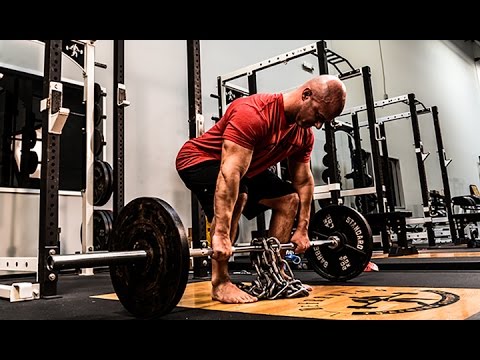
Here’s a deadlift form video. I’ve been following Joe’s work for a decade plus now. Maybe not good I am getting all my info from one source, but he makes sense to me.