What are you planning on using on the sides as “springs.” I’ve got the parts on order for a similar setup and was thinking of trying some thick foam, tennis balls, balance pods and/or a couple of small wheel barrel inner tubes.
the balance pods are likely too thick given the height of the vibration mounts
the tennis balls are probably too big as well
foam can be built up to the right height but not sure about the “feel”
Inner tubes can be adjusted via air pressure but might have too much spring in them
McMaster Carr sells a wide range of vibration mounts, with and without studs for mounting. What height, diameter, and overall durometer of stiffness would seem optimal for 5" inflatable balls? The tallest mounts are the most expensive.
This is a very cool thread. I recently threw a 3/4" sheet of MDF on a couple layers of carpet and pad because I liked the way the trainer moved when on carpet. I had moved from concrete. Now I come here and realize it is a thing, nice!
@mcneese.chad I like it a lot so far! I never had too much discomfort on the trainer myself but it definitely feels more natural. One of the reasons I was hesitant to go with a mechanical hinge design and had a go at a vibe mount design was my worry that with the high radial load and low sweep angle during its lifetime there would be the risk of squeaking. My setup so far is whisper quiet. (Though me with headphones in I guess that’s more of an advantage for the rommmates.)
I’ve been thinking of hard mounting the fork down. When swaying via the saddle the rocker plate rocks well, but I feel that when I put lateral force on the bars it has more of a tendency to spin the front wheel rather than rock. Anyone have experience?
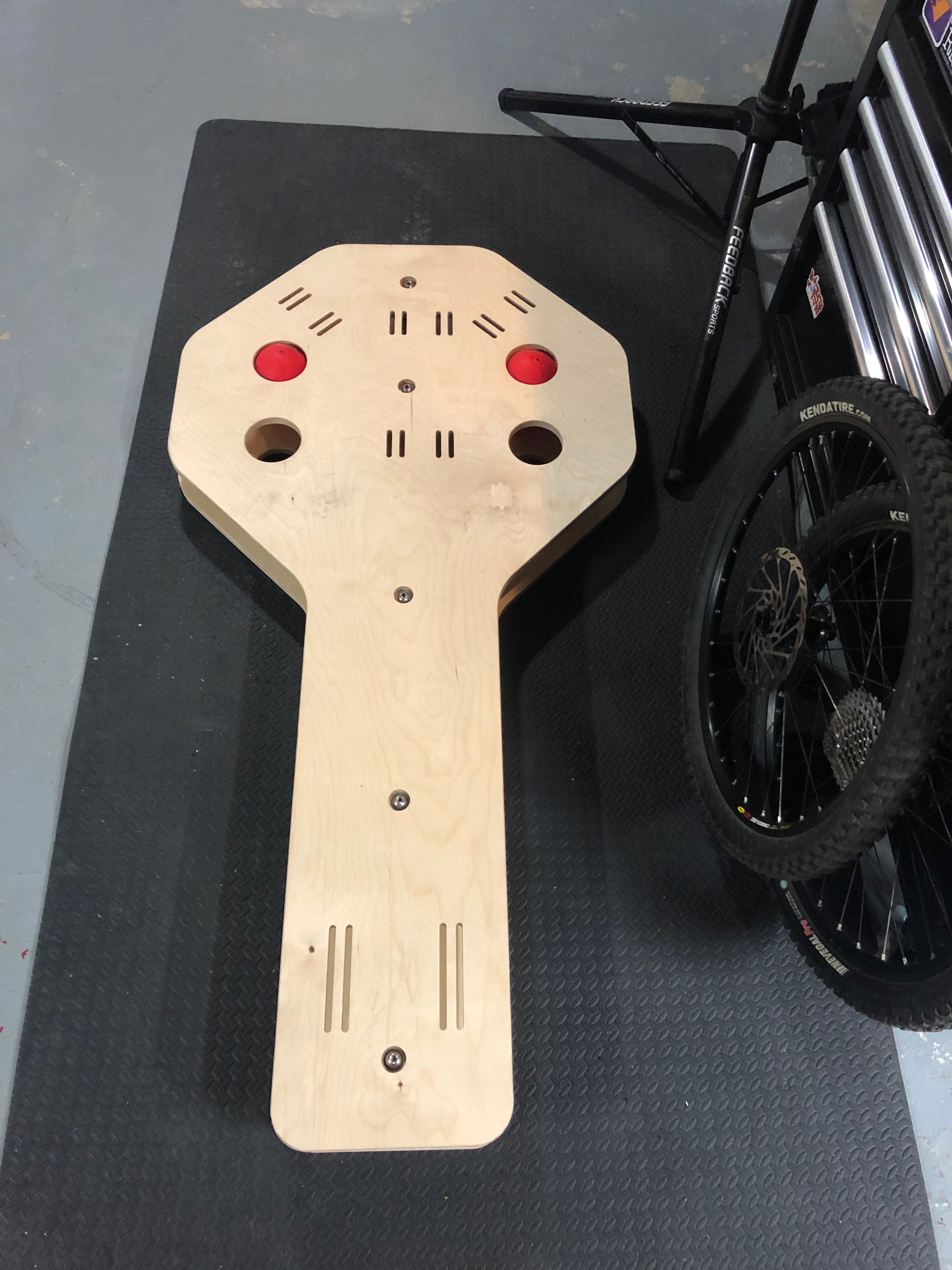
Also, for explanation of the pictures above, my Tacx Flux is held in solely with its own weight and small wooden “fences” made out of cheap 1x1. There’s nothing holding it in vertically right now but it hasn’t been a problem yet. Designs are in the work for 3D printed “shoes” to capture the ends of the legs down to the plate.
We lack the natural centering forces present while rolling outside. So a bit of “flop” is not u common. It takes a little more effort on the bars to keep them centered.
Some have built lazy susans with centering springs, to make the feel more like outside. I need to build one for testing.
That works as a tester. But I dislike the vertical bounce and even pitch (forward rotation) that happens with a full-floater setup like this.
It doesn’t control motion as well as rockers with more rigid support in the center, but is something to see if you like the general addition of movement. If you like it, I’d recommend a full deck with center support to create a pivot axis on the center that better controls the rocking direction.
Nice. Looks like you offset the vibration isolators to deal with flywheel. I’m planning a biz trip to your area soon, will reach out when my plans firm up.
As a long-time user of rollers and the KK RnR trainer (which I turned into a Frankentrainer by replacing the passive KK unit with the CycleOps Magnus unit), I have been thinking about why the rollers always feel the best.
The motion of the rear wheel is much more complex than a damped rotation along a center pivot point like the RnR and the rocker plates. There is a bit of sway perpendicular to the rear wheel that I think having the fixed pivot point negates.
A more complex setup should have high perpendicular compliance to allow sway but less parallel and rotational compliance to reduce the pitching and bouncing. Interesting engineering problem. Probably different shape dampers could solve this.
The current solutions are the simple ways to achieve motion, not necessarily the ‘best’ or most ‘accurate’.
I have 3 designs that are meant to get closer to the actual bike motion. I need to make some time to turn them into prototypes to see if i am on the right track.
They all will reproduce motion differently than all but one other rocker that I have seen. The real question is if they will be “better”.
Well, Chad seems to have everything in order here.
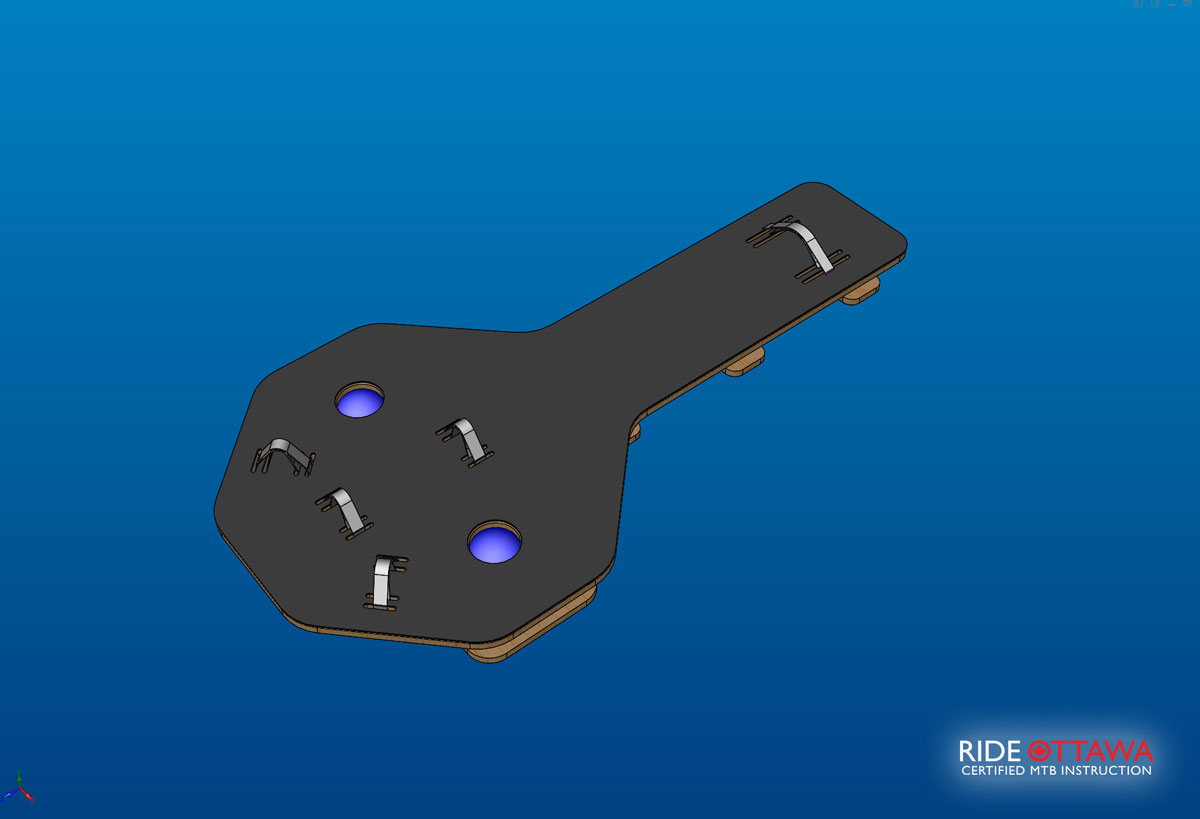
I am attached my V2 design for reference if others are interested. The pictures show the V1 prototype (2 plates) and the other images are the CAD snapshots of the V2 version design. The V2 design is adapted to remove the bottom plate and uses feet to get 2 x units per standard sheet fo plywood.
Page 1 PDF shows the bill of materials including the McMaster Carr part numbers for vibration dampers and fasteners. The PDF file can be supplied to your local shop for CNC routing. (or message me for other file types).
Purpose of this design:
STABLE for heavy rider (that’s me at 101Kg)
Side to side motion only (not interested in front to back)
Quick to build (parts from McMaster Carr)
Sub $400.00 build (CNC routing in main cost)
Adaptable design with 2 x 5", or 2 x 10" playground balls
2 x Full units per standard 4’ x 8’ plywood sheet
Notable Test Results after 30 days of use:
The specified dampers (McMaster-Carr) with high support and shear loads provide excellent motion and adequate damping; IMO opinions far superior to lighter load dampers.
2 x 5" balls provides good spring action for lighter riders. (4-6 psi)
The use 4 x 5" playground balls allows lower pressure and slower spring rates for better feel (2-8psi). 4 balls allows you to keep a lower profile. (but was removed in favour of #4)
By adding the round spacers and increasing the distance between the plates, 2 x 8" (or 10") playground balls can be used. The larger volume in each ball provides a much SLOWER action which feels much better to me. I can run each ball at 6-8psi to keep the plate firm and the side-to-side movement is still great with a much more natural feeling.
Rubber top sheet reduces overall noise and stable trainer mounting using only Velcro. (not shown on prototype)