They are freely available to anyone provided they had an original series I think. I doubt most Americans will get them. Even people I knew who were enthusiastic about getting vaccinated last year are no longer very eager for various reasons. Last year the main selling point was infection prevention, but now that its known protection is not particularly durable, that’s gone.
though this would be a selling point again. The new boosters seem to protect against the circulating variants again. At least over here where omicron is still dominant. Until christmas or Jan protection should be fairly good.
By the way, effect seems stronger for flu vaccination but there is an additonal boost when exercising right after getting the jab:
I think it’s hard to get people excited about 2-3 months of protection from infection when the original vaccination campaign was at times as ambitious as eradicating the virus. It might offer other benefits, but we don’t really know. There weren’t even human trials.
In the US, the second booster if the original vaccine required you to be 50+ or immunocompromised.
For the new bivalent booster, there are no age / health requirements (other than being over 12).
As noted, the new boosters provide protection against the new omicron variants.
Just got the bivalent booster. I was a little bit uncertain if I would get it since I’m still in my 40s. However, vax center doc did not care. Was quite unhappy about the official recommendations.
Also did a 60min zone 2 post-vax boost-the-booster spin (see paper referenced above).
At least some protection for all the biz trips I’ll have to do in the upcoming weeks.

I have no way of knowing for sure, but thinking and hoping I had BA.5. I was sick the last week of May and unlike Delta which I think my wife had in December or BA.1 that I think my son had Feb, we all got sick at the same time, which I think may be because of it’s spreadability. I’m still on the fence about getting another booster. I’m still not sure what the plan is from a medical perspective. Seems like guidance is becoming a bit harder to come by and almost an afterthought.
With the new variants, reinfection has a higher likelihood and after a shorter time period. Getting the new booster 2-3 months after infection is still recommended.
You have a 70-80% chance of being protected against B5, according to the two largest studies.
You are never gonna get 100% agreement on topics like this. In general, I don’t like the idea of waiting for boosters until later months since that leaves you vulnerable now to a highly contagious virus.
YMMV. I don’t know if there is a “right” answer.
After my fourth Pfizer vaccination I was extremely tired the day after, so tired that I even found it difficult to go for a walk with my dog, although I had no side effects with the first 3 Pfizer vaccinations.
Interesting, I had an elevated temperature for 3 days, almost 38 degrees Celsius, I always have 36.8 normally, since Corona I measure my temperature in the morning and in the evening before going to bed
-
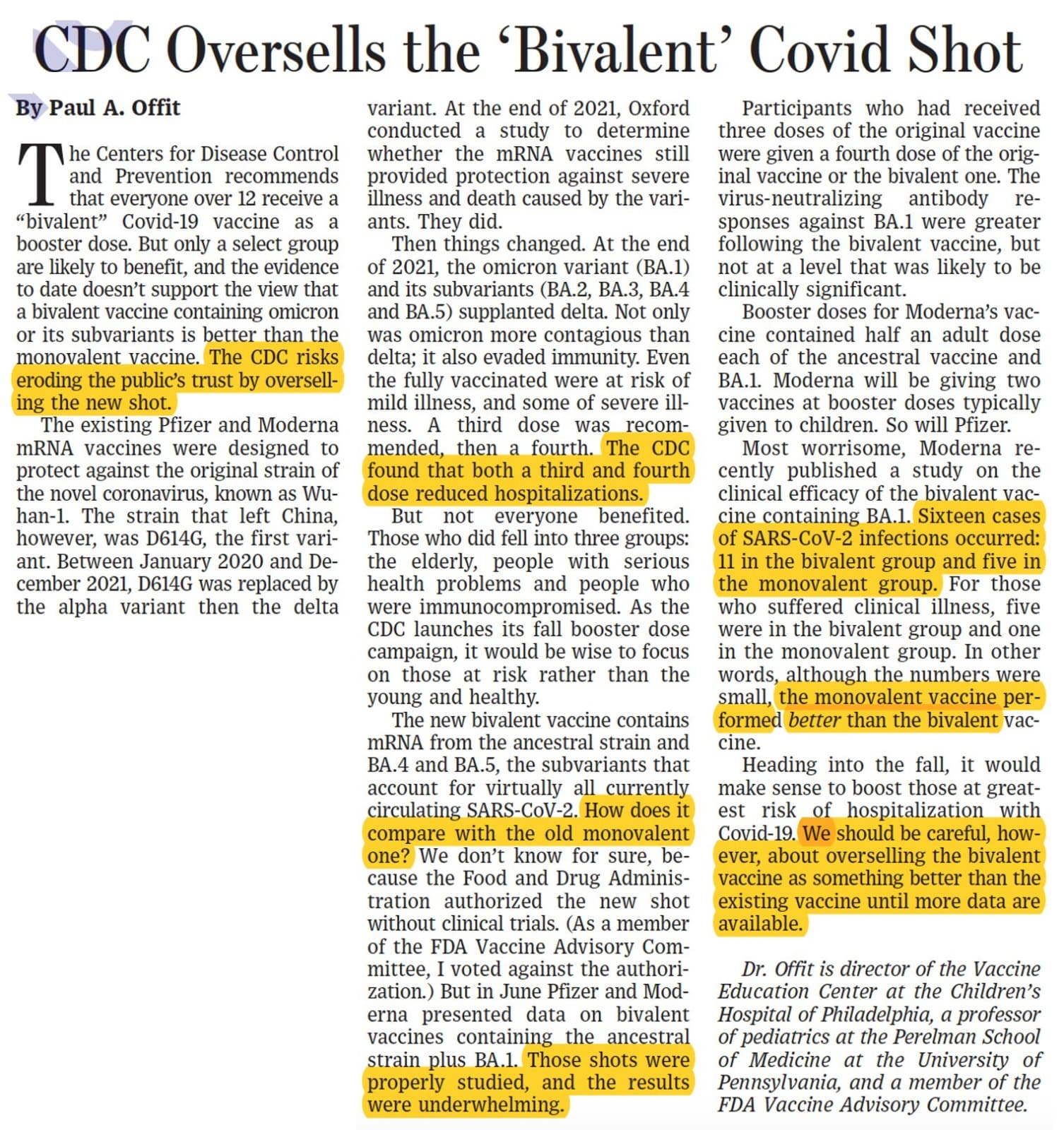
that is an opinion piece, not a study (regardless of Offit’s credentials).
-
My wife has MS and is immunocompromised. It is a no-brainer for me to be as protected as I can be.
-
I am not interested in turning this into a debate about the efficacies of the bivalent booster. Get it, don’t get it…that is your choice. I made mine.
Just returned from a cruise that originated in Southampton, and had stops in England, Ireland, Iceland and Scotland.
Both my wife and I got covid just as we were returning home. We both took boosters before the cruise. Given that BA5 is the predominant strain in Europe, I assume that’s what we got. At this point have no plans to take the Bivalent Booster.
Should have made a bivalent booster targeting BA.2 and BA.4-5. The original version of the virus is pretty much out of circulation, so that half of the booster seems pointless. I’d not be surprised to see BA.2.75 drive the next wave of infections outside of India.
Good info, thanks for the explanation. Still wish there were a version w/o the original wuhan strain for those of us with likely viral persistence from previous bouts with covid.
Edit - I am referring to the WSJ article posted in the comment I am replying to.
Adding to the other comments, this is a discussion of whether the bivalent booster is better and if so how much than a booster with just the original ancestral strain. There is some genuine, good faith disagreement as to the quality of the evidence that the bivalent is better, and this is what is being talked about in this opinion piece. My take is that the evidence is not that strong, however there is also not evidence that it is less effective, along with good reason to believe that it is likely to be more effective.
If you ignore clear anti-vaxers (and you should), there is little disagreement that that boosters are valuable for preventing severe disease and death.
In my opinion, that’s not what this conversation is about. The OP asked about experience with side effects from the bivalent booster … and one may presume that the question was in relation to training impact from the shot.
I don’t work for TR, nor am I an ambassador nor in any way affiliated with them directly or indirectly other than the fee I pay for their software. With that said, I think we should limit this conversation to experience with the bivalent booster vis a vis “getting faster” and leave opinions on its efficacy, necessity, availability and/or epidemiological value to other message boards and discussions … otherwise this discussion will be (rightly) shut down.
As noted earlier in this thread, I got my bivalent to booster a little over a week ago and had no side effects which impacted my training, or ability to train, at all.
Good luck to you all.
Just to clarify, my “this is a discussion” is referring to the Wall Street Journal opinion piece that was in the comment that I was directly replying to.
You are correct in regard to what this thread is discussing.