Last season ended with the typical tapering week, followed by my A event and 7 days completely off the bike.
Then, AI FTP suggested a ~5% decrease, which I obviously rejected
I worked so hard to get to 4+ Watts/Kg, I didn’t want to lose those last 25 watts for the upcoming season.
Fast forward three months and the entire subsequent SS HV block felt hard. Literally, I rated all SS workouts as hard, except for one moderate, two very hard, and one all-out.
Now I’m ending my recovery week, heading to “Build” and I’m wondering what AI will think about those “hard” answers I gave on the surveys.
Furthermore, I’m still unsure why AI FTP detected I should decrease those 25w. Was it because of the tapering, the seven days on the couch, or something else?
And, I’m also wondering whether I made the right call to reject that 25w decrease, or not.
I was wondering if anyone was running into the same issue as me. I’m still being told I need to complete 10 indoor workouts to use AI FTP, however, according to the release notes, AI FTP should be able to work with my outdoor rides.
Will AI FTP Detection detect my FTP if I’ve never used TrainerRoad?
AI FTP Detection requires 10 completed indoor TrainerRoad workouts to begin detecting your FTP. Once you reach this minimum, you don’t need to do any additional TrainerRoad workouts. By enabling RideSync, you can import rides with power data from other services and continue detecting your FTP.
Thanks for the clarification. I didn’t read carefully. That’s a bummer because I don’t have an indoor trainer. I guess the upside is that I live in a place where I don’t need one!
I’m not 100% positive of this next statement, but you MAY still be able to use AI FTPD either by doing a scheduled INSIDE workout OUTSIDE by leveraging your head unit to track it OR at least associating that scheduled inside workout to your outdoor ride upon returning, but perhaps @IvyAudrain or @SarahLaverty can confirm?
Like many, I have gotten so used to the FTP button, I just thought it was a ‘thing’
If I’m honest, I wasn’t sure at first. After several months of use, I’m onboard.
My training and riding has changed drastically over the past six months and AIFTP has recognised this.
I manually dropped my FTP at the end of the season and half expected it bounce straight back up when my first AIFTP rolled around. It didn’t and it hasn’t.
My workouts are still challenging and I’m getting what I need at this time of year. So ego went out the window and reality has been welcomed home.
Hi, this is not totally working in some corner cases. I had to change some time off annotations in my calendar and now my plan shows a ramp test next Tuesday and of course I cannot get rid of it because my last AI FTP is still valid.
N=1 I take what AI FTP and AT gives me. It’s never nice to accept a drop (had too myself after end of season time off), but I’m of the opinion that if I’m going to pay the software development, coaches and I’m not going to 2nd guess!
I see it as the latter (a number to train to) and figures such as Critical Power (CP) is the power you can actually hold for a given time, however depending who you speak to you’ll get a different answer.
Does AI FTP Detection predict my hour power or expected Ramp Test result?
AI FTP Detection isn’t meant to predict the results of any individual effort, because all-out efforts can be affected by nutrition, fatigue, and other subjective factors. Instead, it’s designed to give you a training benchmark (FTP) that represents the full scope of your abilities, so you get the most productive training possible.
Aaaaaaah amazing! We are so excited to have you back! Please don’t hesitate to let us know if you have any questions about anything- there are so many new features to explore!
No, just make sure that your trainer is on the latest firmware and to calibrate your trainer before you ride. Even if there are slight differences, we include your new power data in addition to the various data points we already have to detect your FTP. This is one of the benefits of using a model as opposed to using an estimate .
It’s tough to say. If you would have accepted the drop you’d most likely have been doing more TIZ on sweet spot (higher progression levels). Or maybe you were completing them at a higher rate?
Or maybe now you’re crispy? Or maybe now you’re ready to break through?
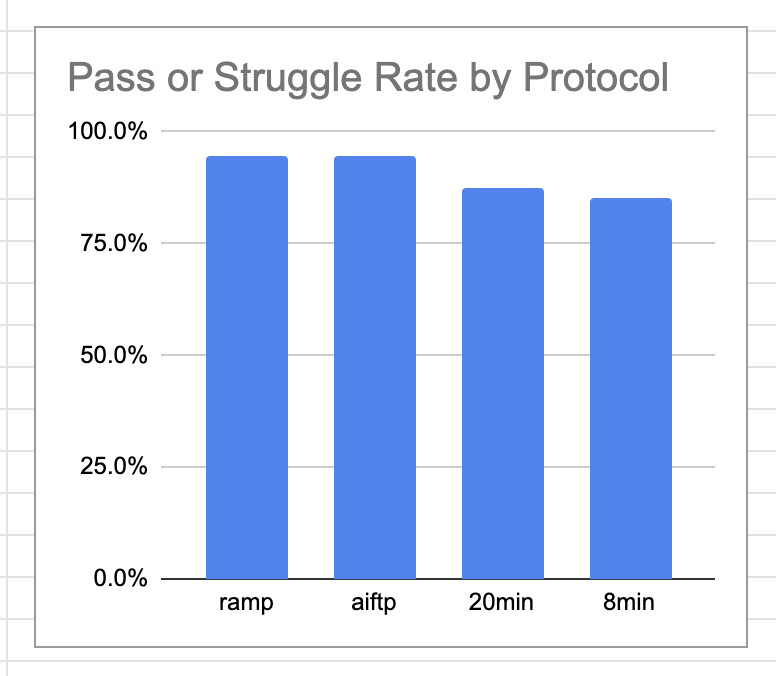
Here’s how athletes perform on the next workout after their FTP change.
We’re actually EXACTLY in line with the Ramp Test. But as I said before, we have fewer “super pass” workouts which are indicative of a testing scoring someone too low.
I also want to say we’ll never get 100% on this graph. Rides that are “cut short” are not included as a pass, so you might just have to take care of the kids even if we have the workout exactly right for you.
Then there’s the variable acute stress like getting a bad night’s sleep, fighting with your partner, forgetting to eat, etc.
The “pass” or “struggle” is scored by an ML model. The “struggle” means that an athlete didn’t perfectly execute the workout, but it’s close enough that we think the athlete should push forward. We can track these over time to look at patterns, but some athletes just never perfectly execute a workout. Or maybe you get a call and have to take a quick break…or stop peddling to get a drink. Stuff like that.
We didn’t want to penalize those athletes, but we still wanted to classify them. Then we can combine it with RPE data to get more context.
@SarahLaverty Do you know if this is an issue that is been actively worked on? I had to change a time off annotation in my calendar and now a ramp test appeared for next Tuesday and I cannot do anything about it. Would you be able to fix this from your side and make a proper workout appear instead? Thanks!