It’s obviously horses for courses, what we need is a best bike split, with sectors outlined by % category, i.e cat 1-4 gravel, road. with the ability to pick a best tyre for a certain sector, or best tyre for overall time.
There are just too many variables in parcours for the RK to be the golden bullet.
Great stuff, just really needs some more skinny tyres. Some 40mm/43mm options like a Schwalbe G1 RS Pro and a skinny option like a GP 5K S-TR 32mm to really show where those transition points are.
Yeah, in the comments section of the Escape article, this point was brought up. Grave, MTB, whatever…the label is immaterial. Just call them “dirt” or “offroad” tires. The type of bike they are mounted on doesn’t matter.
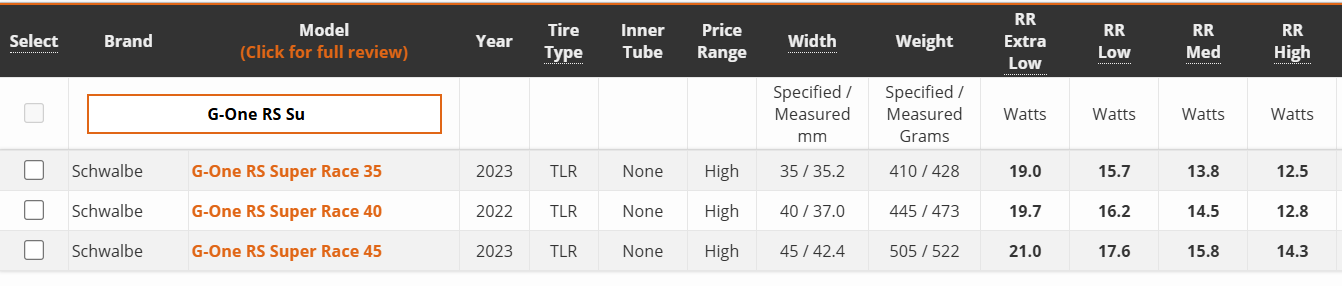
Just a quick aside here: Having tested, specifically, the G One RS 40 mm vs 45 mm in the real world, over multiple iterations of the same course, I have to come to the conclusion that there is no reasonable case scenario where the 45 is not at least as fast, if not faster than the 40 mm. This includes pavement sectors where the 45 was found to have no handicap vs the 40 (@~20+ MPH, perhaps at much higher speeds, like 35 MPH there could be an aero loss, but that is not really relevant to my riding). Hence, for me personally, I will never even consider a tire under 45 mm for gravel riding/racing, and see no need for anyone to be testing narrower tires-going narrower than 45 is just a waste of anybodies time.
It is interesting in what we now define as a “traditional” gravel tire. Here is a short list of gravel bikes and what comes on the bike when you buy it.
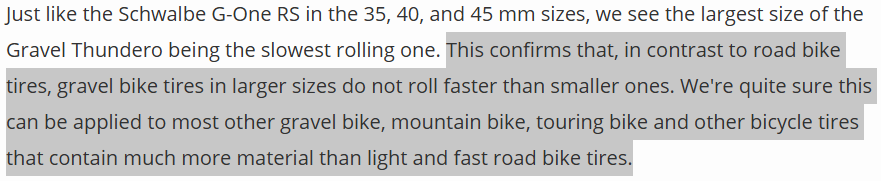
While I agree that in most cases (or all relevant cases) this is true…I run 45mm Terra Speeds now after having run 40mm with no intention of going back down in size… There is most certainly “data” that suggests exactly that a 40mm is faster rolling than a 45mm and it’s a source that this thread consistently holds up as useful for “directional understanding”.
I’m not trying to suggest this is anything groundbreaking, but comments like those above are definitely misleading because you’re cherry picking data to make an absolute statement when this is definitely very muddy.
I don’t think it is that they have “fallen behind” but more a reflection of how fast that “Wider Better” trend has exploded. 12 months ago, very few people were talking about 2.1+ tires on gravel bikes…by the time we got to Unbound, that had completely reversed and many of the biggest names were on MTB tires.
Sure, Dylan had been talking about wider tires for a few years, but he was also maxing out with the Pathfinder 47. It wasn’t until he switch to Felt last year that he started talking about 2.2’s and Race Kings.
So when you combine the speed of wide tire adoption with the leadtimes necessary for spec’ing bikes (with the side element of excess inventory from the COVID burst), it isn’t really that surprising that you see specs as noted above.
Frame designs take years to develop and finalize and bike specs are usually finalized 6-12 months before production. The factor in freight time from Asia, distribution to retailers and time to sell through…
I don’t think these results confirm anything, given that other comparable tire groups tested do not follow this pattern. If anything there seem to be more examples that confirm the opposite - wider is faster for the same tire model. But I don’t believe there is a general trend, casing construction, tread thickness, and compound make as much difference to the result as just width.
The Pathfinder Pro shows a disparity to this argument, as do the René Herse slicks.
On what surface? Because there’s plenty of evidence on tarmac that you start to get slower above 32mm, (for road specific tyres) so it comes in to play depending on surface.