My only advice is to make sure that the tires are pumped up hard. Tires also wear on these rollers so don’t use your $50+ race tires.
I’m with you on all this. Since switching to e-motion rollers (~13 years ago now), I’ve had 2 serious injuries that forced me onto stationary trainers for weeks at a time. Pure misery and was so happy when I got back on the rollers.
4 of the last 5 saturday mornings were Zwift century group rides on the rollers (~4 hours). So much better than multiple hours on a stationary trainer and it only gets better as you get more experience on them. Once you are comfortable, it’s very easy to climb out of the saddle, sit up and stretch, pretty much anything you can do riding in a straight line outside. I honestly don’t understand why stationary trainers dominate the market and rollers are on the fringe, but different strokes for different folks and clearly lots of people love their stationary trainers.
For those of you with the InsideRide rollers, what is the realistic power range they can be used with? I’m assuming they aren’t a good idea for any Zwift racing if there is going to be a full out 1000+ watt sprint at the end, both because of power limitations as well as roller limitations. Beyond that, though, I’m trying to get an idea of how limited the power range is or isn’t when used for structured workouts. For reference, the drivetrain setup I’d be using is either a 46/10-52 Eagle or 42/10-46 XPLR. Not sure on tires yet.
Part of my question is because only the base rollers are currently in stock, both of the upgraded packages are currently listed as “sold out.”
I used the base rollers for many years and also have a bunch of years on the smart version. Unless they have changed it, the resistance range is the same between the 2. The problem is that the base model can’t be adjusted while riding, so you have to pick a setting that works and then just use your gears. I think the only problem you might run into is sprinting and it depends on how strong your sprint is. I was using them for zwift racing before I got the smart version and had no issue sprinting at the end of races, but I’m also not a 1500w sprinter. If you have a big sprint, you might struggle to find a setting that feels reasonable for the majority of the race and doesn’t spin out for the sprint.
For training, I never ran into a problem hitting the numbers I needed and still having it easy enough during the rest intervals. All my inside training and zwift riding/racing has been on rollers for the past ~14 years, I love them and I hate stationary trainers. I’ve had a couple injuries over the years that forced me off the rollers for short periods and it just reminds me how much better the experience is compared to a fixed trainer.
I trained on InsideRide for a decade. I was a TT’er and climber, not a crit guy, so I didn’t need to do sprints. Loved the feel and doing threshold up to VO2 work on them.
You do have to be good about regular cleaning. I unfortunately destroyed mine by getting sloppy one winter and sweat-welding the bolts.
Ah, so the difference between the smart unit and the base is the ability to use ERG mode? That makes sense.
My main concern for Zwift racing is that a full-tilt sprint will inevitably be less controlled on the rollers than on a trainer. Maybe it’s less of an issue after some use and roller skill gained, but I imagine it’s a little harder to stay upright on rollers when you’re fully at your limit.
I’ve had issues with saddle sores during indoor season in the past, even with a rocker plate. I also struggled to have the rocker not list to one side, so I was thinking rollers could be a solution for me.
Good tip on the cleaning. I’m a big sweater, even in a 40 F garage, so that would definitely be something for me to maintain.
You really need to wipe them off after each use, and take them apart for a full clean once a month to prevent sweat corrosion of the bolts – if you’re a heavy sweater and your sweat is corrosive.
Four lazy months of irregular wiping down and not taking them apart for clean/grease on the bolts rendered mine useless.
Honestly, I just couldn’t imagine using ERG on rollers. I guess when you hit a death spiral you fall over sideways. 
I seem to recall that their power unit maybe wasn’t the most accurate.
I have the insideride rollers where you manually change the resistance with the lever. With an ftp that ranges from 210 to 250, I’ve always used them on level 2. I can easily do anywhere from endurance to vo2 efforts by changing the gears.
I couldn’t imagine that but some people get really good at rollers.
One downside of rollers is that they do wear down tires. I’d end up with black dust under mine. Plus, they wear less if you pump up the tires hard. So for me, the other downside is having to pump up tires for every ride.
I have an eflex now and I absolutely love it for indoor riding. It’s always ready to go, no pumping up tires, etc. I’m not sure I’d want an eflex either for zwift racing. I think my eflex robs me of some power at lower cadences - at least as reflected by my Stages power meter.
I’ve got up to about 950w on Zwift sprints on my InsideRide rollers, but that’s my limitation, I can generally hit about 1200w fresh but most Zwift sprints are after sitting at FTP for a while lol. I don’t find it scary at all, except for the one time I dropped a chain during a sprint. But overall, things get more stable as speed increases.
Well, I’ve had a week of training on my InsideRide rollers now, and I’m pretty sold! The difference in motion from a rocker plate is night and day in favor of the rollers. I’m still learning a few things - how to get started, standing comfortably, and riding no hands (all of which are obviously a non-issue on a stationary trainer), but even after only a week, I’m already much more comfortable on them. I have some questions for other owners:
- What gearing do you typically use? I’ve been on a 46/10-52, and the difference in stability between just a few gears is very noticeable. I’m debating whether I want to figure out a full road double for winter since I have a cassette and road derailleur available, I’d just need the chainrings.
- I’ve been power matching my Quarq to the rollers for ERG workouts. The power seems to be decently accurate like that, but the ERG performance of the rollers could be better, fluctuating somewhat. Any tips here? On a stationary trainer, I’d move to a larger cog in back, but on the rollers, that negatively affects stability.
- Any tips on starting and ending? My rollers are on a 3-4 inch platform I built to counteract the unlevel garage floor, so with that height plus the rollers, I’m a good bit above the ground. I saw a story on Zwift Insider where a guy built a platform around the rollers so that they were effectively recessed below the platform level which seems like a great idea albeit some work.
Overall, I’m about 9/10 satisfied with them. Some bonus points:
- I like that I can preset a resistance in the app if l ever need to use them without power.
- I did get the floating fork stand for the occasional Zwift race, but I’ve been happy without it so far.
They’re pricey but worth it so far!
Take this with a grain of salt because I don’t follow a TR plan anymore and rarely do structured intervals, but I do them without ERG, despite having IR smart rollers. It adds another level of immersion to be pacing them on your own. The rollers are also just real slow to react and I wasn’t a fan of the ERG. I made some DIY smart rollers before I got the IR rollers and it reacted much much faster. So now all my intervals are done on a really flat route in Zwift with the trainer difficulty turned a bit down.
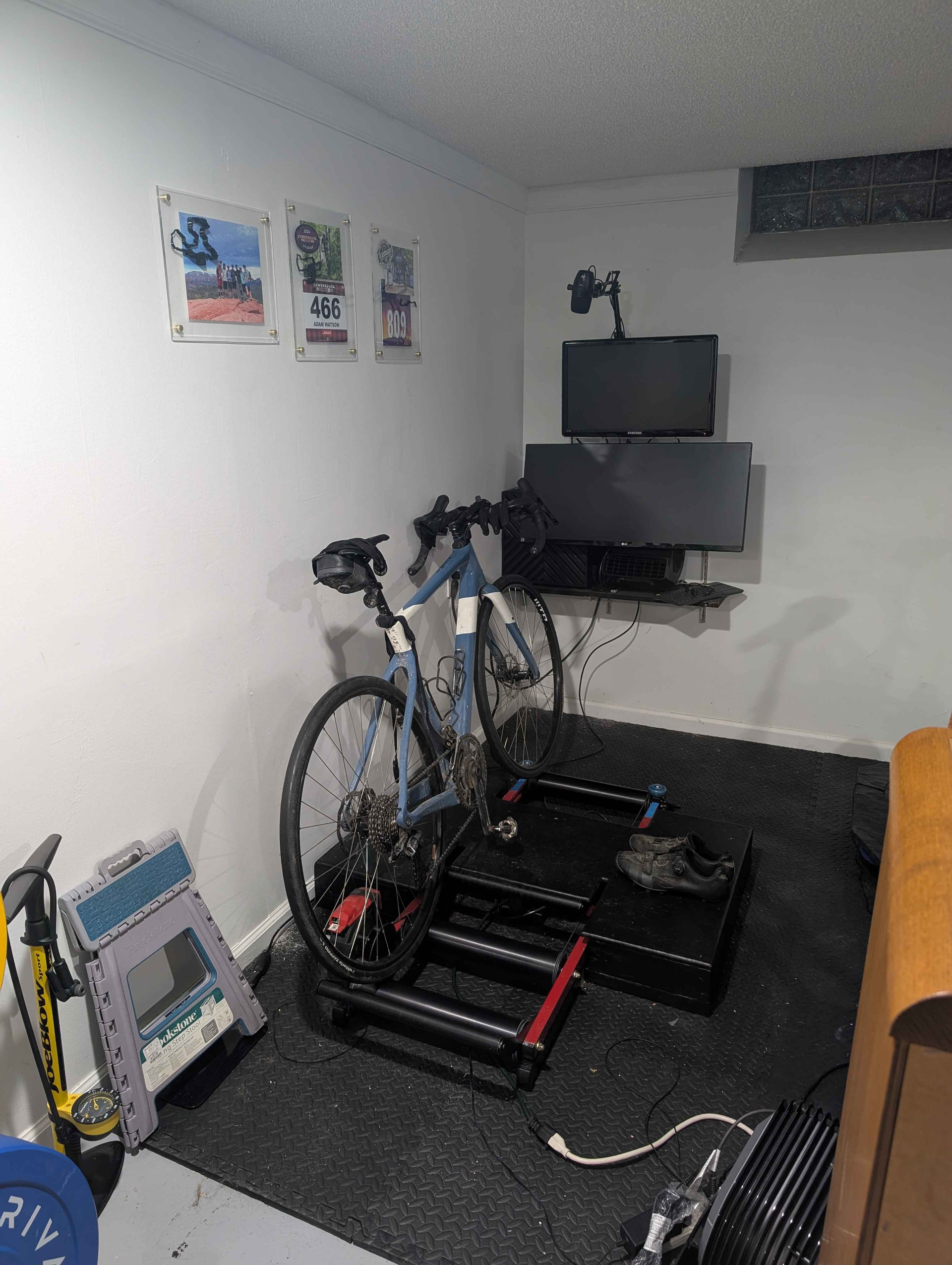
I made a platform that sits over the rollers. It feels just like stepping on and off a bike outside, though I do still start with my shoulder on the wall.
I’ve run them with my gravel bike with 1x mullet setup (10-52) and run them with my road bike with traditional road gearing. Other than the differences in gear jumps (same as on the road), I don’t notice any difference in stability. You just need decent wheel speed. I find tire choice makes a bigger difference than gearing as far as wheel speed vs. resistance goes.
Personally not a fan of ERG mode, I do everything in resistance mode and I will adjust it sometimes in the app to best fit the intervals I’m doing.
With practice, it can be just like the road. Clip a foot in and give it a good push and that should provide enough spin/momentum to get rolling. Until you are comfortable at slower wheel speeds, a good drill is to clip that single foot in and spin it up using the one leg (while still standing on the ground) and then jump on once you have some speed built up. Setting the resistance low helps with the startup.
That platform looks slick! I like the channels cut for the front rear wheel supports. A platform is definitely on my to-do list.
I’ve been using GP5000s because that was what was on my wheels, but I have some actual trainer tires I’ve been meaning to try.
Usually, I like ERG because it’s easier to watch TV or a movie to pass the time and not have to worry about shifting. Plus, when I’m dying at the end of a Vo2 set and my recovery coasting is limited to just a few seconds, I like not having to dump gears to get the relief. I have my first Vo2 set since the rollers arrived this week, though, so maybe I’ll test out resistance mode and shifting.
I’ve been using the InsideRide rollers for the entire winter so far, and my opinion hasn’t changed. They’ve enabled me to do harder workouts than previous years and yet be far more comfortable. The difference between my indoor and outdoor power is also much smaller, probably partly due to the using the bike power meter directly with TR and partly due to the added freedom of movement.
One thing I have noticed, though, and I’m curious if others have experienced this: When I do long steady-state rides, e.g. James which is most of 90 minutes at one intensity, I find I have to keep increasing the InsideRide resistance in order for the same cadence to result in the same power. It’s like the roller resistance slowly decays over time. I’m riding in a 40 degree F garage, so I wonder if there is a warming effect on some part of the rollers that results in less inherent resistance over time. Anyone else?
Longtime Inside Ride user here and yes, the resistance does drop a bit after starting. I’m not sure if it’s the bearings or the belt, but it’s enough that I’ll tick up the resistance a couple points. It’s usually after my first interval, but no significant drift after that for me. I keep the app handy and always set the resistance manually, no erg mode for me. The only time I’ll use the “smart” resistance is when riding zwift. But often, I’ll use fixed resistance in zwift when just wanting to push steady watts.
Tyre pressure increases during a ride. I’ve seen mine increase by as much as 0.2‐0.3 bar, something to be aware off, especially with hookless rims!
Good call. That’s probably the primary contributor. Tires definitely get warm in a hurry on the rollers.