I can’t speak on behalf of the 200, but a few comments regarding tires on the 100:
The muddy sections were just greasy mud, maybe a couple inches deep, that washed right off. Clearance was a non-contributing factor.
The really rugged descents/chunk stuff were not selective points where anyone was going to attack. Basically everyone was limited by conditions and I couldn’t imagine someone with a 2.2 riding away from someone on a 45 (and it sticking) on one of those descents or chunky sections.
I saw a post of a gentleman on TB’s and he used 5 oz sealant and went through 4 co2’s and two tubes. I don’t know any more (what sealant he used, etc.)
There were a LOT of miles (probably 70+) that I would consider nothing special other than fast, normal gravel. Based on DJ’s/others testing, I’m not convinced that on pavement (or hard packed gravel/dirt, which is nearly the same) the RK is faster than some of the gravel tire offerings. If a course was the opposite (70+ miles of chunky, rocky, technical terrain) it’d be a different story.
I think not flatting will destroy most any moderate gain in rolling resistance. If someone flats even once and has to stop and loses their group/can’t chase back on, that completely blows apart practically any gain in rolling resistance. Even if you do catch back on, not sure if the matches burned chasing make up for the rolling resistance elsewhere.
I had a 50mm G-one RX pro up front and a 47mm pathfinder in back. If I had clearance I would have considered a Race King, but felt at 0 disadvantage with my setup. The RX is relatively new but I felt comfortable with it up front considering I had a redshift stem which helps absorb impacts/reduce flats. Its traction was 1000x better than a TB or pathfinder (my main go-to gravel choices). I didn’t go a 50mm G-one RS pro in back because I didn’t feel it was proven enough from a flat protection perspective to risk it. Seeing the podium choices, that will likely be my race setup moving forward. In some races around me in Houston that aren’t technical/rocky, I may even consider running 45’s..
One year ago I have the Pathfinder 47 front and rear on a Checkpoint at Unbound 200 and thought I had a pretty big tire set up. The discussion heading into the event a lot of folks were having was whether to run the 42s or the 47s because there might be some mud. Your 50F/47R would have been really beefy last year. So much has changed in a year.
I think Schwalbe is going to get a lot of sales after this year’s Unbound. The Schwalbe 50’s front and rear in some sort of combination is likely going to be a popular race setup the rest of this gravel season.
With riding a Seigla now, it’s finding the sweet spot between 50s and 2.25s depending on the course. Nice that there are more and more options popping up.
Yeah, the 100 mile north course is totally different than the 200. I’m not saying the 200 course dramatically favored a mtb tire, but the 200 north course is night and day more chunky and hilly than the 100. Basically, the 200 starts and finishes on the 100 course and the entire middle section is where the climbing and chunky sections are. Other than the rutting, it was really smooth in comparison to a month ago (all the fresh/loose gravel mashed in), but still chunky in spots. Divide road (~40 miles in) was an early selective spot where bigger tires would be an advantage. It’s the first punchy climbing and descending and it’s a bit technical and chunky.
The 200 course is 68’/mile climbing while the 100 course is 50’/mile. A good amount more, but I wouldn’t consider that terribly dramatic.
On the 100 course, the first 20 miles and last 20 miles were by far the smoothest. Not sure where the courses broke apart, but all the chunk/technical stuff for the 100 was also in the middle, which sounds like wasn’t part of the 200 course. I understand you are very familiar with all the routes north/south for different distances, but I think you’re aware that judging the 100 route based on the first and last sections would be pretty inaccurate of the route as a whole as all the rugged sections were also in the middle.
200 course is ~12000/202 = 59 feet per mile
100 course is ~3800/108 = 35 feet per mile
Don’t believe the garmin/RWGPS elevations
Not quite 2x per mile, but significantly more.
And for me, it’s the nature of the climbing as much as the number of feet. The northern portion has more steep/punchy spots. And I’ve ridden these roads a good bit and while the entire course was running relatively smooth, the middle parts of the 200 are dramatically more chunky. Just as a data point, I pre-rode the entire 100 course solo about a month ago (and added Kaw reserve road which the 100 course skipped) and averaged over 1 mph faster on lower watts compared to riding the middle ~108 miles of the 200 course (starting at eskridge). And that was the day after rain and had 2 walking sections on that 100 course.
I’m not saying the 100 mile course isn’t tough or doesn’t have some chunk, but mile per mile is much less climbing (particularly steep stuff) and less chunk. They are totally different animals.
Pretty good video linked below. Shows are couple of the early selective sections of the 200 course (Kaw Reserve and Divide Rd). Worth watching starting around ~8:30 (and then the next section is Divide Rd. These videos never do justice to how fast and technical these sections are, but should still give a perspective on the areas of the course where bigger tires can play a significant advantage. At Kaw Reserve, it’s really not that technical, but it’s so early that everyone is fighting for position since it’s so strung out and gaps can form in front of you. With a MTB tire, you have better options for riding off the main racing line into the looser gravel and/or grass to pass people. And then Divide road is chunky enough that it would favor a full suspension MTB. I know it doesn’t look that bad, but some of those ruts are literally over a foot deep and your view is often blocked by people in front of you. Also, you can see a strong case for why a 1x setup can be an advantage on these types of courses. Monkeying with a chain for a minute or 2 is going to cost you a bunch of energy chasing. Divide Rd. is where I flatted this year after working hard to be in the lead group to that point. Nothing technical, just bad luck with a small puncture right in the middle of the tire. Over 10 minutes to fix due to my stupidity, chased mostly solo the rest of the day.
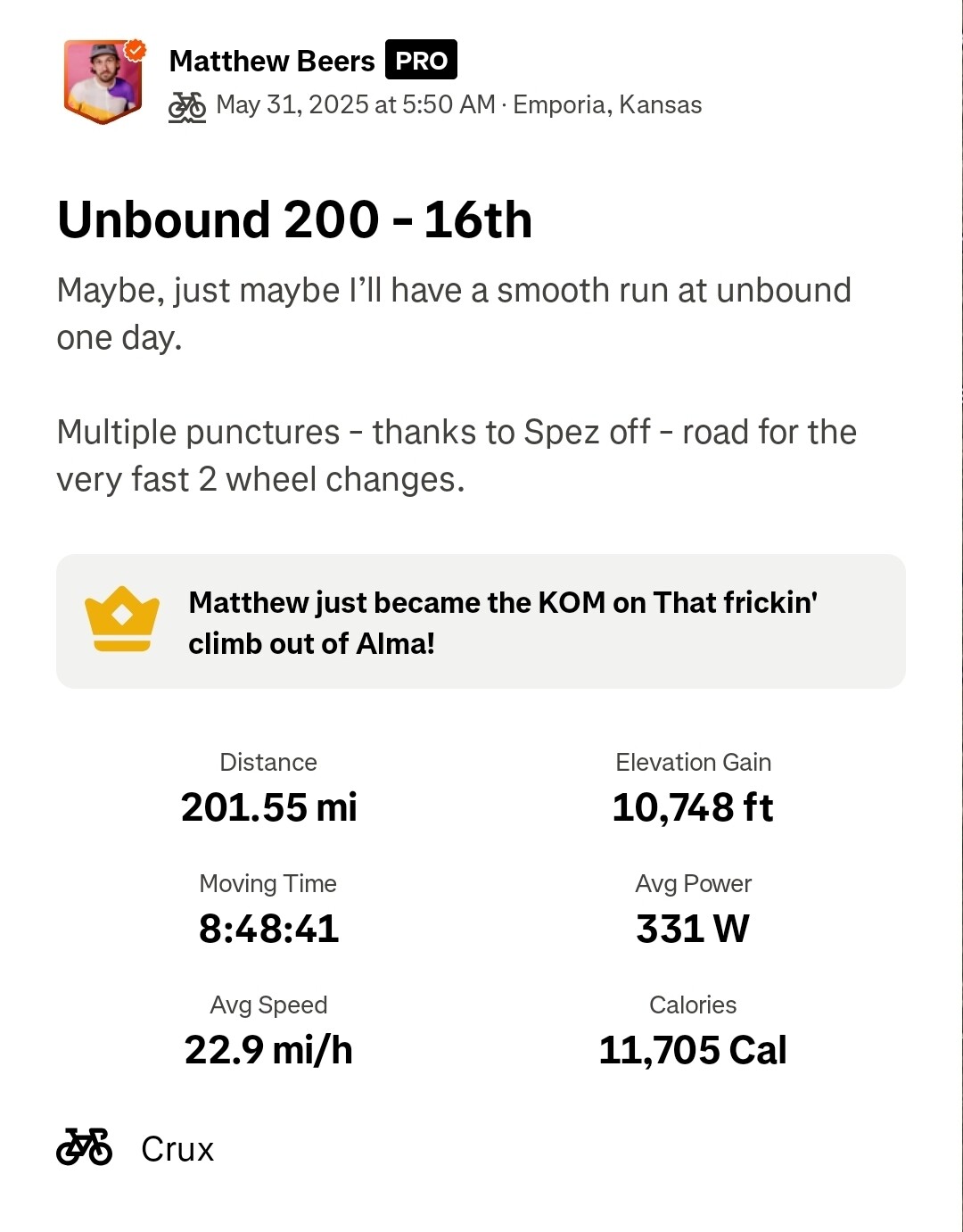
When considering pro rider’s tire choices at Unbound, it is important to consider that many of these pros are on frames which limit them to 50 mm tires, especially in the rear. Cam was on the Scott which is limited to 45s, so one must take this into account. Note that defending women’s champ, Rosa Kloeser rode the Canyon Grizl and not the Grail, and was on 2.2 Dubnitals, she would likely have finished 3rd if not for her wrong turn into the finishing straight. Poor Matt Beers, if anyone would have benefitted from a larger tire it would have been him, too bad Specialized did not seem to be doing him any favors in terms of tire selection/availability for Unbound.
I think all the specialized riders were on Tracer 50’s. Not MTB sized, but 50 seems like the size a lot of folks are gravitating towards (due to clearance limitation and/or preference). Agree that Matt would benefit from larger though, he certainly isn’t lacking the watts on the flats/pavement where a larger tire might be slower at times.
Yeah, I was assuming he was on the Tracer 50. A nice volume for someone like Sophia of course, but Matt B could have be fitter from something larger. I heard Alex Wild was going to run the new Air Trak 2.2… I guess he is at a different sponsor lever with Specialized perhaps, and not mandated to run Tracers? I would also assume the new Diverge frames would fit a 2.2 if Specialized has any idea of what they are doing, given it is their “more capable” gravel bike.
I also wonder how much the possibility of mud had Specialized mitigating risk for their top riders. Even Friday night before the race, I’m not sure anyone had a perfect idea of what the course would bring saturday morning. I went out and pre-rode the first 2-3 miles of Kaw Reserve and Divide Rd Friday night and it wasn’t peanut butter mud, but it was sloppy and certainly didn’t give me confidence that we wouldn’t run into any PB mud on race day. I don’t think anyone got out and could look at that every possible mud section late Friday and the XL riders didn’t see all of those sections. I rolled the dice with MTB tires, but I have good clearance with them. I know at least 2 pros personally (not big names) that would have rolled bigger tires, but were scared about being stopped walking due to clearance. A lot of the current bikes have marginal clearance with 50’s and maybe a couple millimeters when trying to squeeze a MTB tire in. Any PB mud would be an immediate stop without decent clearance.
A couple mm of clearance and you’ll likely see some rubbing on the frame due to flexing. (I know I have). Someone like Beers who can put down massive power it may have been an issue.
I haven’t done unbound but are 2.2 an advantage over a 2.0 tire? I get from a volume standpoint but if you are planning on being there in the end they are thinking of a sprint too. But of course you got to get there first.
And as for the specialized riders I wonder why not the terra?
For unbound, the key is staying connected in the selective technical spots and not flatting. For me, a bigger tire is going to help with that. Not right for everyone, but seems like a no brainer for a rider like Beers. He’s probably not going to win a big group sprint anyway and the possible loss of ~15 watts (or whatever) on the smooth/flat stuff to a smaller tire is a rounding error in his FTP. I feel for the guy because he’s definitely got the motor to win a race like unbound, but he’s got to figure out how to keep his bike working and get away. Tough when everyone knows you have that engine.
Rosa Kloeser chose 2.2 Dubs, and chose her bike to fit them…. After last year I am sure she was ready for a sprint finish as well. There are a lot of different ways of looking at this, big tires equals less chance of flatting, big tires will save energy over the course of two hundred miles: perhaps that saved energy results in a more potent sprint at the finish…. I have not seen the math, but I doubt the penalty for a 50 mm tire vs a 2.2 is much in terms of a sprint at the end of a two hundred mile race, being a little fresher could easily outweigh anything else.
I’m all for the big tire movement and agree with all the benefits you mentioned. Flats are slow. Not beating yourself up may cost watts but saves them too.
After watching “the cool down” Keagan mentioned the drag and slow acceleration of MTB tires. Also mentioned that 45-50 (for them) seems to be the sweet spot. But those at the pointy end trying to win I guess the risks are worth it.
Seems to be a suggestion that wider tyres reduces the risk of flats. Assuming that those on the wider tyres are selecting fast ones, I really don’t think that’s the case. In fact, I think riders, especially in the elite fields, are choosing their fastest available option, and that’s partly why we are seeing so many flats - it’s almost an all or nothing approach.
I think a slightly more conservative approach with casing selection could pay dividends for a lot of riders. Especially if they end up running buckets of sealant, inserts and ‘double valve tubeless setups with a tube’. Those choices likely make the RR significantly worse anyway.
Honestly, I thought Keegan’s responses were more about towing the line for Maxxis… I wonder how much they might be paying him. Anyway, he is only talking about Maxxis tires, and we should be careful to avoid extrapolating his remarks as if they have anything to do with offerings from Schwalbe and Conti. Acceleration, when it comes to human powered bikes is such a small factor, we are not talking about motorized vehicles here. For gravel racing, how a tire holds speed is hugely more important than a few ms differences in acceleration. Also, if they were so bad, why would he have been riding Aspens all last season??? Quite curious indeed. He ran 50 mm Ramblers for Unbound, that is not a fast tire no matter how one looks at it. On the other hand, I am not trying to suggest that I believe a gravel racer should always run a 2.1 or 2.2, it still depends on a lot of factors. At SBT I plan on running 50 mm G One RS myself, and for that course, 45s would be pretty good as well. I suspect to see some folks on 40 mm road slicks, but IMO that would be a wrong choice.
If you would’ve thought of something that creative in the middle of the race, I’d probably say you weren’t riding hard enough
Received an email back today and they’re replacing the tire. Functioned fine but at $80-$90/tire, it shouldn’t have that type of defect. Very pleased with the support. Will probably save the replacement for big sugar.
It’s great to have sponsors until you have to ride stuff you really don’t want to ride. I’m not saying that’s the case for Keegan, but I know first hand from a couple pros that they aren’t too happy with the tire size limitations on their current frames. Just to be clear, these aren’t top level pros, just some guys who get bikes from certain unnamed companies and wish they weren’t stuck running skinny tires when there is any risk of mud. I think that’s one of the good things about the privateer model where you can kind of pick and choose your sponsors to a point. But if you aren’t getting big results or have a big social footprint, I guess you take what you can get to make ends meet. Tough way to make a living (or just trying to help fund your side gig).